Senate Judiciary Committee advances proposed Minnesota Equal Rights Amendment after hours of testimony, 6–4
February 21, 2026 | 2026 Legislature MN, Minnesota
This article was created by AI summarizing key points discussed. AI makes mistakes, so for full details and context, please refer to the video of the full meeting. Please report any errors so we can fix them. Report an error »
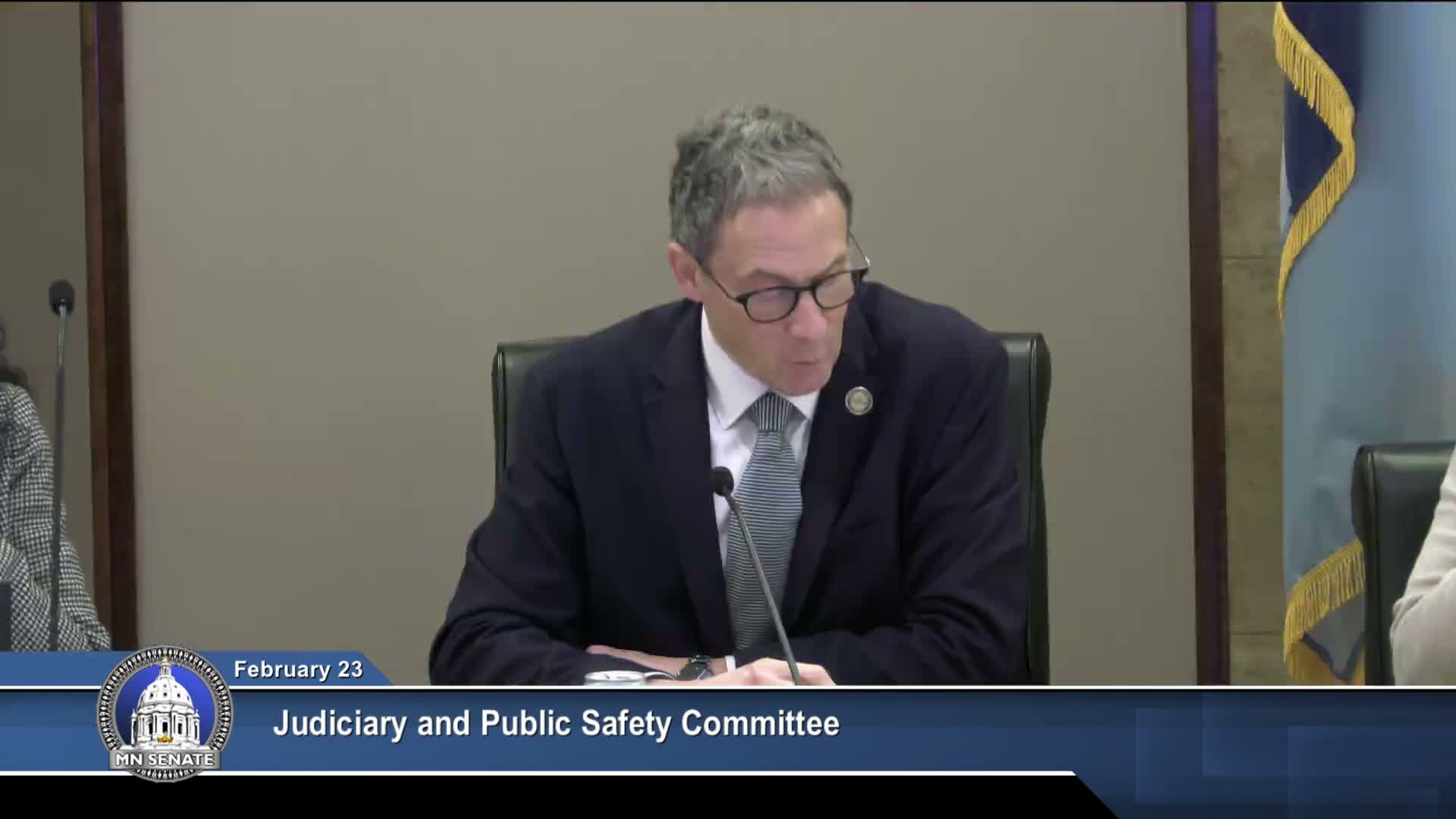
The Minnesota Senate Judiciary Committee on Feb. 23 voted 6–4 to recommend passage of Senate File 473, a proposed Minnesota Equal Rights Amendment (ERA), after extended pro and con testimony and the rejection of two amendments that would have narrowed the measure.
Sen. Kunish, the bill’s chief author, opened the hearing urging the committee to let Minnesota voters decide whether to enshrine a constitutional guarantee barring discrimination “on account of race, color, national origin, ancestry, disability, pregnancy, gender identity or gender expression, and sexual orientation.” She told the committee that polls show strong public support and said the amendment would “provide clarity and stability to our legal system.”
Supporters — including Melissa Heising of the Minnesota AFL‑CIO, Mai Thor of The Arc Minnesota, and Betty Folliard of ERA Minnesota — told the committee the amendment is intended to create a lasting constitutional shield that statutes cannot easily remove. “A constitutional amendment is the strongest, most lasting way to protect our rights,” Melissa Heising said in support of placing the question before voters.
Opponents raised multiple concerns about the draft language, especially its treatment of pregnancy, gender identity, and the absence of an explicit religious‑liberty clause. Several speakers, including Renee Carlson of True North Legal and Rebecca Delahunt of Minnesota Family Council, argued the amendment could require courts to resolve contested policy issues about access to women‑only spaces, prison housing and athletic competition. Kathy Blazer of Minnesota Citizens Concerned for Life and other opponents asserted the measure would effectively enshrine broad abortion protections; Blazer said the bill “conceals abortion up to birth in innocuous language.”
Jamie Ali, a formerly incarcerated person, testified about trauma she said resulted from being housed at the Shakopee Correctional Facility alongside people she identified as biological men. Ali told the committee she experienced panic attacks, withdrew from programming, and saw inadequate protections in custody. When senators asked whether she had observed physical assaults, Ali and subsequent questioning described fear, alleged predatory behavior, and an absence of protective measures but did not provide documentary evidence that would resolve those claims within the hearing record.
Committee members pressed legal testifiers about how the amendment would interact with existing constitutional protections for religion and how courts might treat private entities that receive public funds. Jess Braverman, legal director at Gender Justice, told the committee that courts have a body of case law to decide when a private actor is functionally a state actor and said receiving public funds alone would not automatically make a private entity a state actor.
Two floor amendments offered by Sen. Holmstrom were put to roll call and defeated. Amendment a1, which would have removed the language concerning “making and effectuating decisions about all matters related to one’s own pregnancy,” failed on a roll call the clerk recorded as 4 in favor and 6 opposed. Amendment a2, which would have removed references to “gender identity” and “gender expression,” likewise failed 4–6.
Sen. Pappas moved that SF 473 be recommended to pass and be re‑referred to the Senate Committee on Rules. The clerk’s roll call recorded 6 votes in favor and 4 opposed; the motion prevailed and the committee passed the bill out and re‑referred it to Rules.
The committee’s action sends SF 473 further along the legislative process and places the question of whether to put a revised Equal Rights Amendment before Minnesota voters within reach. The committee chair said members should continue to work with stakeholders on forthcoming bills; no additional votes were taken that day and the committee adjourned.
The measure’s next formal step is consideration by the Senate Committee on Rules; any changes beyond that would be reflected in subsequent committee records and public filings.
Sen. Kunish, the bill’s chief author, opened the hearing urging the committee to let Minnesota voters decide whether to enshrine a constitutional guarantee barring discrimination “on account of race, color, national origin, ancestry, disability, pregnancy, gender identity or gender expression, and sexual orientation.” She told the committee that polls show strong public support and said the amendment would “provide clarity and stability to our legal system.”
Supporters — including Melissa Heising of the Minnesota AFL‑CIO, Mai Thor of The Arc Minnesota, and Betty Folliard of ERA Minnesota — told the committee the amendment is intended to create a lasting constitutional shield that statutes cannot easily remove. “A constitutional amendment is the strongest, most lasting way to protect our rights,” Melissa Heising said in support of placing the question before voters.
Opponents raised multiple concerns about the draft language, especially its treatment of pregnancy, gender identity, and the absence of an explicit religious‑liberty clause. Several speakers, including Renee Carlson of True North Legal and Rebecca Delahunt of Minnesota Family Council, argued the amendment could require courts to resolve contested policy issues about access to women‑only spaces, prison housing and athletic competition. Kathy Blazer of Minnesota Citizens Concerned for Life and other opponents asserted the measure would effectively enshrine broad abortion protections; Blazer said the bill “conceals abortion up to birth in innocuous language.”
Jamie Ali, a formerly incarcerated person, testified about trauma she said resulted from being housed at the Shakopee Correctional Facility alongside people she identified as biological men. Ali told the committee she experienced panic attacks, withdrew from programming, and saw inadequate protections in custody. When senators asked whether she had observed physical assaults, Ali and subsequent questioning described fear, alleged predatory behavior, and an absence of protective measures but did not provide documentary evidence that would resolve those claims within the hearing record.
Committee members pressed legal testifiers about how the amendment would interact with existing constitutional protections for religion and how courts might treat private entities that receive public funds. Jess Braverman, legal director at Gender Justice, told the committee that courts have a body of case law to decide when a private actor is functionally a state actor and said receiving public funds alone would not automatically make a private entity a state actor.
Two floor amendments offered by Sen. Holmstrom were put to roll call and defeated. Amendment a1, which would have removed the language concerning “making and effectuating decisions about all matters related to one’s own pregnancy,” failed on a roll call the clerk recorded as 4 in favor and 6 opposed. Amendment a2, which would have removed references to “gender identity” and “gender expression,” likewise failed 4–6.
Sen. Pappas moved that SF 473 be recommended to pass and be re‑referred to the Senate Committee on Rules. The clerk’s roll call recorded 6 votes in favor and 4 opposed; the motion prevailed and the committee passed the bill out and re‑referred it to Rules.
The committee’s action sends SF 473 further along the legislative process and places the question of whether to put a revised Equal Rights Amendment before Minnesota voters within reach. The committee chair said members should continue to work with stakeholders on forthcoming bills; no additional votes were taken that day and the committee adjourned.
The measure’s next formal step is consideration by the Senate Committee on Rules; any changes beyond that would be reflected in subsequent committee records and public filings.
View the Full Meeting & All Its Details
This article offers just a summary. Unlock complete video, transcripts, and insights as a Founder Member.
✓
Watch full, unedited meeting videos
✓
Search every word spoken in unlimited transcripts
✓
AI summaries & real-time alerts (all government levels)
✓
Permanent access to expanding government content
30-day money-back guarantee
