MDVA outlines statewide veteran suicide-prevention strategy as roughly 100 veterans die by suicide each year in Minnesota
February 21, 2026 | 2026 Legislature MN, Minnesota
This article was created by AI summarizing key points discussed. AI makes mistakes, so for full details and context, please refer to the video of the full meeting. Please report any errors so we can fix them. Report an error »
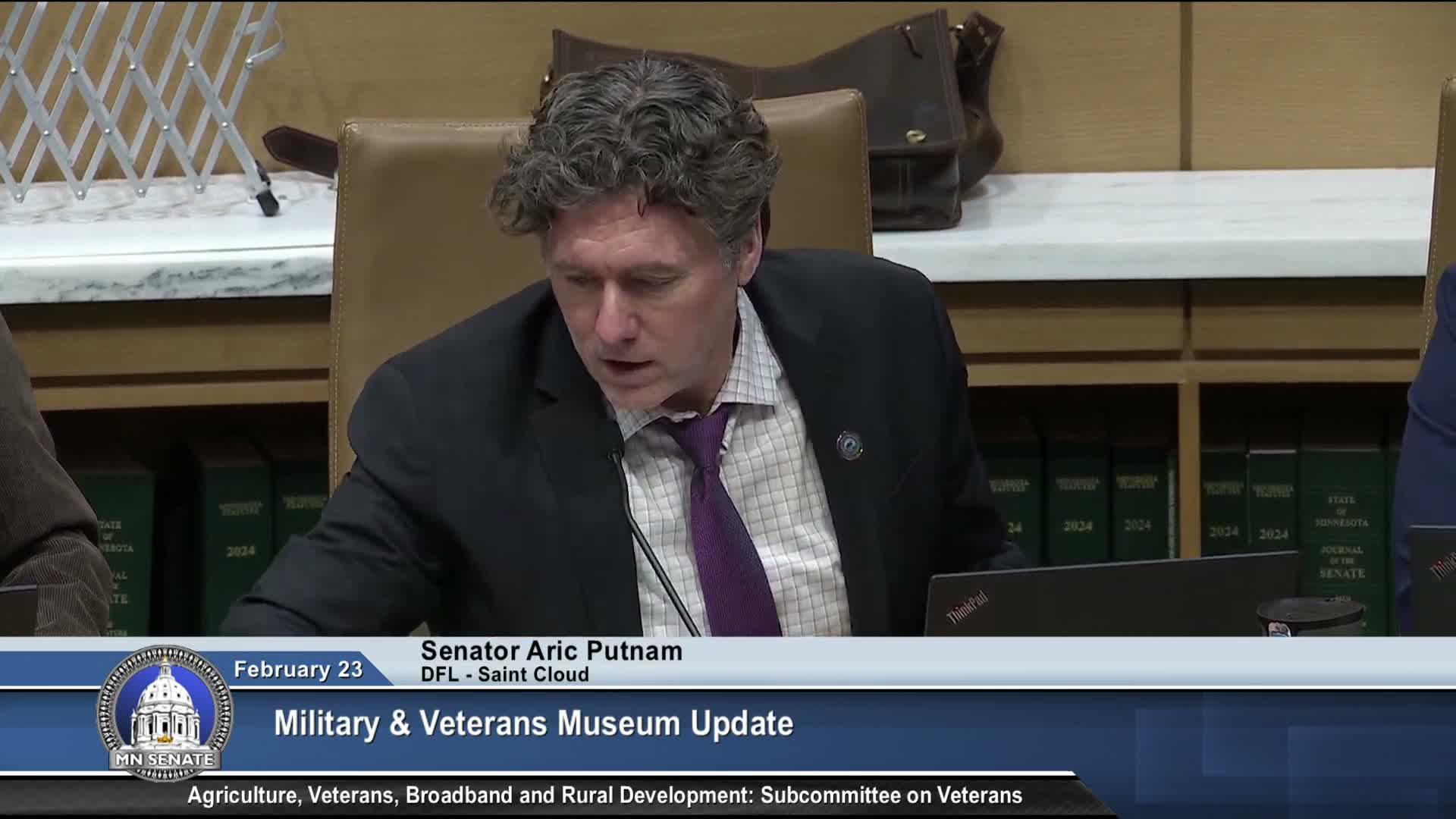
Rachel Johnson, Veterans Committee Health Director at the Minnesota Department of Veterans Affairs (MDVA), presented a state suicide-prevention plan to the Senate Subcommittee on Veterans and Military Affairs on Feb. 23, 2026. Johnson said the department has used recent legislative funding to expand regional coordination, veteran health navigators, clinical consultation and data analytics to move from isolated programs to a coordinated statewide prevention system.
Johnson said Minnesota continues to lose approximately 100 veterans each year to suicide and that the plan is a "living, working framework" designed to scale, measure outcomes and adapt to new data and veteran feedback. She described work to expand rural outreach and implement a multidisciplinary veteran suicide mortality review pilot in Hennepin County that will include public health, the VA, the Minnesota National Guard and the Minnesota Department of Health. The pilot aims to produce an initial review by May or June 2026.
Committee members asked about data-sharing barriers, the operation and staffing of 988 veteran routing, and potential federal impacts on services. Johnson said MDVA is working with the Minnesota Department of Health and local partners to address aggregated data-sharing policies and that 988 calls in Minnesota are partially answered by local crisis lines; she said MDVA has not yet received Minnesota-specific 988 reports for the veteran-option routing. John Kelly, MDVA director of government affairs, added that recent legislative increases have supported MDVA suicide-prevention work and that the department is tracking federal legislative changes affecting advisory groups.
Johnson emphasized that firearms remain a primary mechanism in veteran suicide and that prevention requires community-level connection and services beyond clinical settings. She invited follow-up questions and offered to provide updated data to the subcommittee as available.
Johnson said Minnesota continues to lose approximately 100 veterans each year to suicide and that the plan is a "living, working framework" designed to scale, measure outcomes and adapt to new data and veteran feedback. She described work to expand rural outreach and implement a multidisciplinary veteran suicide mortality review pilot in Hennepin County that will include public health, the VA, the Minnesota National Guard and the Minnesota Department of Health. The pilot aims to produce an initial review by May or June 2026.
Committee members asked about data-sharing barriers, the operation and staffing of 988 veteran routing, and potential federal impacts on services. Johnson said MDVA is working with the Minnesota Department of Health and local partners to address aggregated data-sharing policies and that 988 calls in Minnesota are partially answered by local crisis lines; she said MDVA has not yet received Minnesota-specific 988 reports for the veteran-option routing. John Kelly, MDVA director of government affairs, added that recent legislative increases have supported MDVA suicide-prevention work and that the department is tracking federal legislative changes affecting advisory groups.
Johnson emphasized that firearms remain a primary mechanism in veteran suicide and that prevention requires community-level connection and services beyond clinical settings. She invited follow-up questions and offered to provide updated data to the subcommittee as available.
View the Full Meeting & All Its Details
This article offers just a summary. Unlock complete video, transcripts, and insights as a Founder Member.
✓
Watch full, unedited meeting videos
✓
Search every word spoken in unlimited transcripts
✓
AI summaries & real-time alerts (all government levels)
✓
Permanent access to expanding government content
30-day money-back guarantee
