Chamber Foundation: Minnesota's growth has slowed; report cites weak per-capita GDP, flat workforce and migration risks
February 23, 2026 | 2026 Legislature MN, Minnesota
This article was created by AI summarizing key points discussed. AI makes mistakes, so for full details and context, please refer to the video of the full meeting. Please report any errors so we can fix them. Report an error »
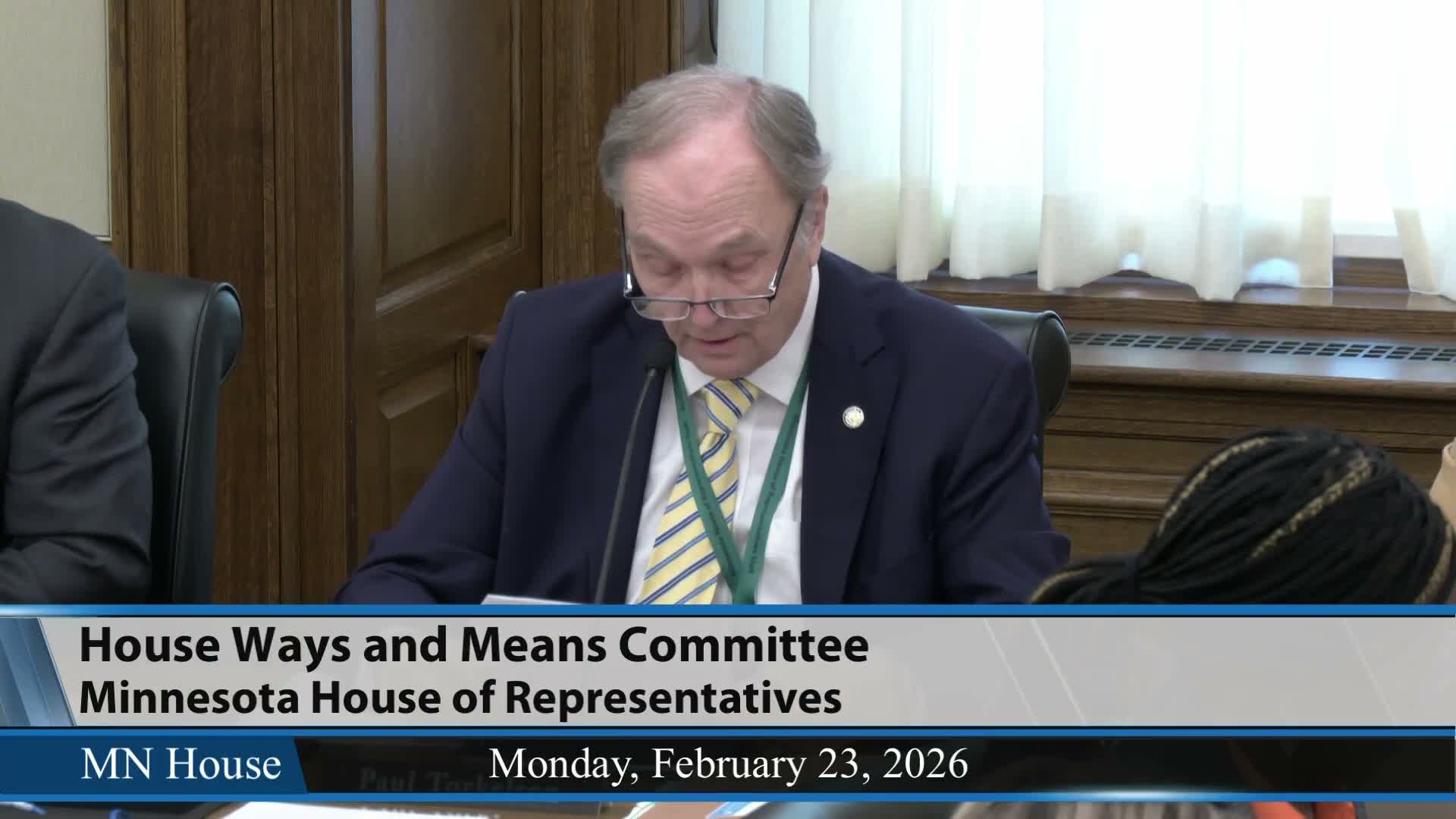
The Minnesota Chamber Foundation presented its 2026 Business Benchmarks report to the House Ways and Means Committee on Feb. 23, 2026, warning that "Minnesota's economy is being at a crossroads" and that the state has seen slowing per-capita growth, weak labor-force expansion and migration trends that could limit future prosperity.
Jennifer Byers, vice president at the Minnesota Chamber Foundation, outlined the foundation's three pillars—Grow Minnesota business retention visits, workforce development and economic research—and said the annual benchmarks report is intended to track long-term performance and policy levers. "Our goal is really to grow the pie for everyone," Byers said.
Sean O'Neil, the foundation's research lead, said the report centers on three metrics: GDP per capita, labor-force growth and migration. He said Minnesota's GDP per capita has been growing at "just 1% annually" in the first half of this decade and now ranks in the lower half of states on that measure. O'Neil described Minnesota's historic strengths'including a skilled workforce, high patent rates and a diversified industry base'but cautioned that those advantages have not translated into recent growth.
The presentation called out three persistent constraints. First, the foundation cited competitiveness measures, noting Tax Foundation data ranked Minnesota 44th for tax competitiveness in 2025, which O'Neil said can influence where companies locate. Second, he pointed to regulatory complexity and permitting timelines, especially for small and medium-sized firms facing high compliance costs. Third, the report highlighted housing and affordability: Minnesota ranked near the bottom of states for growth in new housing starts this decade and ranks poorly on college affordability, factors the foundation said affect migration and labor-supply dynamics.
During questions, committee members pressed the presenters on implementation and evidence. O'Neil said companies consistently report regulatory complexity, taxes and workforce availability as top barriers and gave examples, including a midsize manufacturer that spent more than $200,000 to overhaul management systems to comply with recent labor mandates. On paid family medical leave, both presenters said it was "top of mind" for businesses and that the foundation is still assessing implementation impacts.
The foundation emphasized opportunities as well, listing potential growth in AI, data centers, advanced manufacturing, clean tech and medtech, and cited roughly 100 annual expansion announcements in Minnesota. O'Neil said the foundation will publish follow-up strategy work this spring.
The committee did not take formal action on policy at the hearing; members requested follow-up data and the presenters offered to provide sources and additional analysis to the committee staff.
The committee next moved to a second presentation by the Center of the American Experiment and adjourned after both sessions.
Jennifer Byers, vice president at the Minnesota Chamber Foundation, outlined the foundation's three pillars—Grow Minnesota business retention visits, workforce development and economic research—and said the annual benchmarks report is intended to track long-term performance and policy levers. "Our goal is really to grow the pie for everyone," Byers said.
Sean O'Neil, the foundation's research lead, said the report centers on three metrics: GDP per capita, labor-force growth and migration. He said Minnesota's GDP per capita has been growing at "just 1% annually" in the first half of this decade and now ranks in the lower half of states on that measure. O'Neil described Minnesota's historic strengths'including a skilled workforce, high patent rates and a diversified industry base'but cautioned that those advantages have not translated into recent growth.
The presentation called out three persistent constraints. First, the foundation cited competitiveness measures, noting Tax Foundation data ranked Minnesota 44th for tax competitiveness in 2025, which O'Neil said can influence where companies locate. Second, he pointed to regulatory complexity and permitting timelines, especially for small and medium-sized firms facing high compliance costs. Third, the report highlighted housing and affordability: Minnesota ranked near the bottom of states for growth in new housing starts this decade and ranks poorly on college affordability, factors the foundation said affect migration and labor-supply dynamics.
During questions, committee members pressed the presenters on implementation and evidence. O'Neil said companies consistently report regulatory complexity, taxes and workforce availability as top barriers and gave examples, including a midsize manufacturer that spent more than $200,000 to overhaul management systems to comply with recent labor mandates. On paid family medical leave, both presenters said it was "top of mind" for businesses and that the foundation is still assessing implementation impacts.
The foundation emphasized opportunities as well, listing potential growth in AI, data centers, advanced manufacturing, clean tech and medtech, and cited roughly 100 annual expansion announcements in Minnesota. O'Neil said the foundation will publish follow-up strategy work this spring.
The committee did not take formal action on policy at the hearing; members requested follow-up data and the presenters offered to provide sources and additional analysis to the committee staff.
The committee next moved to a second presentation by the Center of the American Experiment and adjourned after both sessions.
Don't Miss a Word: See the Full Meeting!
Go beyond summaries. Unlock every video, transcript, and key insight with a Founder Membership.
✓
Get instant access to full meeting videos
✓
Search and clip any phrase from complete transcripts
✓
Receive AI-powered summaries & custom alerts
✓
Enjoy lifetime, unrestricted access to government data
30-day money-back guarantee
