Minnesota committee declines statewide massage-therapy licensure after narrow roll call
February 23, 2026 | 2026 Legislature MN, Minnesota
This article was created by AI summarizing key points discussed. AI makes mistakes, so for full details and context, please refer to the video of the full meeting. Please report any errors so we can fix them. Report an error »
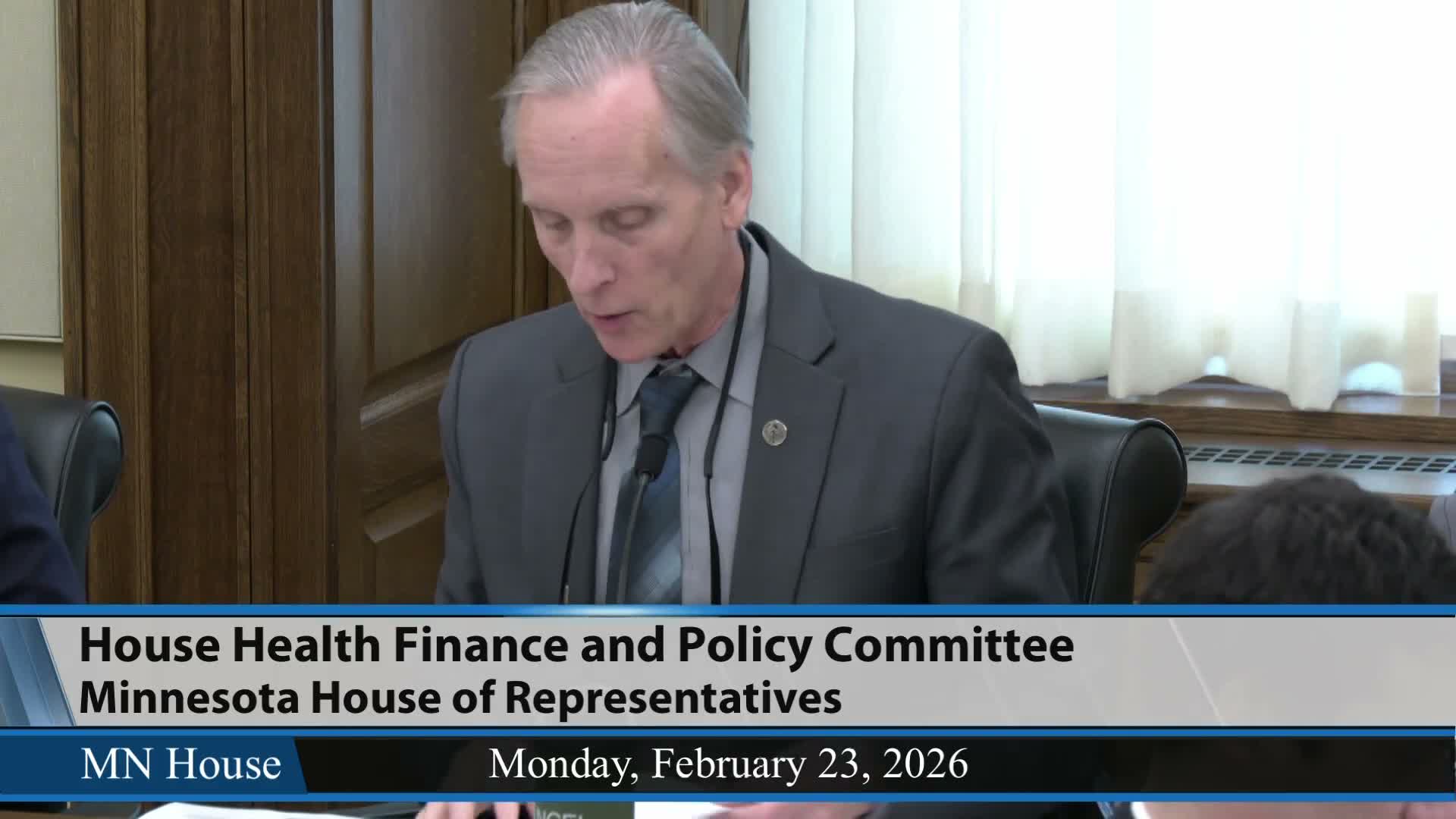
ST. PAUL — The Minnesota House Health Finance and Policy Committee rejected a proposal to establish statewide licensure for massage therapists on Feb. 23, 2026, after a close roll-call that ended 10-11.
Representative Kelly Pinto, the bill’s author, opened debate on House File 362 by saying the measure would replace a patchwork of more than 100 local ordinances with a uniform educational and licensure standard. Pinto — who described his background prosecuting trafficking cases — said the change would “improve public safety, support small businesses, and reflect professional standards” already common in other states.
Supporters included educators and business owners who said consistent standards would protect patients and remove barriers that now prevent therapists from working across municipal lines. Ellie Larson, massage therapy program chair at Northwestern Health Sciences University, testified that a national entry-level analysis established a 625-hour baseline and said Minnesota’s programs already meet those standards. “These harms are preventable when educational standards are consistent statewide,” Larson told the committee.
Testimony opposing the bill emphasized costs, access and legal limits on regulation. Several witnesses, including practitioners and advocates, urged that apprenticeship pathways be preserved and warned that new training requirements could price out small or rural providers. “Passing HF362 ... would put me out of business,” said Nicole Gaeta, a practicing massage therapist, describing the financial and time burden of additional training.
A survivor’s account shaped much of the committee’s discussion. Dr. Carrie Borchardt, a child psychiatrist, described an incident she said occurred during a 2024 massage at Madden’s Resort; she said she filed a police report and that the county attorney did not prosecute. “I froze just wishing it would be over,” Borchardt said. She argued a licensing system could have prevented the therapist from moving to other facilities.
Opponents including attorney Petra Bridal and long-time practitioners argued existing Minnesota law (cited to statutes discussed as 2.14 and chapter 146A during testimony) already provides criminal remedies and consumer protections and that licensing may not reduce trafficking. Leo B. Cashman of the Minnesota Natural Health Coalition said chapter 146A has functioned for 25 years to guarantee access for nonlicensed practitioners.
The committee adopted two technical amendments to HF362 during the hearing, DE1 and A2, addressing consistency with Minnesota Department of Health practice and removing a superfluous head note, respectively. Chair Biermann initially called for the bill to be re-referred to the Judiciary, Finance and Civil Law Committee by voice vote. After a member asked to reconsider, the committee conducted a roll-call that recorded 10 ayes and 11 nays; the chair announced that the bill did not pass the committee.
Members’ statements encapsulated the policy split: supporters said licensure would create uniform standards and protect the public; opponents argued it raised barriers to entry, risked excluding apprenticeship-trained practitioners and may not address trafficking. Representative Liebling summarized the caution, noting Minnesota’s statutory standard requires regulation only when harm is “recognizable and not remote.” Representative Elkins, by contrast, cited personal clinical referrals where trained massage therapists filled specific, medically valuable roles.
With the 10-11 vote, HF362 will not move forward from this committee. Chair Biermann adjourned the meeting.
(Reporting from committee transcript; quotes and vote tally are drawn from the Feb. 23, 2026 Health Finance and Policy Committee record.)
Representative Kelly Pinto, the bill’s author, opened debate on House File 362 by saying the measure would replace a patchwork of more than 100 local ordinances with a uniform educational and licensure standard. Pinto — who described his background prosecuting trafficking cases — said the change would “improve public safety, support small businesses, and reflect professional standards” already common in other states.
Supporters included educators and business owners who said consistent standards would protect patients and remove barriers that now prevent therapists from working across municipal lines. Ellie Larson, massage therapy program chair at Northwestern Health Sciences University, testified that a national entry-level analysis established a 625-hour baseline and said Minnesota’s programs already meet those standards. “These harms are preventable when educational standards are consistent statewide,” Larson told the committee.
Testimony opposing the bill emphasized costs, access and legal limits on regulation. Several witnesses, including practitioners and advocates, urged that apprenticeship pathways be preserved and warned that new training requirements could price out small or rural providers. “Passing HF362 ... would put me out of business,” said Nicole Gaeta, a practicing massage therapist, describing the financial and time burden of additional training.
A survivor’s account shaped much of the committee’s discussion. Dr. Carrie Borchardt, a child psychiatrist, described an incident she said occurred during a 2024 massage at Madden’s Resort; she said she filed a police report and that the county attorney did not prosecute. “I froze just wishing it would be over,” Borchardt said. She argued a licensing system could have prevented the therapist from moving to other facilities.
Opponents including attorney Petra Bridal and long-time practitioners argued existing Minnesota law (cited to statutes discussed as 2.14 and chapter 146A during testimony) already provides criminal remedies and consumer protections and that licensing may not reduce trafficking. Leo B. Cashman of the Minnesota Natural Health Coalition said chapter 146A has functioned for 25 years to guarantee access for nonlicensed practitioners.
The committee adopted two technical amendments to HF362 during the hearing, DE1 and A2, addressing consistency with Minnesota Department of Health practice and removing a superfluous head note, respectively. Chair Biermann initially called for the bill to be re-referred to the Judiciary, Finance and Civil Law Committee by voice vote. After a member asked to reconsider, the committee conducted a roll-call that recorded 10 ayes and 11 nays; the chair announced that the bill did not pass the committee.
Members’ statements encapsulated the policy split: supporters said licensure would create uniform standards and protect the public; opponents argued it raised barriers to entry, risked excluding apprenticeship-trained practitioners and may not address trafficking. Representative Liebling summarized the caution, noting Minnesota’s statutory standard requires regulation only when harm is “recognizable and not remote.” Representative Elkins, by contrast, cited personal clinical referrals where trained massage therapists filled specific, medically valuable roles.
With the 10-11 vote, HF362 will not move forward from this committee. Chair Biermann adjourned the meeting.
(Reporting from committee transcript; quotes and vote tally are drawn from the Feb. 23, 2026 Health Finance and Policy Committee record.)
Don't Miss a Word: See the Full Meeting!
Go beyond summaries. Unlock every video, transcript, and key insight with a Founder Membership.
✓
Get instant access to full meeting videos
✓
Search and clip any phrase from complete transcripts
✓
Receive AI-powered summaries & custom alerts
✓
Enjoy lifetime, unrestricted access to government data
30-day money-back guarantee
