State higher-education officials warn lottery scholarships may face out-year shortfalls
February 23, 2026 | 2026 Legislature TN, Tennessee
This article was created by AI summarizing key points discussed. AI makes mistakes, so for full details and context, please refer to the video of the full meeting. Please report any errors so we can fix them. Report an error »
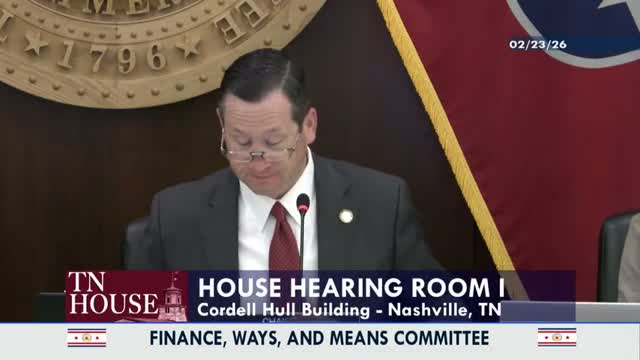
Steven Gentile, executive director of the Tennessee Higher Education Commission, told the House Financial Aids and Means Committee on Feb. 23 that Tennessee’s portfolio of lottery-funded scholarships faces revenue pressure in future years and will require policy changes or new funding to remain solvent. "For the first time in the history of the lottery program, there's a projected deficit in the coming years," Gentile said, adding the projected deficit for this year is "just under $30,000,000."
Gentile presented THEC’s agency requests and context for the committee. He said the commission requested large increases in outcomes funding for institutions and asked the legislature to consider fully funding capital maintenance requests. Among items Gentile cited: a requested increase for outcomes funding (figure given in presentation), a $350,000,000 annual capital-maintenance need statewide of which the agency received about $70,000,000 this cycle, a $12,000,000 recurring request for the Tennessee Student Assistance Award (TSAA), and a $16,000,000 recurring request for a "Careers Start Here" advising initiative. He said TSAA serves about 65,000 students today and that an additional $12,000,000 would allow the program to serve roughly 6,500 more students.
The presentation also previewed a two-part THEC memo on lottery finances and options to reduce future deficits; Gentile said part 1 has been delivered and part 2 will recommend portfolio changes. On potential reductions, Gentile described a "last in, first out" approach as one option—targeting the most recently added lottery-funded programs if revenue constraints require scaling back. "There's so many different ways that you can look at it, but the first one is the last in, first out approach," he said.
Committee members questioned how other states handled similar challenges, the potential effect on Tennessee Promise, and what would qualify as a lower-priority program. Gentile said Tennessee Promise is funded by an endowment (not the lottery), noting the endowment is "cresting over 1,300,000,000.0," and that Promise is a last-dollar program that could become more costly if other state scholarship amounts are reduced. "Should there be changes to the HOPE scholarship or other lottery programs that reduce the value of those programs, Tennessee Promise expenditure would increase to fill that gap," Gentile said.
Gentile also addressed workforce-targeted grants ("GIVE grants") and said the administration has set aside funds to support nuclear-related curricular needs at institutions with nuclear programs and that a study will define curricular priorities to guide future grant awards. He repeatedly urged the committee to consider outcomes funding and capital maintenance as investments that keep tuition lower and support workforce outcomes.
The committee did not take votes on THEC’s presentations during the hearing; members asked staff for follow-ups and documentation on the lottery memo and program-cost estimates. The THEC presentation to the committee began with Gentile’s remarks and concluded with a Q&A session where members pressed on timelines, affected programs, and the interplay between lottery programs and other state-funded scholarships.
Gentile presented THEC’s agency requests and context for the committee. He said the commission requested large increases in outcomes funding for institutions and asked the legislature to consider fully funding capital maintenance requests. Among items Gentile cited: a requested increase for outcomes funding (figure given in presentation), a $350,000,000 annual capital-maintenance need statewide of which the agency received about $70,000,000 this cycle, a $12,000,000 recurring request for the Tennessee Student Assistance Award (TSAA), and a $16,000,000 recurring request for a "Careers Start Here" advising initiative. He said TSAA serves about 65,000 students today and that an additional $12,000,000 would allow the program to serve roughly 6,500 more students.
The presentation also previewed a two-part THEC memo on lottery finances and options to reduce future deficits; Gentile said part 1 has been delivered and part 2 will recommend portfolio changes. On potential reductions, Gentile described a "last in, first out" approach as one option—targeting the most recently added lottery-funded programs if revenue constraints require scaling back. "There's so many different ways that you can look at it, but the first one is the last in, first out approach," he said.
Committee members questioned how other states handled similar challenges, the potential effect on Tennessee Promise, and what would qualify as a lower-priority program. Gentile said Tennessee Promise is funded by an endowment (not the lottery), noting the endowment is "cresting over 1,300,000,000.0," and that Promise is a last-dollar program that could become more costly if other state scholarship amounts are reduced. "Should there be changes to the HOPE scholarship or other lottery programs that reduce the value of those programs, Tennessee Promise expenditure would increase to fill that gap," Gentile said.
Gentile also addressed workforce-targeted grants ("GIVE grants") and said the administration has set aside funds to support nuclear-related curricular needs at institutions with nuclear programs and that a study will define curricular priorities to guide future grant awards. He repeatedly urged the committee to consider outcomes funding and capital maintenance as investments that keep tuition lower and support workforce outcomes.
The committee did not take votes on THEC’s presentations during the hearing; members asked staff for follow-ups and documentation on the lottery memo and program-cost estimates. The THEC presentation to the committee began with Gentile’s remarks and concluded with a Q&A session where members pressed on timelines, affected programs, and the interplay between lottery programs and other state-funded scholarships.
View the Full Meeting & All Its Details
This article offers just a summary. Unlock complete video, transcripts, and insights as a Founder Member.
✓
Watch full, unedited meeting videos
✓
Search every word spoken in unlimited transcripts
✓
AI summaries & real-time alerts (all government levels)
✓
Permanent access to expanding government content
30-day money-back guarantee
