Tennessee Senate expands state'' right to immediate appeals after heated debate
February 23, 2026 | 2026 Legislature TN, Tennessee
This article was created by AI summarizing key points discussed. AI makes mistakes, so for full details and context, please refer to the video of the full meeting. Please report any errors so we can fix them. Report an error »
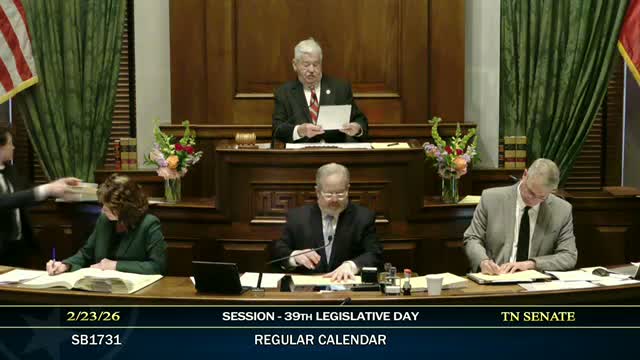
The Tennessee Senate on Feb. 24 approved Senate Bill 17-31, a measure that expands the state's right to an immediate interlocutory appeal in cases involving denials of sovereign or qualified immunity and certain motions to dismiss challenging the constitutionality or lawfulness of government action.
Chairman Richard Stevens, the bill's sponsor, said the change is meant to resolve high-stakes threshold legal questions quickly so the state and courts do not wait months or years for final resolution. "These are threshold issues," Stevens said, arguing they "need to be heard quickly by an appellate court" to avoid prolonged uncertainty.
Senator Steve Yarbrough pressed the sponsor on how broadly the bill would apply. Yarbrough warned the change could give the state an expansive right to pause cases at the pleading stage, potentially adding months and tens of thousands of dollars to private-party litigation. "It could extend the duration of the case by a year to 18 months," Yarbrough said, and "it can cost private citizens everything." He cautioned the bill could let the state "close the courthouse doors" by injecting procedural delay that favors the government.
Stevens replied that the bill targets a narrow class of "exceptionally important threshold issues" and does not create a blanket right to appeal every motion to dismiss. "We are removing the trial court's discretion in these limited circumstances," Stevens said, calling the change "a prudent addition" intended to promote judicial efficiency and preserve separation-of-powers questions for appellate review.
Senators debated how the proposal interacts with existing appellate rules (including references during debate to rules of appellate procedure and a statutory cross-reference cited on the floor). Yarbrough and others warned the practical effect could be to shift litigation costs and delays onto private litigants while giving the state an outsized procedural advantage.
After extended discussion and closing remarks from the sponsor, the Senate voted to pass SB 17-31 by a recorded vote of 26-6. The bill moves next according to legislative processing rules for enactment.
Chairman Richard Stevens, the bill's sponsor, said the change is meant to resolve high-stakes threshold legal questions quickly so the state and courts do not wait months or years for final resolution. "These are threshold issues," Stevens said, arguing they "need to be heard quickly by an appellate court" to avoid prolonged uncertainty.
Senator Steve Yarbrough pressed the sponsor on how broadly the bill would apply. Yarbrough warned the change could give the state an expansive right to pause cases at the pleading stage, potentially adding months and tens of thousands of dollars to private-party litigation. "It could extend the duration of the case by a year to 18 months," Yarbrough said, and "it can cost private citizens everything." He cautioned the bill could let the state "close the courthouse doors" by injecting procedural delay that favors the government.
Stevens replied that the bill targets a narrow class of "exceptionally important threshold issues" and does not create a blanket right to appeal every motion to dismiss. "We are removing the trial court's discretion in these limited circumstances," Stevens said, calling the change "a prudent addition" intended to promote judicial efficiency and preserve separation-of-powers questions for appellate review.
Senators debated how the proposal interacts with existing appellate rules (including references during debate to rules of appellate procedure and a statutory cross-reference cited on the floor). Yarbrough and others warned the practical effect could be to shift litigation costs and delays onto private litigants while giving the state an outsized procedural advantage.
After extended discussion and closing remarks from the sponsor, the Senate voted to pass SB 17-31 by a recorded vote of 26-6. The bill moves next according to legislative processing rules for enactment.
View the Full Meeting & All Its Details
This article offers just a summary. Unlock complete video, transcripts, and insights as a Founder Member.
✓
Watch full, unedited meeting videos
✓
Search every word spoken in unlimited transcripts
✓
AI summaries & real-time alerts (all government levels)
✓
Permanent access to expanding government content
30-day money-back guarantee
