Senate unveils supplemental operating budget; Robinson says plan uses $750M from reserves and avoids broad‑based tax hikes
February 23, 2026 | Press Conferences, Executive, Washington
This article was created by AI summarizing key points discussed. AI makes mistakes, so for full details and context, please refer to the video of the full meeting. Please report any errors so we can fix them. Report an error »
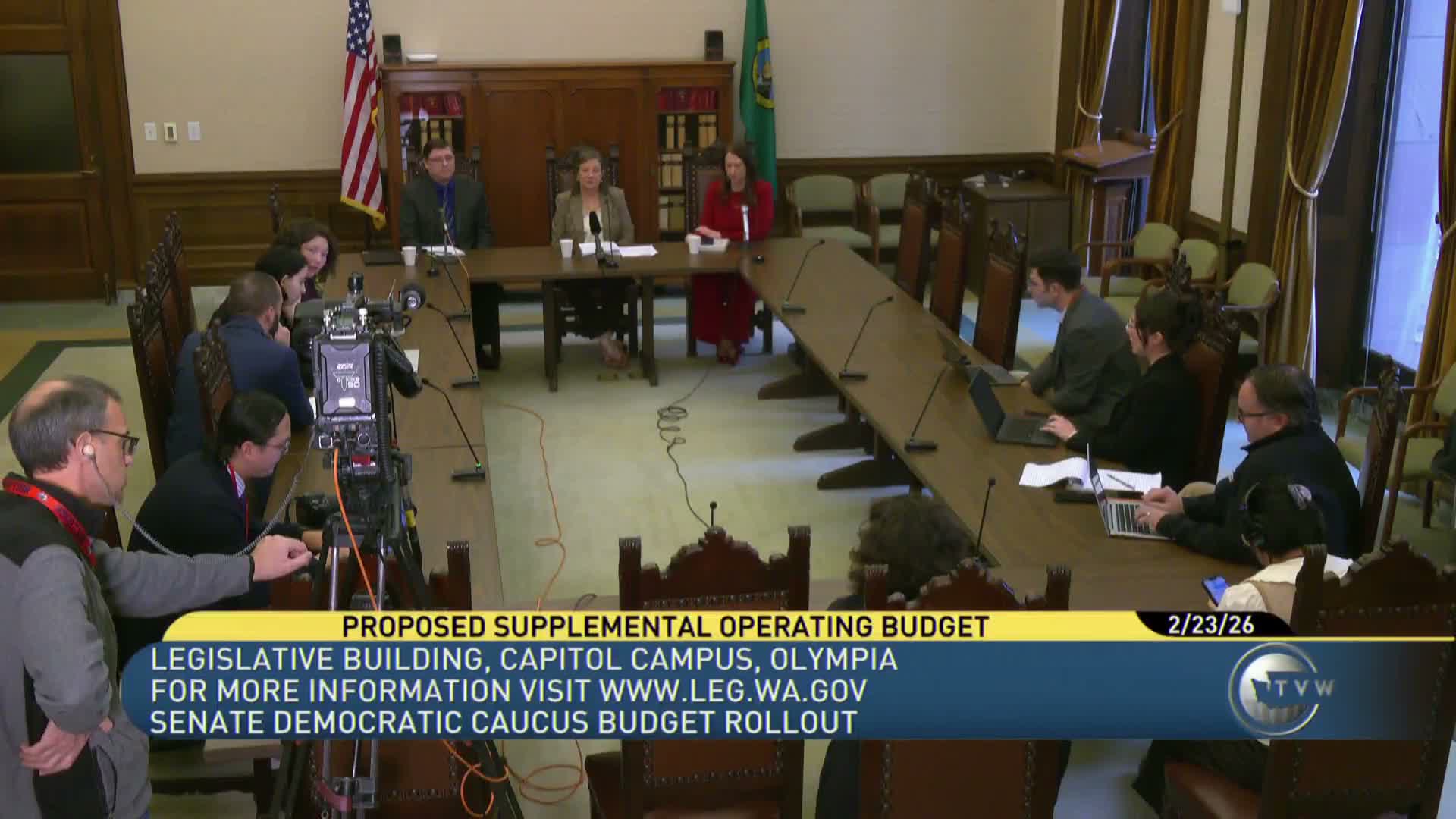
At a Senate press conference, State Senator June Robinson, chair of the Senate Ways and Means Committee, outlined the Senate’s supplemental operating budget and said it includes reductions and a $750 million withdrawal from the rainy day fund to avoid deeper cuts. “This has been an extremely challenging budget to write,” Robinson said, adding that the proposal contains “no broad based tax increases.”
Robinson framed the rollout around federal uncertainty and rising costs for core services. She told reporters that federal dollars comprise roughly one‑third of the state operating budget, and that reductions at the federal level (including impacts tied to HR 1) have forced the Senate to make difficult choices to preserve health care, K‑12 education, food assistance and long‑term care.
On the Working Families Tax Credit, Robinson said the Climate Commitment Act statute allows that program to be funded from CCA revenues but acknowledged disagreement among proponents and said the Senate will negotiate with House leaders; the House budget includes $330 million for the credit. The senator also addressed the Working Connections Child Care program: she said the Senate rejected the governor’s proposed enrollment cap and waitlist approach and instead reduced program costs through changes to the provider payment and attendance policy, a change Robinson described as intended to have less direct impact on families while still generating savings.
Asked why the Senate chose $750 million rather than the governor’s larger $880 million reserve proposal, Robinson said a recent positive revenue forecast made a smaller draw preferable. She said the rainy day fund would not be depleted by the proposal and offered rough estimates that the fund would hold about $1 billion at the end of fiscal years 2026 and 2027 and grow with revenues to about $2 billion in fiscal year 2029 if the millionaire’s tax is enacted.
The budget rollout drew criticism from the Washington Education Association, which said the plan falls short on basic and special education. Robinson replied that she hears those concerns and pointed to recent progress in special education funding, noting that education remains the largest part of the state budget and a constitutional priority.
Several reporters asked whether a full‑time legislature would improve the budget process; participants said it is a conversation worth having because part‑time pay limits who can serve. Robinson also pushed back on general Republican critiques about Democratic spending, asking critics to identify specific reductions.
Robinson said the Senate will continue negotiating with House counterparts to reconcile differences in policy and funding levels. No formal votes or final decisions were announced at the press briefing.
The Senate briefing included direct Q&A; staff closed the event with scheduling logistics and a note that an additional staffer (Miss Trasko) would arrive later.
Robinson framed the rollout around federal uncertainty and rising costs for core services. She told reporters that federal dollars comprise roughly one‑third of the state operating budget, and that reductions at the federal level (including impacts tied to HR 1) have forced the Senate to make difficult choices to preserve health care, K‑12 education, food assistance and long‑term care.
On the Working Families Tax Credit, Robinson said the Climate Commitment Act statute allows that program to be funded from CCA revenues but acknowledged disagreement among proponents and said the Senate will negotiate with House leaders; the House budget includes $330 million for the credit. The senator also addressed the Working Connections Child Care program: she said the Senate rejected the governor’s proposed enrollment cap and waitlist approach and instead reduced program costs through changes to the provider payment and attendance policy, a change Robinson described as intended to have less direct impact on families while still generating savings.
Asked why the Senate chose $750 million rather than the governor’s larger $880 million reserve proposal, Robinson said a recent positive revenue forecast made a smaller draw preferable. She said the rainy day fund would not be depleted by the proposal and offered rough estimates that the fund would hold about $1 billion at the end of fiscal years 2026 and 2027 and grow with revenues to about $2 billion in fiscal year 2029 if the millionaire’s tax is enacted.
The budget rollout drew criticism from the Washington Education Association, which said the plan falls short on basic and special education. Robinson replied that she hears those concerns and pointed to recent progress in special education funding, noting that education remains the largest part of the state budget and a constitutional priority.
Several reporters asked whether a full‑time legislature would improve the budget process; participants said it is a conversation worth having because part‑time pay limits who can serve. Robinson also pushed back on general Republican critiques about Democratic spending, asking critics to identify specific reductions.
Robinson said the Senate will continue negotiating with House counterparts to reconcile differences in policy and funding levels. No formal votes or final decisions were announced at the press briefing.
The Senate briefing included direct Q&A; staff closed the event with scheduling logistics and a note that an additional staffer (Miss Trasko) would arrive later.
View the Full Meeting & All Its Details
This article offers just a summary. Unlock complete video, transcripts, and insights as a Founder Member.
✓
Watch full, unedited meeting videos
✓
Search every word spoken in unlimited transcripts
✓
AI summaries & real-time alerts (all government levels)
✓
Permanent access to expanding government content
30-day money-back guarantee
