Sawyer County zoning committee denies waiver that would let asphalt plant refile within a year
February 23, 2026 | Sawyer County, Wisconsin
This article was created by AI summarizing key points discussed. AI makes mistakes, so for full details and context, please refer to the video of the full meeting. Please report any errors so we can fix them. Report an error »
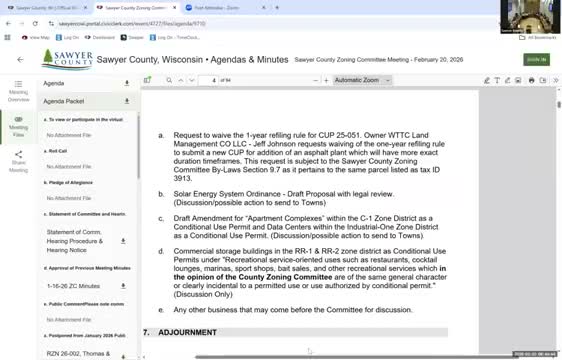
The Sawyer County Zoning Committee on Feb. 18 denied a request to waive its one‑year refiling rule for a previously rejected asphalt plant permit, blocking the applicant’s plan to submit a job‑specific one‑year conditional use permit for Highway 27 paving work in 2026.
The motion to deny the waiver carried by a 4–1 tally after more than an hour of testimony and questioning. Tristan Gardner, representing Mathey Construction and WTTC, told the committee the company wants to file a new, one‑year CUP limited to specific projects — notably a mill‑and‑overlay of Highway 27 — and said the plant would be portable and operate only during the paving window. Gardner said the new filing would include additional environmental information and extra town‑level outreach.
Opponents told the committee the earlier denial in November 2025 was based on substantial evidence, including air‑quality and emissions concerns and impacts to public health, property values and the general welfare. Tracy Yackel, speaking for neighbors of the Skilly Pit, said the public packet contained no amended CUP application, no site plan, no emissions data and no written findings to justify a waiver. “If the committee is going to waive its own rule, it must do so based on a complete materially different proposal that is part of the public record,” she said.
Residents also pressed for better notification. Multiple speakers, including Hazel John Jack and Shelly Payne, said legal notices in the Sawyer County Record and other publications do not reach many affected property owners and urged mailed notices or other outreach when projects affect air, water and soil.
Staff and legal counsel explained the difference between waiving the refiling rule and holding a full CUP hearing. Staff said the waiver item had been published as a meeting agenda item; if the committee had granted the waiver the applicant would then file a full CUP that would trigger mailed notices to property owners within 300 feet of the subject parcel. Legal counsel confirmed Robert’s Rules permit the committee to consider such a motion.
Committee members asked whether the town had approved the applicant’s proposal (staff said the town had approved it) and pressed the applicant for maps, trucking and road‑use details, and evidence of mitigation plans. Tristan Gardner said the DOT had not yet published the job window but that paving work on the Highway 27 project would likely require six to eight weeks; he emphasized the applicant’s intent to provide additional environmental data in a new application.
The committee’s denial means the applicant cannot refile immediately; under the existing rule the applicant must wait one year or bring new material changes that are documented in the public record. The committee did not vote on a related CUP during the meeting; staff said applicants may return with new, documented proposals at a later date.
The motion to deny the waiver carried by a 4–1 tally after more than an hour of testimony and questioning. Tristan Gardner, representing Mathey Construction and WTTC, told the committee the company wants to file a new, one‑year CUP limited to specific projects — notably a mill‑and‑overlay of Highway 27 — and said the plant would be portable and operate only during the paving window. Gardner said the new filing would include additional environmental information and extra town‑level outreach.
Opponents told the committee the earlier denial in November 2025 was based on substantial evidence, including air‑quality and emissions concerns and impacts to public health, property values and the general welfare. Tracy Yackel, speaking for neighbors of the Skilly Pit, said the public packet contained no amended CUP application, no site plan, no emissions data and no written findings to justify a waiver. “If the committee is going to waive its own rule, it must do so based on a complete materially different proposal that is part of the public record,” she said.
Residents also pressed for better notification. Multiple speakers, including Hazel John Jack and Shelly Payne, said legal notices in the Sawyer County Record and other publications do not reach many affected property owners and urged mailed notices or other outreach when projects affect air, water and soil.
Staff and legal counsel explained the difference between waiving the refiling rule and holding a full CUP hearing. Staff said the waiver item had been published as a meeting agenda item; if the committee had granted the waiver the applicant would then file a full CUP that would trigger mailed notices to property owners within 300 feet of the subject parcel. Legal counsel confirmed Robert’s Rules permit the committee to consider such a motion.
Committee members asked whether the town had approved the applicant’s proposal (staff said the town had approved it) and pressed the applicant for maps, trucking and road‑use details, and evidence of mitigation plans. Tristan Gardner said the DOT had not yet published the job window but that paving work on the Highway 27 project would likely require six to eight weeks; he emphasized the applicant’s intent to provide additional environmental data in a new application.
The committee’s denial means the applicant cannot refile immediately; under the existing rule the applicant must wait one year or bring new material changes that are documented in the public record. The committee did not vote on a related CUP during the meeting; staff said applicants may return with new, documented proposals at a later date.
View the Full Meeting & All Its Details
This article offers just a summary. Unlock complete video, transcripts, and insights as a Founder Member.
✓
Watch full, unedited meeting videos
✓
Search every word spoken in unlimited transcripts
✓
AI summaries & real-time alerts (all government levels)
✓
Permanent access to expanding government content
30-day money-back guarantee
