Zoning committee advances solar ordinance drafting; votes fence setback and asks for tiered financial assurance
February 23, 2026 | Sawyer County, Wisconsin
This article was created by AI summarizing key points discussed. AI makes mistakes, so for full details and context, please refer to the video of the full meeting. Please report any errors so we can fix them. Report an error »
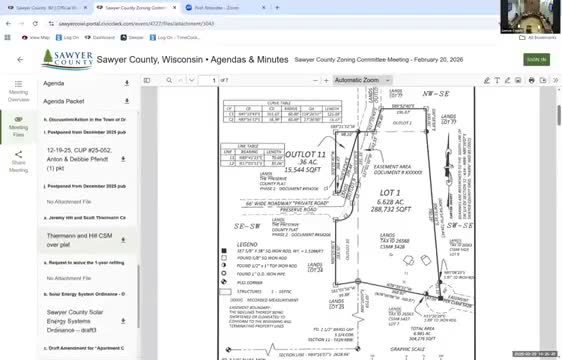
The Sawyer County Zoning Committee on Feb. 18 continued drafting a countywide Solar Energy System Ordinance and gave staff direction on several technical items, including fencing setbacks and financial assurance requirements.
Staff presented draft Version 3 of the ordinance and described the framework for community‑scale and mid‑scale solar siting and design standards. Committee discussion centered on setbacks (the draft proposes 250 feet from residential dwellings and 150 feet from public rights‑of‑way), and staff proposed a 20‑foot setback from property lines for perimeter fencing so that access roads and manufacturer‑required panel setbacks would be inside the fenced area. The committee voted by voice to adopt a 20‑foot property‑line fencing setback and to keep fencing wildlife‑friendly in design.
Legal counsel recommended a tiered approach for financial assurance tied to developer‑prepared decommissioning cost estimates (an expert report), with staged percentage requirements over a project life (for example, lower percentages in the early years, increasing toward the mid‑life of the system). Counsel noted large‑scale projects and battery energy storage systems (BESS) present separate legal and regulatory considerations and recommended staff and counsel produce example tiers and sample language for the next draft.
Other open items flagged for further legal and staff work included whether to codify utility aid payments (statutorily authorized payments into a state fund), how to reference water/well requirements and groundwater protections, and whether more specificity on fencing materials/height is needed. Counsel emphasized the difficulty and legal complexity of renewable‑energy ordinances and offered resources from the Wisconsin Counties Association to inform drafting.
Separately, the committee approved sending draft amendments to allow apartment complexes by conditional use in Commercial 1 and to define and limit data centers to Industrial 1 districts to towns for review; staff said the packet would be split and towns would receive separate items for feedback prior to a public hearing.
Staff presented draft Version 3 of the ordinance and described the framework for community‑scale and mid‑scale solar siting and design standards. Committee discussion centered on setbacks (the draft proposes 250 feet from residential dwellings and 150 feet from public rights‑of‑way), and staff proposed a 20‑foot setback from property lines for perimeter fencing so that access roads and manufacturer‑required panel setbacks would be inside the fenced area. The committee voted by voice to adopt a 20‑foot property‑line fencing setback and to keep fencing wildlife‑friendly in design.
Legal counsel recommended a tiered approach for financial assurance tied to developer‑prepared decommissioning cost estimates (an expert report), with staged percentage requirements over a project life (for example, lower percentages in the early years, increasing toward the mid‑life of the system). Counsel noted large‑scale projects and battery energy storage systems (BESS) present separate legal and regulatory considerations and recommended staff and counsel produce example tiers and sample language for the next draft.
Other open items flagged for further legal and staff work included whether to codify utility aid payments (statutorily authorized payments into a state fund), how to reference water/well requirements and groundwater protections, and whether more specificity on fencing materials/height is needed. Counsel emphasized the difficulty and legal complexity of renewable‑energy ordinances and offered resources from the Wisconsin Counties Association to inform drafting.
Separately, the committee approved sending draft amendments to allow apartment complexes by conditional use in Commercial 1 and to define and limit data centers to Industrial 1 districts to towns for review; staff said the packet would be split and towns would receive separate items for feedback prior to a public hearing.
Don't Miss a Word: See the Full Meeting!
Go beyond summaries. Unlock every video, transcript, and key insight with a Founder Membership.
✓
Get instant access to full meeting videos
✓
Search and clip any phrase from complete transcripts
✓
Receive AI-powered summaries & custom alerts
✓
Enjoy lifetime, unrestricted access to government data
30-day money-back guarantee
