DEED: 47,000 applications and rapid adjudications in early months of Minnesota paid‑leave rollout
February 21, 2026 | 2026 Legislature MN, Minnesota
This article was created by AI summarizing key points discussed. AI makes mistakes, so for full details and context, please refer to the video of the full meeting. Please report any errors so we can fix them. Report an error »
Deputy Commissioner Evan Rowe and Paid Leave Director Greg Norfleet told a Minnesota legislative committee on Feb. 23 that the state’s paid‑leave program, enacted in 2023 and effective Jan. 1, 2026, has received just over 47,000 unique applications and made more than 30,000 determinations with roughly two‑thirds of those determinations approved.
Rowe opened by describing the law and its intent, saying the program provides job protections and state benefit payments for workers who need time off for medical or family reasons. "We are here to provide an update on the operations and rollout of Minnesota's new paid leave program," he told the committee. Director Norfleet said the division pursued an incremental, pilot‑driven rollout and emphasized user testing: "These moments matter, and it's our goal as a division to ensure that you, as a Minnesotan, can be there when it matters."
Why it matters: DEED’s early figures give lawmakers a first look at how demand and costs are materializing under the new program. Norfleet told the committee that bonding and medical leave account for roughly 90% of applications; bonding leaves average 8.7 weeks and medical leaves average 6.6 weeks. DEED reported the average weekly payment so far is $1,121 (about 78% of the program maximum) and that the program is processing most applications quickly — Director Norfleet offered a 13.8‑day average decision time for November through Feb. 15.
Key operational details: DEED said the program uses a combination of employer, employee, provider and administrative data to protect program integrity. The agency built an employer portal with notification and (recently added) search capabilities and is piloting a provider certification workflow with Fairview Health. Norfleet said identity verification through LoginMN and timely employer responses help speed adjudication.
Costs, premiums and employer supports: Rowe summarized 2026 premiums at 0.88% of wages for large employers and 0.66% for small employers (applied to wages up to the Social Security wage base). First premium payments are due April 30, 2026. DEED also described a $5 million annual small‑employer assistance grant program that reimburses eligible costs (up to $3,000 per leave, $6,000 per year) and said grants are reimbursed only after employers demonstrate incurred costs; DEED reported two grants have been awarded so far and said most of the $5 million appropriation remains available.
Questions from lawmakers and outstanding items: Senators pressed DEED on multiple fronts. Senator Nelson asked how many equivalent private plans DEED has approved; Norfleet said more than 7,000 equivalent plans have been certified and that equivalents cover a modest share of employers and employees. Several senators, including Senator Pratt and Senator Brett, raised questions about actuarial stability and budget baselines after DEED said it expects to revert about $70 million of unspent implementation funds to the family and medical benefits trust; DEED said the actuarial review (required annually) and the July 1 actuarial report will refine premium‑setting and projections.
Small‑employer and sector concerns: Senators also raised concerns about small businesses and seasonal employers (for example, ski hills and hospitality‑sector seasonal work). DEED said the statute narrowly defines which seasonal businesses qualify for exclusion and that the department does not have discretion to expand those exclusions; DEED offered to provide technical assistance to lawmakers drafting any statutory change. On enforcement, DEED said penalties for nonpayment are prescribed in statute but that the agency’s approach prioritizes compliance and assistance.
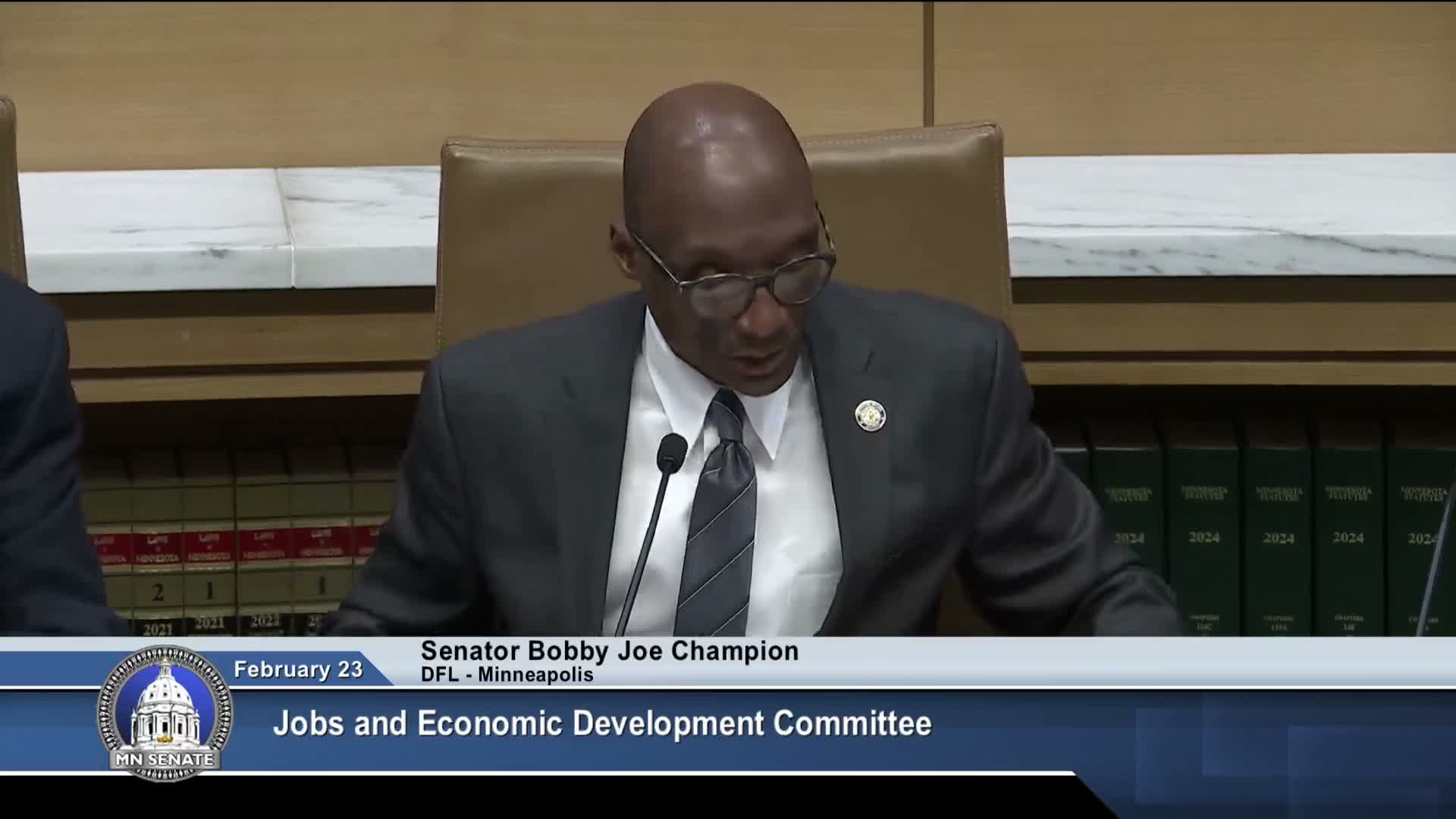
The next steps: DEED will provide follow‑up materials requested by senators (additional denial reason detail, application processing breakdowns and links to cited studies). The committee was told the formal actuarial analysis will be completed by July 1 and that DEED will continue weekly improvements to the online service. Chair (Senator Champion) announced a follow‑up meeting schedule and a community legislative hearing planned for March 23.
No formal votes were taken. The committee adjourned after the briefing.
Rowe opened by describing the law and its intent, saying the program provides job protections and state benefit payments for workers who need time off for medical or family reasons. "We are here to provide an update on the operations and rollout of Minnesota's new paid leave program," he told the committee. Director Norfleet said the division pursued an incremental, pilot‑driven rollout and emphasized user testing: "These moments matter, and it's our goal as a division to ensure that you, as a Minnesotan, can be there when it matters."
Why it matters: DEED’s early figures give lawmakers a first look at how demand and costs are materializing under the new program. Norfleet told the committee that bonding and medical leave account for roughly 90% of applications; bonding leaves average 8.7 weeks and medical leaves average 6.6 weeks. DEED reported the average weekly payment so far is $1,121 (about 78% of the program maximum) and that the program is processing most applications quickly — Director Norfleet offered a 13.8‑day average decision time for November through Feb. 15.
Key operational details: DEED said the program uses a combination of employer, employee, provider and administrative data to protect program integrity. The agency built an employer portal with notification and (recently added) search capabilities and is piloting a provider certification workflow with Fairview Health. Norfleet said identity verification through LoginMN and timely employer responses help speed adjudication.
Costs, premiums and employer supports: Rowe summarized 2026 premiums at 0.88% of wages for large employers and 0.66% for small employers (applied to wages up to the Social Security wage base). First premium payments are due April 30, 2026. DEED also described a $5 million annual small‑employer assistance grant program that reimburses eligible costs (up to $3,000 per leave, $6,000 per year) and said grants are reimbursed only after employers demonstrate incurred costs; DEED reported two grants have been awarded so far and said most of the $5 million appropriation remains available.
Questions from lawmakers and outstanding items: Senators pressed DEED on multiple fronts. Senator Nelson asked how many equivalent private plans DEED has approved; Norfleet said more than 7,000 equivalent plans have been certified and that equivalents cover a modest share of employers and employees. Several senators, including Senator Pratt and Senator Brett, raised questions about actuarial stability and budget baselines after DEED said it expects to revert about $70 million of unspent implementation funds to the family and medical benefits trust; DEED said the actuarial review (required annually) and the July 1 actuarial report will refine premium‑setting and projections.
Small‑employer and sector concerns: Senators also raised concerns about small businesses and seasonal employers (for example, ski hills and hospitality‑sector seasonal work). DEED said the statute narrowly defines which seasonal businesses qualify for exclusion and that the department does not have discretion to expand those exclusions; DEED offered to provide technical assistance to lawmakers drafting any statutory change. On enforcement, DEED said penalties for nonpayment are prescribed in statute but that the agency’s approach prioritizes compliance and assistance.
The next steps: DEED will provide follow‑up materials requested by senators (additional denial reason detail, application processing breakdowns and links to cited studies). The committee was told the formal actuarial analysis will be completed by July 1 and that DEED will continue weekly improvements to the online service. Chair (Senator Champion) announced a follow‑up meeting schedule and a community legislative hearing planned for March 23.
No formal votes were taken. The committee adjourned after the briefing.
View the Full Meeting & All Its Details
This article offers just a summary. Unlock complete video, transcripts, and insights as a Founder Member.
✓
Watch full, unedited meeting videos
✓
Search every word spoken in unlimited transcripts
✓
AI summaries & real-time alerts (all government levels)
✓
Permanent access to expanding government content
30-day money-back guarantee
