Committee advances bill to disclose certain DHS fraud investigations after debate over tipping off subjects
February 23, 2026 | 2026 Legislature MN, Minnesota
This article was created by AI summarizing key points discussed. AI makes mistakes, so for full details and context, please refer to the video of the full meeting. Please report any errors so we can fix them. Report an error »
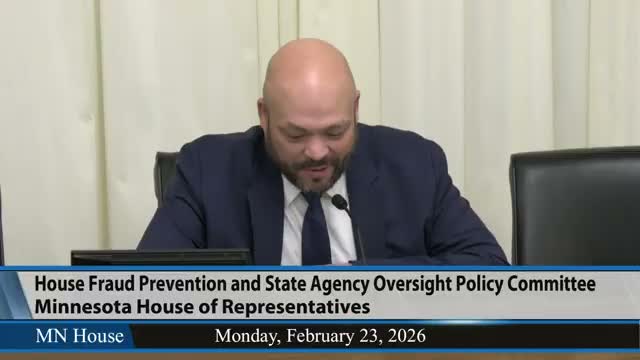
Representative Hudson moved House File 3542 to the Committee on Children and Families, describing the bill as an effort to increase transparency about DHS investigations that affect providers. The bill would change current statutory language from discretionary ('may') to mandatory ('must') disclosure of the existence of certain investigations in specified circumstances.
Representative Lee Pinto offered an A2 amendment that would require disclosure within 30 days unless disclosure would compromise an investigation. DHS staff and Inspector General James Clark warned that disclosure can — and does — compromise investigations: Clark said subjects sometimes destroy evidence, coordinate stories or threaten vulnerable recipients after learning they are under investigation. John Connolly said law enforcement may also ask states to delay notification in certain cases.
Connolly and Clark cited federal law that can require delayed notification to providers in fraud investigations (counsel referenced 42 CFR 455.23), and Connolly said state practice requires written notice to providers when payments are suspended, but federal authorities can order a delay. Committee members debated whether disclosure tied to payment actions would be a workable bright‑line rule.
The committee voted on A2 and the amendment failed. Representative Hudson then offered an oral amendment that narrowed required disclosure: DHS must disclose the existence of an investigation to legislators or authorized requesters if the commissioner has taken action to reduce, suspend, or withhold payments to the subject. Members debated process and whether the text would conflict with federal rules or hinder active criminal investigations; Clark recommended consulting law enforcement (BCA, U.S. Attorney, HHS OIG) on notification policies.
The oral amendment was adopted and the committee re‑referred HF3542, as amended, to the Children, Families, Finance and Policy Committee.
What’s next: HF3542 will go to additional committee stops. Members and agency staff signaled they will seek legal guidance about federal notification rules and whether the adopted language needs technical changes in later hearings.
Representative Lee Pinto offered an A2 amendment that would require disclosure within 30 days unless disclosure would compromise an investigation. DHS staff and Inspector General James Clark warned that disclosure can — and does — compromise investigations: Clark said subjects sometimes destroy evidence, coordinate stories or threaten vulnerable recipients after learning they are under investigation. John Connolly said law enforcement may also ask states to delay notification in certain cases.
Connolly and Clark cited federal law that can require delayed notification to providers in fraud investigations (counsel referenced 42 CFR 455.23), and Connolly said state practice requires written notice to providers when payments are suspended, but federal authorities can order a delay. Committee members debated whether disclosure tied to payment actions would be a workable bright‑line rule.
The committee voted on A2 and the amendment failed. Representative Hudson then offered an oral amendment that narrowed required disclosure: DHS must disclose the existence of an investigation to legislators or authorized requesters if the commissioner has taken action to reduce, suspend, or withhold payments to the subject. Members debated process and whether the text would conflict with federal rules or hinder active criminal investigations; Clark recommended consulting law enforcement (BCA, U.S. Attorney, HHS OIG) on notification policies.
The oral amendment was adopted and the committee re‑referred HF3542, as amended, to the Children, Families, Finance and Policy Committee.
What’s next: HF3542 will go to additional committee stops. Members and agency staff signaled they will seek legal guidance about federal notification rules and whether the adopted language needs technical changes in later hearings.
Don't Miss a Word: See the Full Meeting!
Go beyond summaries. Unlock every video, transcript, and key insight with a Founder Membership.
✓
Get instant access to full meeting videos
✓
Search and clip any phrase from complete transcripts
✓
Receive AI-powered summaries & custom alerts
✓
Enjoy lifetime, unrestricted access to government data
30-day money-back guarantee
