House panel advances Hudson bill after adding payment‑action trigger for disclosure of investigations
February 23, 2026 | 2026 Legislature MN, Minnesota
This article was created by AI summarizing key points discussed. AI makes mistakes, so for full details and context, please refer to the video of the full meeting. Please report any errors so we can fix them. Report an error »
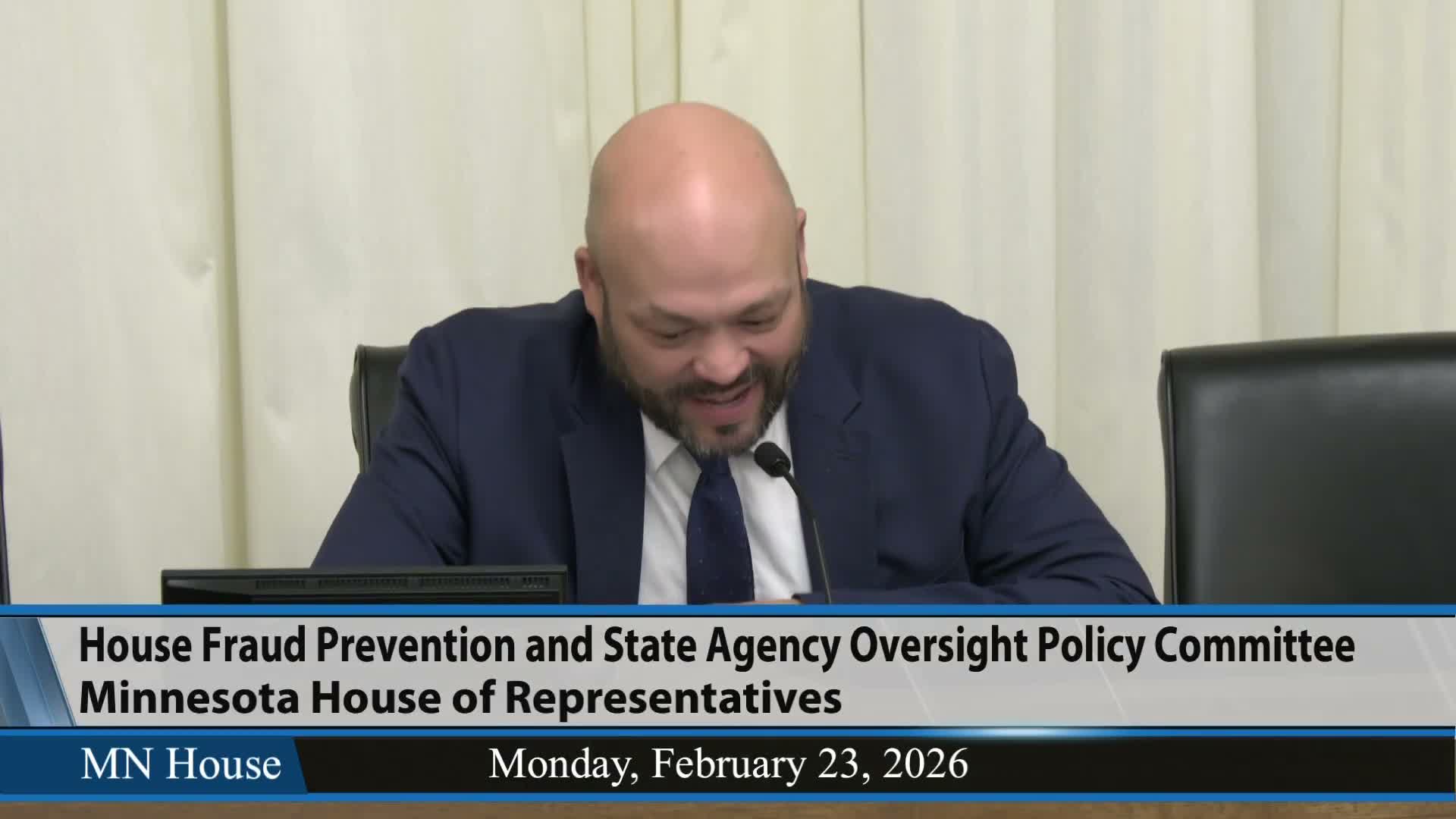
Representative Hudson’s House File 3542, which would require top officials at the Department of Human Services to disclose the existence of investigations to the Legislature, moved forward after the House committee adopted an oral amendment linking disclosure to payment actions.
Hudson told the committee the bill’s purpose is to increase transparency by changing statutory language from allowing disclosure ('may') to requiring it ('must') in defined circumstances. "Our intention in order to increase transparency to both the public and especially to the legislature is to change that may to a must," he said.
The bill drew immediate questions from members and agency staff about whether mandatory disclosure could tip off subjects of investigations and hinder law‑enforcement efforts. John Connolly, deputy commissioner and state Medicaid director at the Minnesota Department of Human Services, warned the committee that a requirement to disclose every payment withhold could "tip‑off agencies that may be committing fraud" and allow them to falsify records or hide information before investigations are complete.
Inspector General Clark echoed that concern: "Disclosure does oftentimes, lead to compromising investigations," he said, citing instances in which notification allowed subjects to destroy evidence, coordinate stories or flee.
Representative Lee Pinto offered an A2 amendment that would have required disclosure within 30 days unless disclosure would compromise an investigation. Members debated whether that exception would undercut the bill’s purpose. "To my mind, [the A2] completely hollows out the intent of the underlying amendment," Hudson said, while Pinto described her change as balancing transparency with investigative integrity.
The committee voted on the A2 and, after members voiced 'aye' and 'nay,' Chair Robbins announced that the amendment did not pass.
Hudson then offered an oral amendment read by nonpartisan staff that narrows the disclosure trigger to cases in which the commissioner "has taken action to reduce, suspend, or withhold payments to the subject of the investigation." Hudson said the amendment rests on the premise that withholding or reducing payments is likely to make the subject aware of an investigation, and therefore disclosure to legislators would be appropriate in those instances.
Representative Greenman and others questioned whether tying disclosure to payment actions could still conflict with federal law or law‑enforcement requests to delay notification. The inspector general recommended seeking law‑enforcement perspective (including the Bureau of Criminal Apprehension, the attorney general’s office or federal oversight) because federal regulation (42 CFR 455.23) can allow delayed notification in certain coordinated investigations.
Nonpartisan staff clarified the bill, as amended, authorizes only disclosure of the existence of an investigation — "basically just a yes or no" — and does not compel release of investigative details or override trade‑secret redactions under the Data Practices Act.
Chair Robbins waived committee rules to allow the oral amendment; the committee adopted the oral amendment and then voted to re‑refer HF 3542, as amended, to the Committee on Children, Families, Finance and Policy. The transcript records members saying 'aye' and the chair announcing, "The bill is on its way."
Hudson told the committee the bill’s purpose is to increase transparency by changing statutory language from allowing disclosure ('may') to requiring it ('must') in defined circumstances. "Our intention in order to increase transparency to both the public and especially to the legislature is to change that may to a must," he said.
The bill drew immediate questions from members and agency staff about whether mandatory disclosure could tip off subjects of investigations and hinder law‑enforcement efforts. John Connolly, deputy commissioner and state Medicaid director at the Minnesota Department of Human Services, warned the committee that a requirement to disclose every payment withhold could "tip‑off agencies that may be committing fraud" and allow them to falsify records or hide information before investigations are complete.
Inspector General Clark echoed that concern: "Disclosure does oftentimes, lead to compromising investigations," he said, citing instances in which notification allowed subjects to destroy evidence, coordinate stories or flee.
Representative Lee Pinto offered an A2 amendment that would have required disclosure within 30 days unless disclosure would compromise an investigation. Members debated whether that exception would undercut the bill’s purpose. "To my mind, [the A2] completely hollows out the intent of the underlying amendment," Hudson said, while Pinto described her change as balancing transparency with investigative integrity.
The committee voted on the A2 and, after members voiced 'aye' and 'nay,' Chair Robbins announced that the amendment did not pass.
Hudson then offered an oral amendment read by nonpartisan staff that narrows the disclosure trigger to cases in which the commissioner "has taken action to reduce, suspend, or withhold payments to the subject of the investigation." Hudson said the amendment rests on the premise that withholding or reducing payments is likely to make the subject aware of an investigation, and therefore disclosure to legislators would be appropriate in those instances.
Representative Greenman and others questioned whether tying disclosure to payment actions could still conflict with federal law or law‑enforcement requests to delay notification. The inspector general recommended seeking law‑enforcement perspective (including the Bureau of Criminal Apprehension, the attorney general’s office or federal oversight) because federal regulation (42 CFR 455.23) can allow delayed notification in certain coordinated investigations.
Nonpartisan staff clarified the bill, as amended, authorizes only disclosure of the existence of an investigation — "basically just a yes or no" — and does not compel release of investigative details or override trade‑secret redactions under the Data Practices Act.
Chair Robbins waived committee rules to allow the oral amendment; the committee adopted the oral amendment and then voted to re‑refer HF 3542, as amended, to the Committee on Children, Families, Finance and Policy. The transcript records members saying 'aye' and the chair announcing, "The bill is on its way."
View the Full Meeting & All Its Details
This article offers just a summary. Unlock complete video, transcripts, and insights as a Founder Member.
✓
Watch full, unedited meeting videos
✓
Search every word spoken in unlimited transcripts
✓
AI summaries & real-time alerts (all government levels)
✓
Permanent access to expanding government content
30-day money-back guarantee
