Advocates tell Minnesota transportation committee pedestrian and bicycle fatalities have surged, urge design and policy fixes
February 23, 2026 | 2026 Legislature MN, Minnesota
This article was created by AI summarizing key points discussed. AI makes mistakes, so for full details and context, please refer to the video of the full meeting. Please report any errors so we can fix them. Report an error »
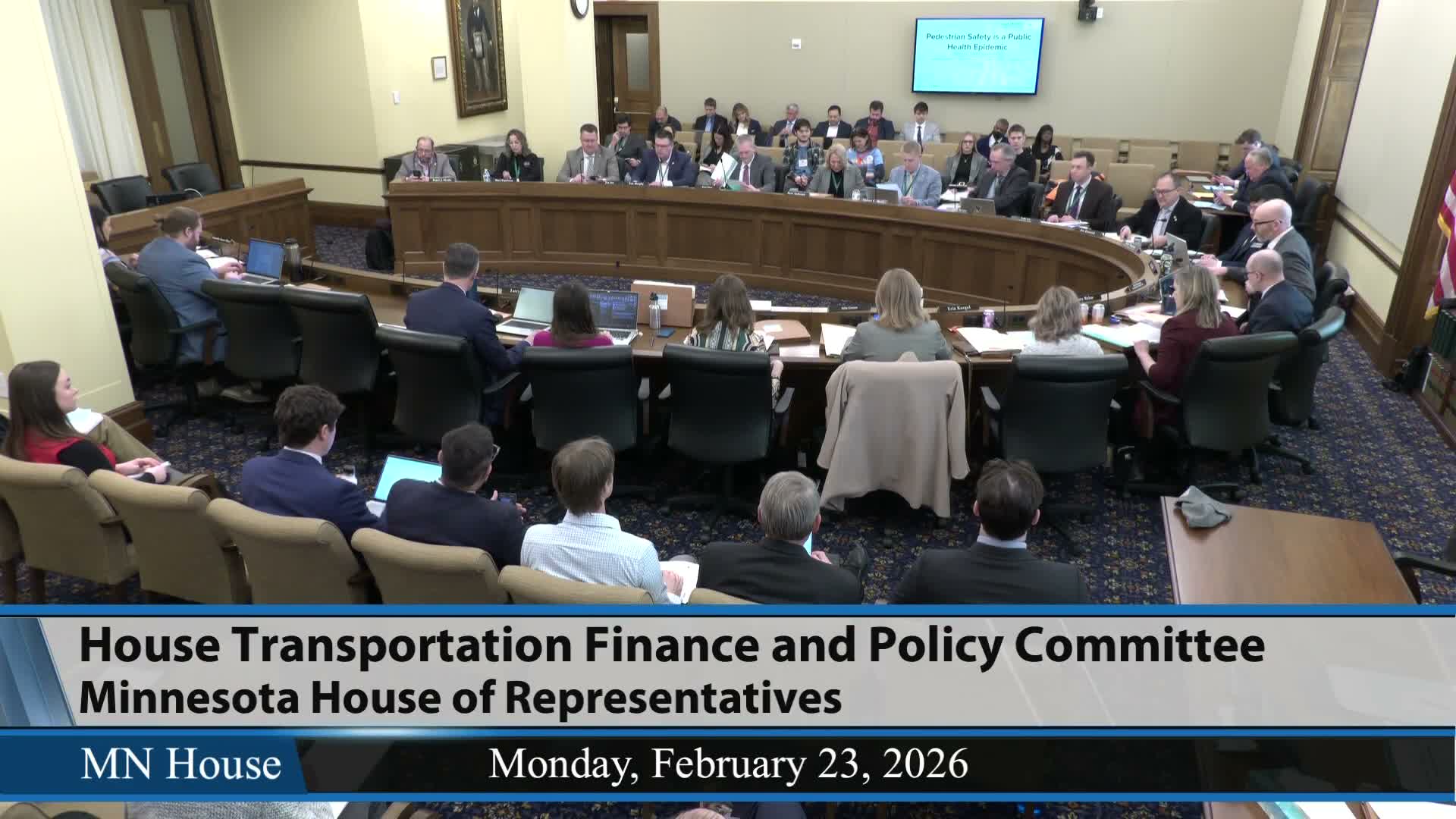
Joe Harrington, policy manager at Our Streets, and Michael Wojcick, executive director of the Bicycle Alliance of Minnesota, told the House Transportation Committee on Feb. 23 that pedestrian and bicycle fatalities have reversed earlier declines and now represent a growing share of traffic deaths. "This is a pedestrian and bicycle safety crisis," Harrington said, citing a national rise in pedestrian deaths since about 2010 and local examples such as Olson Memorial Highway in Minneapolis where community organizing has failed to secure meaningful safety changes.
Harrington pointed to a mix of causes — distracted driving, larger vehicles and engineering choices that prioritize vehicle throughput over safety — and said those factors help explain why the U.S. trend diverges from many developed nations. He told lawmakers Minnesota’s overall traffic fatalities spiked during the pandemic, peaked in 2021, and that bicycle and pedestrian fatalities remained “stubbornly high,” noting 61 bicycle and pedestrian deaths in 2024.
Wojcick emphasized the human toll and pointed to low-cost interventions that are often constrained by state standards. "The solutions can be incredibly inexpensive, but they're often not allowed," he said, citing raised crosswalks and tabletop crossings as measures that reduce speeds and crash severity but which MnDOT state aid standards can prohibit or require lengthy variances to install. He also said preliminary state advisory‑council data show a marked year‑to‑year increase in bicycle fatalities and that roughly 75% of fatal bicycle crashes in Minnesota occur at intersections.
Committee members asked for detail on causes and remedies. Representative Olson pressed presenters on whether higher participation in walking and biking explained the rising share of fatalities; Harrington said the slide shown reflected a share of total fatalities (not raw counts) and Wojcick pointed to concentrated crash locations and localized spikes. Members also discussed near‑side signals, autonomous vehicles and whether some redesigns (roundabouts, medians, bumpouts) could create new hazards if not engineered carefully.
The presentation framed speed and street design as policy choices. Harrington and Wojcick urged state policy and aid standard changes so local governments could deploy proven, low‑cost countermeasures more quickly. The committee moved from that discussion into consideration of related legislation on intelligent speed‑assist technology and automated speed enforcement later in the hearing.
Harrington pointed to a mix of causes — distracted driving, larger vehicles and engineering choices that prioritize vehicle throughput over safety — and said those factors help explain why the U.S. trend diverges from many developed nations. He told lawmakers Minnesota’s overall traffic fatalities spiked during the pandemic, peaked in 2021, and that bicycle and pedestrian fatalities remained “stubbornly high,” noting 61 bicycle and pedestrian deaths in 2024.
Wojcick emphasized the human toll and pointed to low-cost interventions that are often constrained by state standards. "The solutions can be incredibly inexpensive, but they're often not allowed," he said, citing raised crosswalks and tabletop crossings as measures that reduce speeds and crash severity but which MnDOT state aid standards can prohibit or require lengthy variances to install. He also said preliminary state advisory‑council data show a marked year‑to‑year increase in bicycle fatalities and that roughly 75% of fatal bicycle crashes in Minnesota occur at intersections.
Committee members asked for detail on causes and remedies. Representative Olson pressed presenters on whether higher participation in walking and biking explained the rising share of fatalities; Harrington said the slide shown reflected a share of total fatalities (not raw counts) and Wojcick pointed to concentrated crash locations and localized spikes. Members also discussed near‑side signals, autonomous vehicles and whether some redesigns (roundabouts, medians, bumpouts) could create new hazards if not engineered carefully.
The presentation framed speed and street design as policy choices. Harrington and Wojcick urged state policy and aid standard changes so local governments could deploy proven, low‑cost countermeasures more quickly. The committee moved from that discussion into consideration of related legislation on intelligent speed‑assist technology and automated speed enforcement later in the hearing.
Don't Miss a Word: See the Full Meeting!
Go beyond summaries. Unlock every video, transcript, and key insight with a Founder Membership.
✓
Get instant access to full meeting videos
✓
Search and clip any phrase from complete transcripts
✓
Receive AI-powered summaries & custom alerts
✓
Enjoy lifetime, unrestricted access to government data
30-day money-back guarantee
