Committee advances bill to require intelligent speed‑assist devices for habitual and extreme speeders
February 23, 2026 | 2026 Legislature MN, Minnesota
This article was created by AI summarizing key points discussed. AI makes mistakes, so for full details and context, please refer to the video of the full meeting. Please report any errors so we can fix them. Report an error »
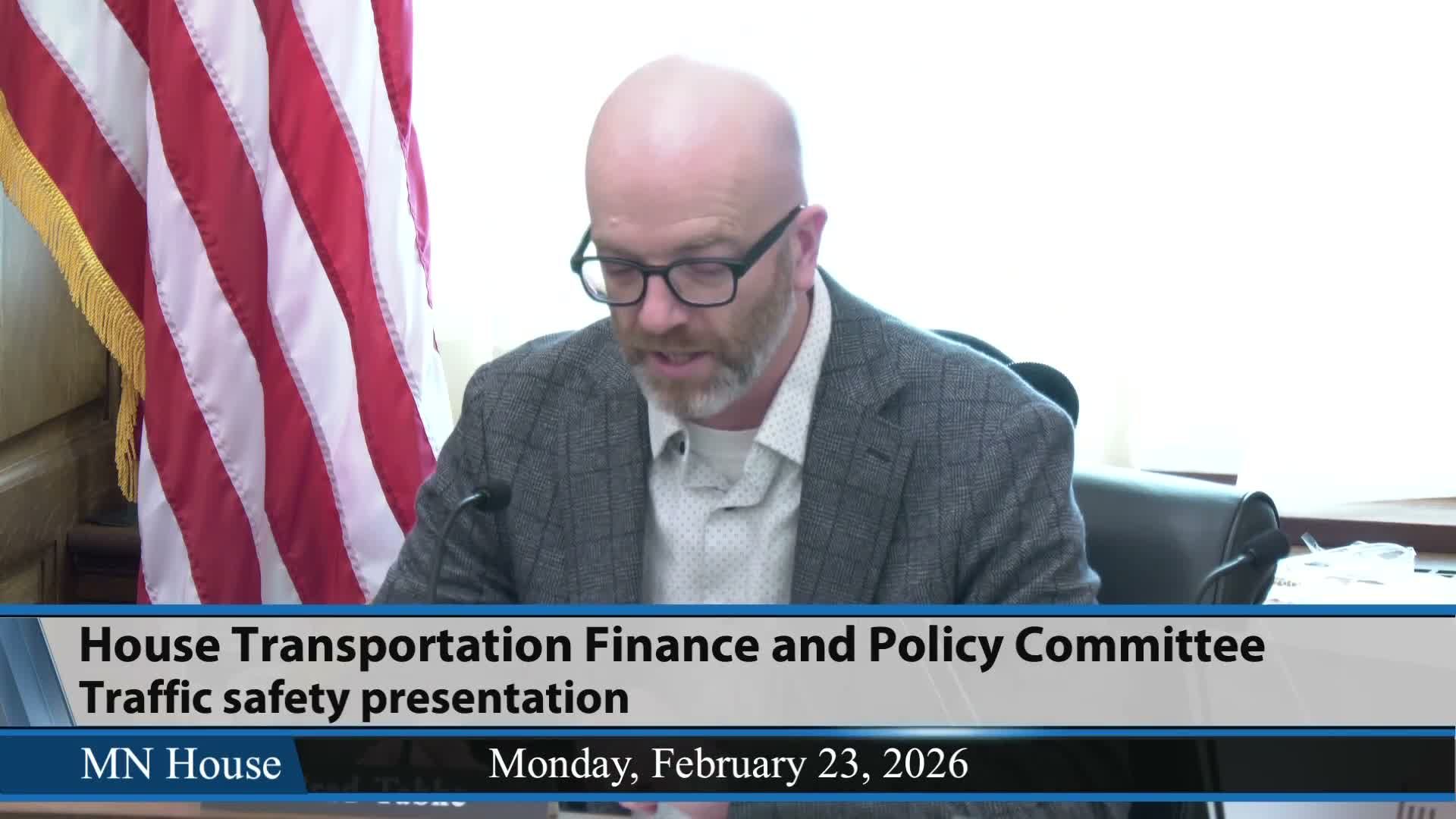
Representative Peter Kraft moved House File 3429, the "stop super speeders" bill, and the committee approved the author's A2 amendment before referring the measure to the judiciary and finance and civil law committees on Feb. 23.
Kraft told the committee the bill targets drivers who habitually or egregiously exceed speed limits and uses intelligent speed‑assist technology to prevent vehicles from accelerating beyond posted limits for drivers subject to the program. "Too much speed causes too much death on our roads," Kraft said, citing speed‑related fatality statistics and research on risk increases at higher speeds.
Testimony came from survivors and advocacy groups. Sarah Risser of Families for Safe Streets described the loss of her son and urged lawmakers to "prevent harm before it happens rather than addressing harm after it's been caused." Pam Mason and Julie Risser offered similar survivor accounts. Ian Thomas of America Walks called ISA "a reliable and well‑tested" tool that can be used passively as a warning or actively to limit acceleration.
Key details discussed on the record: the A2 amendment expands offenses covered and clarifies rulemaking and liability; section language cited in committee would trigger ISA for extreme speeds (examples discussed on the record included 30 mph over a posted speed limit or exceeding 100 mph, with different thresholds where posted limits are lower and enhanced thresholds in work or school zones); section 4 ties the length of an ISA requirement to the number of offenses; section 6 sets program definitions and requires a reduced‑fee option for low‑income participants; and appropriation language references the Driver and Vehicle Services operating account rather than the general fund. Representative Kraft said the fiscal note estimates roughly 13,000 individuals could be affected (fiscal‑note number discussed in committee).
Members questioned implementation mechanics and costs for participants. Committee discussion noted parallels to ignition‑interlock programs: providers are third‑party vendors, monthly service costs were estimated in committee discussion in the range of traditional interlock fees (roughly $100–$200 monthly), and the bill contemplates financial relief for low‑income participants. Committee members also pressed why license suspension alone has not deterred repeat offenders; the author pointed to data that many suspended‑license drivers continue to drive and cited studies estimating about 75% drive despite revocation in comparable contexts.
The DPS Office of Traffic Safety director, Mike Hanson, testified that ISA technology is mature and used in commercial fleets, and that speed remains the major factor increasing crash severity. After testimony and questions, Representative Kraft renewed his motion and the committee approved re‑referral of HF3429 as amended to the judiciary and finance and civil law committees by voice vote.
Next steps: HF3429 will proceed to its next committee stops for further fiscal and policy review.
Kraft told the committee the bill targets drivers who habitually or egregiously exceed speed limits and uses intelligent speed‑assist technology to prevent vehicles from accelerating beyond posted limits for drivers subject to the program. "Too much speed causes too much death on our roads," Kraft said, citing speed‑related fatality statistics and research on risk increases at higher speeds.
Testimony came from survivors and advocacy groups. Sarah Risser of Families for Safe Streets described the loss of her son and urged lawmakers to "prevent harm before it happens rather than addressing harm after it's been caused." Pam Mason and Julie Risser offered similar survivor accounts. Ian Thomas of America Walks called ISA "a reliable and well‑tested" tool that can be used passively as a warning or actively to limit acceleration.
Key details discussed on the record: the A2 amendment expands offenses covered and clarifies rulemaking and liability; section language cited in committee would trigger ISA for extreme speeds (examples discussed on the record included 30 mph over a posted speed limit or exceeding 100 mph, with different thresholds where posted limits are lower and enhanced thresholds in work or school zones); section 4 ties the length of an ISA requirement to the number of offenses; section 6 sets program definitions and requires a reduced‑fee option for low‑income participants; and appropriation language references the Driver and Vehicle Services operating account rather than the general fund. Representative Kraft said the fiscal note estimates roughly 13,000 individuals could be affected (fiscal‑note number discussed in committee).
Members questioned implementation mechanics and costs for participants. Committee discussion noted parallels to ignition‑interlock programs: providers are third‑party vendors, monthly service costs were estimated in committee discussion in the range of traditional interlock fees (roughly $100–$200 monthly), and the bill contemplates financial relief for low‑income participants. Committee members also pressed why license suspension alone has not deterred repeat offenders; the author pointed to data that many suspended‑license drivers continue to drive and cited studies estimating about 75% drive despite revocation in comparable contexts.
The DPS Office of Traffic Safety director, Mike Hanson, testified that ISA technology is mature and used in commercial fleets, and that speed remains the major factor increasing crash severity. After testimony and questions, Representative Kraft renewed his motion and the committee approved re‑referral of HF3429 as amended to the judiciary and finance and civil law committees by voice vote.
Next steps: HF3429 will proceed to its next committee stops for further fiscal and policy review.
Don't Miss a Word: See the Full Meeting!
Go beyond summaries. Unlock every video, transcript, and key insight with a Founder Membership.
✓
Get instant access to full meeting videos
✓
Search and clip any phrase from complete transcripts
✓
Receive AI-powered summaries & custom alerts
✓
Enjoy lifetime, unrestricted access to government data
30-day money-back guarantee
