House committee debates revisions to Farm Down Payment Assistance program; zoning and acreage thresholds draw pushback
February 23, 2026 | 2026 Legislature MN, Minnesota
This article was created by AI summarizing key points discussed. AI makes mistakes, so for full details and context, please refer to the video of the full meeting. Please report any errors so we can fix them. Report an error »
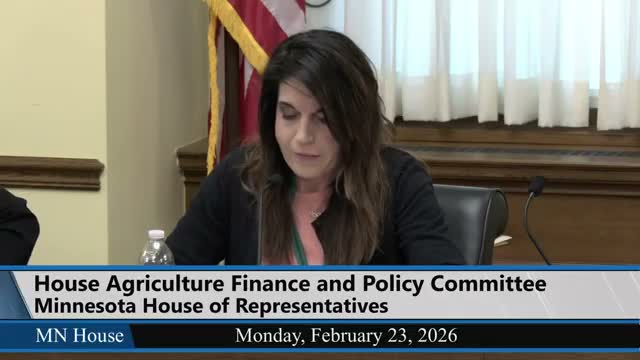
Chair Anderson moved House File 3548, a bill changing the state’s Farm Down Payment Assistance Grants, onto the Agriculture Finance and Policy Committee agenda and described several proposed changes including a larger award tier for purchases of about 75 acres, a plan to reserve roughly half of the funding for applicants who have a purchase agreement in hand, and added minimum experience or readiness requirements for applicants.
Anderson said the program began in 2023 with a $500,000 appropriation and has since expanded; the bill would increase annual program appropriations to $1,250,000. "My intent was if somebody was gonna purchase what we would call an 80, 80 acres of land... to double the award that the recipient would be given," Anderson said while explaining the rationale.
Department of Agriculture staff (Jenny Heck, program administrator) told members the program’s average recipient farm size over the last three years was about 60 acres and that very small acreage awards (under two acres) were rare. Heck also said the department currently checks experience through similar criteria used in the beginning farmer tax credit—farm business management enrollment, a relevant degree, or at least three years of verified farm management or working experience.
Testimony produced competing perspectives. Laura Schreiber, government relations director for the Land Stewardship Project, said she supported readiness requirements and the idea of set‑asides for applicants with purchase agreements but recommended using purchase price rather than acreage to determine award tiers because land values vary widely across Minnesota.
Alyssa Ayl, who runs California Street Farm in Minneapolis, described operating a profitable, small, primarily residentially zoned microfarm and said an acreage or zoning cutoff would exclude many urban and small‑scale farmers. "My land that I farm on right now is zone residential, and I would not be able to purchase it if this change were to be made utilizing the down payment assistance grant," Ayl testified. She urged the committee to preserve access for microfarmers and suggested stronger readiness supports, such as connecting applicants to land‑access navigators.
Representatives expressed mixed concerns: some members warned that enlarging awards or changing eligibility could advantage larger, more capitalized farms, while others stressed the program should continue prioritizing beginning and microfarmers, including immigrant and limited‑English communities the program was intended to reach. A number of members asked the department for data on past applicants and recipients to assess the practical impacts of proposed eligibility changes; committee staff said the department’s report contains that data.
After extended discussion, Chair Anderson said he heard concerns about the residential‑zoning provision and would remove it from the draft. The committee laid House File 3548 over for further drafting and negotiation rather than advancing it to a committee vote.
Anderson said the program began in 2023 with a $500,000 appropriation and has since expanded; the bill would increase annual program appropriations to $1,250,000. "My intent was if somebody was gonna purchase what we would call an 80, 80 acres of land... to double the award that the recipient would be given," Anderson said while explaining the rationale.
Department of Agriculture staff (Jenny Heck, program administrator) told members the program’s average recipient farm size over the last three years was about 60 acres and that very small acreage awards (under two acres) were rare. Heck also said the department currently checks experience through similar criteria used in the beginning farmer tax credit—farm business management enrollment, a relevant degree, or at least three years of verified farm management or working experience.
Testimony produced competing perspectives. Laura Schreiber, government relations director for the Land Stewardship Project, said she supported readiness requirements and the idea of set‑asides for applicants with purchase agreements but recommended using purchase price rather than acreage to determine award tiers because land values vary widely across Minnesota.
Alyssa Ayl, who runs California Street Farm in Minneapolis, described operating a profitable, small, primarily residentially zoned microfarm and said an acreage or zoning cutoff would exclude many urban and small‑scale farmers. "My land that I farm on right now is zone residential, and I would not be able to purchase it if this change were to be made utilizing the down payment assistance grant," Ayl testified. She urged the committee to preserve access for microfarmers and suggested stronger readiness supports, such as connecting applicants to land‑access navigators.
Representatives expressed mixed concerns: some members warned that enlarging awards or changing eligibility could advantage larger, more capitalized farms, while others stressed the program should continue prioritizing beginning and microfarmers, including immigrant and limited‑English communities the program was intended to reach. A number of members asked the department for data on past applicants and recipients to assess the practical impacts of proposed eligibility changes; committee staff said the department’s report contains that data.
After extended discussion, Chair Anderson said he heard concerns about the residential‑zoning provision and would remove it from the draft. The committee laid House File 3548 over for further drafting and negotiation rather than advancing it to a committee vote.
View the Full Meeting & All Its Details
This article offers just a summary. Unlock complete video, transcripts, and insights as a Founder Member.
✓
Watch full, unedited meeting videos
✓
Search every word spoken in unlimited transcripts
✓
AI summaries & real-time alerts (all government levels)
✓
Permanent access to expanding government content
30-day money-back guarantee
