Twin Valley board hears data report, asks for deeper curriculum review after ELA declines
January 19, 2026 | Twin Valley SD, School Districts, Pennsylvania
This article was created by AI summarizing key points discussed. AI makes mistakes, so for full details and context, please refer to the video of the full meeting. Please report any errors so we can fix them. Report an error »
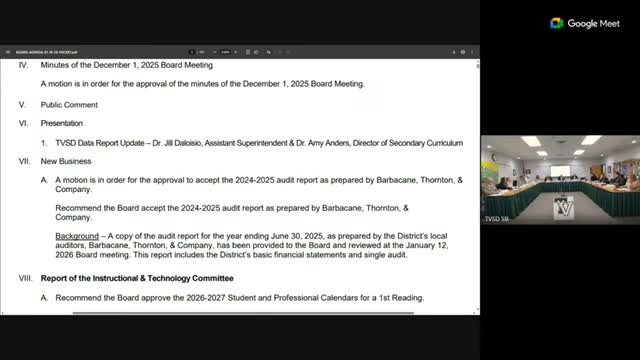
Doctor Dolosio presented the Twin Valley School District annual data report on Jan. 19, outlining six-year enrollment trends, special education percentages and three-year assessment results for PSSA (grades 3–8) and Keystone exams. Dolosio told the board a full slide deck and the underlying data have been shared with members and will be posted in the board letter.
The presentation compared the district with 18 county districts and the state and showed mixed results: the district ranked in the top third in math for several grades but had declining ELA performance in multiple cohorts. "We want to analyze how students are getting to benchmark, below benchmark or above benchmark, as well as their individual growth," Dolosio said, describing plans to examine curricular resources, assessments and instructional delivery.
Board members flagged specific grade-level drops (one board member noted a fall from 1st to 14th in a cohort highlight) and asked for root-cause analysis rather than an immediate curriculum swap. Dolosio said the district has had the same ELA curriculum for three years and recommended a methodical approach: a 6–8 week root-cause review with teacher-leader input, subgroup analysis (economically disadvantaged, special education, ethnicity), and classroom walk-throughs to assess instructional fidelity. He proposed returning to the board early March with tentative recommendations if changes are required.
Board members also asked the administration to provide: county comparisons of curricula used by top-performing districts; analysis of whether teacher caseloads and planning time correlate with scores; and cost estimates if a curriculum shift is recommended. Dolosio committed to sharing the slide deck and to presenting a progress update and action steps in the quarter following the review.
The discussion concluded with a request that the follow-up use the same bullet points and measures presented so the board can evaluate concrete action items rather than repeating prior summary material. No formal vote was taken on curriculum changes at the meeting; the board directed staff to pursue the described analysis and report back.
The presentation compared the district with 18 county districts and the state and showed mixed results: the district ranked in the top third in math for several grades but had declining ELA performance in multiple cohorts. "We want to analyze how students are getting to benchmark, below benchmark or above benchmark, as well as their individual growth," Dolosio said, describing plans to examine curricular resources, assessments and instructional delivery.
Board members flagged specific grade-level drops (one board member noted a fall from 1st to 14th in a cohort highlight) and asked for root-cause analysis rather than an immediate curriculum swap. Dolosio said the district has had the same ELA curriculum for three years and recommended a methodical approach: a 6–8 week root-cause review with teacher-leader input, subgroup analysis (economically disadvantaged, special education, ethnicity), and classroom walk-throughs to assess instructional fidelity. He proposed returning to the board early March with tentative recommendations if changes are required.
Board members also asked the administration to provide: county comparisons of curricula used by top-performing districts; analysis of whether teacher caseloads and planning time correlate with scores; and cost estimates if a curriculum shift is recommended. Dolosio committed to sharing the slide deck and to presenting a progress update and action steps in the quarter following the review.
The discussion concluded with a request that the follow-up use the same bullet points and measures presented so the board can evaluate concrete action items rather than repeating prior summary material. No formal vote was taken on curriculum changes at the meeting; the board directed staff to pursue the described analysis and report back.
View the Full Meeting & All Its Details
This article offers just a summary. Unlock complete video, transcripts, and insights as a Founder Member.
✓
Watch full, unedited meeting videos
✓
Search every word spoken in unlimited transcripts
✓
AI summaries & real-time alerts (all government levels)
✓
Permanent access to expanding government content
30-day money-back guarantee
