Salinas planning staff gives CEQA 101, explains new 'near miss' rule and upcoming EIRs tied to general plan update
February 23, 2026 | Salinas, Monterey County, California
This article was created by AI summarizing key points discussed. AI makes mistakes, so for full details and context, please refer to the video of the full meeting. Please report any errors so we can fix them. Report an error »
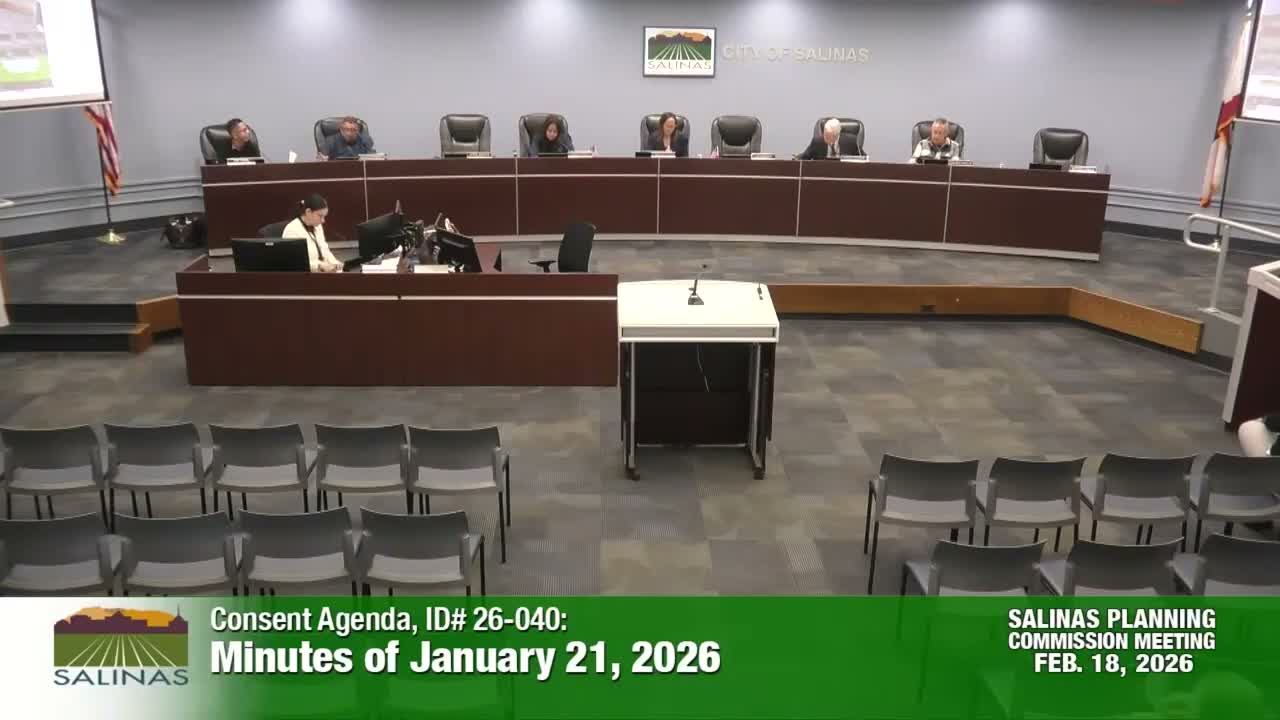
Senior Planner Sona Fong Gallardo told the Salinas Planning Commission on Feb. 18 that the California Environmental Quality Act, or CEQA, requires government agencies to consider potential environmental effects before approving projects and that CEQA offers three common review paths: categorical/statutory exemptions, an initial study followed by a negative or mitigated negative declaration, or an environmental impact report (EIR).
Gallardo outlined the most-used local exemptions — Class 1 (existing facilities), Class 3 (small structures) and Class 32 (infill) — and said a Class 32 exemption requires, among other things, that the site be within city limits, be no more than five acres, be consistent with applicable general plan and zoning designations, be substantially surrounded by urban uses and not contain habitat for rare species. "If an action does not meet the definition of a project, CEQA does not apply," she said.
She also described recent state changes aimed at housing production, citing Assembly Bill 130 and Senate Bill 131 and explaining the so-called "near miss" rule created by SB 131. Under that rule, a housing or mixed‑use project that meets all but one of an exemption's conditions may still qualify for a statutory or categorical exemption in some cases, Gallardo said, giving a square‑footage example where a 12,500 sq. ft. building could be treated as a near miss to a 10,000 sq. ft. threshold.
Commissioners pressed staff on how CEQA interacts with local planning authority. Staff answered that the city's general plan and zoning code guide where growth occurs, that the planning commission reviews projects before forwarding recommendations to City Council, and that planners perform initial studies and request technical reports (for example, from certified biologists or traffic engineers) when needed. Gallardo noted that specialized studies are typically paid for by the applicant.
Staff flagged several major upcoming CEQA items the commission should expect in 2026, including recommendations on certification of EIRs and CEQA consistency analyses tied to the Viroshi Business Center specific plan EIR, the Vision Salinas '24 general plan EIR, and the East Area specific plan EIR.
On the practical effects of CEQA, planning staff said the law sometimes prompts project changes or delays. "Developers typically like predictable outcomes," one senior planner said, noting that market conditions, construction costs and interest rates also influence whether approved tentative maps move to final maps and construction. Staff said roughly 6,500 residential units are pending in the pipeline but that final maps and development timelines vary by project.
The commission did not take formal action on policy during the study session; staff advised the planning commission will later be asked to provide recommendations to council when the EIRs and general plan documents are ready for review.
Gallardo outlined the most-used local exemptions — Class 1 (existing facilities), Class 3 (small structures) and Class 32 (infill) — and said a Class 32 exemption requires, among other things, that the site be within city limits, be no more than five acres, be consistent with applicable general plan and zoning designations, be substantially surrounded by urban uses and not contain habitat for rare species. "If an action does not meet the definition of a project, CEQA does not apply," she said.
She also described recent state changes aimed at housing production, citing Assembly Bill 130 and Senate Bill 131 and explaining the so-called "near miss" rule created by SB 131. Under that rule, a housing or mixed‑use project that meets all but one of an exemption's conditions may still qualify for a statutory or categorical exemption in some cases, Gallardo said, giving a square‑footage example where a 12,500 sq. ft. building could be treated as a near miss to a 10,000 sq. ft. threshold.
Commissioners pressed staff on how CEQA interacts with local planning authority. Staff answered that the city's general plan and zoning code guide where growth occurs, that the planning commission reviews projects before forwarding recommendations to City Council, and that planners perform initial studies and request technical reports (for example, from certified biologists or traffic engineers) when needed. Gallardo noted that specialized studies are typically paid for by the applicant.
Staff flagged several major upcoming CEQA items the commission should expect in 2026, including recommendations on certification of EIRs and CEQA consistency analyses tied to the Viroshi Business Center specific plan EIR, the Vision Salinas '24 general plan EIR, and the East Area specific plan EIR.
On the practical effects of CEQA, planning staff said the law sometimes prompts project changes or delays. "Developers typically like predictable outcomes," one senior planner said, noting that market conditions, construction costs and interest rates also influence whether approved tentative maps move to final maps and construction. Staff said roughly 6,500 residential units are pending in the pipeline but that final maps and development timelines vary by project.
The commission did not take formal action on policy during the study session; staff advised the planning commission will later be asked to provide recommendations to council when the EIRs and general plan documents are ready for review.
Don't Miss a Word: See the Full Meeting!
Go beyond summaries. Unlock every video, transcript, and key insight with a Founder Membership.
✓
Get instant access to full meeting videos
✓
Search and clip any phrase from complete transcripts
✓
Receive AI-powered summaries & custom alerts
✓
Enjoy lifetime, unrestricted access to government data
30-day money-back guarantee
