Salinas committee hears predevelopment plans for Chinatown Soledad Street sites; no votes due to lack of quorum
February 23, 2026 | Salinas, Monterey County, California
This article was created by AI summarizing key points discussed. AI makes mistakes, so for full details and context, please refer to the video of the full meeting. Please report any errors so we can fix them. Report an error »
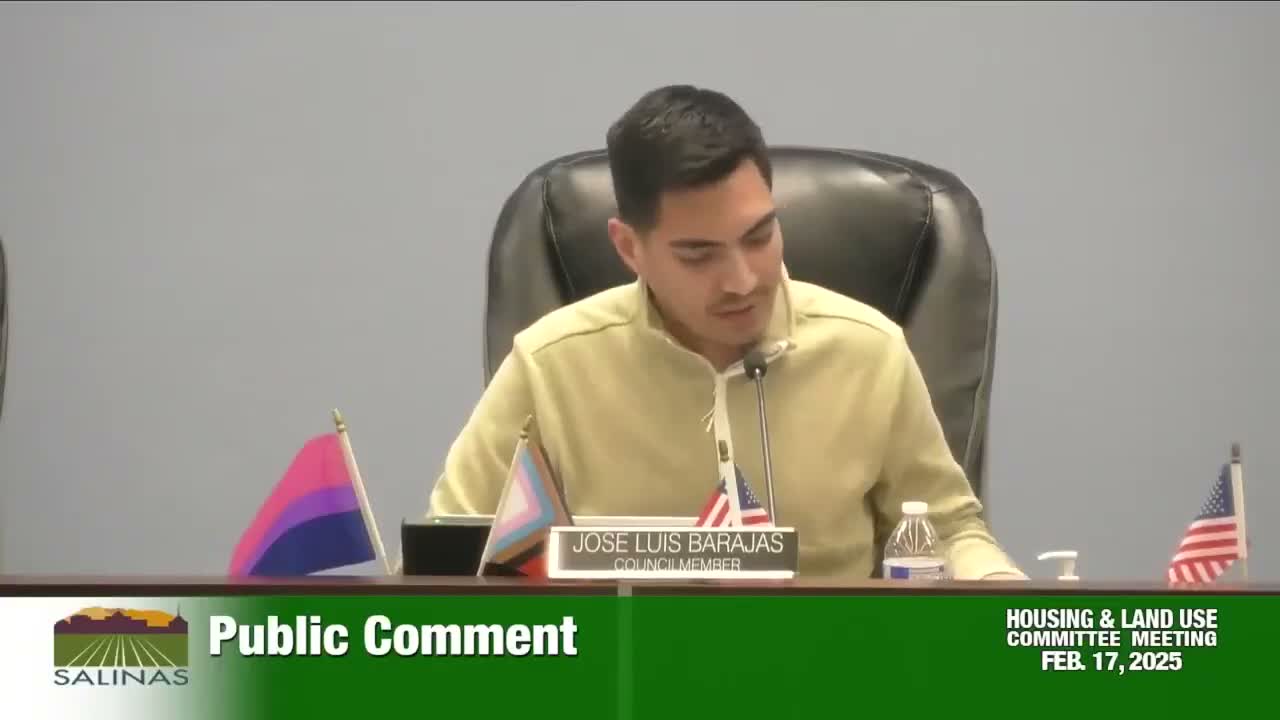
At a meeting of the Salinas Housing and Land Use Committee, city staff presented predevelopment plans for multiple properties on Soledad Street in Chinatown, including design concepts, funding approaches and emergency stabilization work for the Republic Cafe. The committee did not take formal votes because it lacked a quorum; the minutes from the Jan. 20, 2026 meeting were continued to the March meeting.
Mr. Leonard, who led the presentation, outlined the project goals and site consolidation for 34–40 Soledad, 37–39 Soledad and 45 Soledad Street. He said the work is intended to reduce risk for private and nonprofit developers by assembling land, completing environmental studies, producing plans and moving sites toward entitlement. “We were successful in applying for and receiving approximately 1 and a half million dollars in funding to do predevelopment work,” he said, referring to a 2024 regional early action planning grant and the selection of TEF Design and Architecture for design and entitlement services.
Staff described the sites in detail. 34 and 36 were one-story commercial buildings (one formerly the PI Market) that were demolished after a fire; 38 (the Ayers Pool Hall) was a two-story historic-eligible building later lost to fire in 2025; 40 is a former gas station. The addresses are combined into one parcel on the west side of Soledad Street. 45 Soledad was demolished after a 2017 fire. Mr. Leonard said the city’s aims include restoring the Republic Cafe as a cultural asset and creating mixed-use, affordable housing with a variety of unit sizes and ground-floor commercial space.
Design work emphasizes contextual architecture and public art. Staff said TEF reviewed 5–6 story mixed-use precedents and is considering Spanish-vernacular elements (clay-tile awnings, exposed wood brackets and sidewalk-level tile work) alongside Asian-influenced features such as a moon-gate entry motif and sunshades. Mr. Leonard said the design seeks to avoid an overly stylized “Chinatown Disneyland effect” by balancing historic details at street level with more contemporary massing above.
The Republic Cafe (part of 37–39 Soledad) is nationally listed on the National Register of Historic Places (listed since 2011), staff said. The city described a two-part effort for that site: emergency stabilization to prevent further loss (front façade stabilization, repair of 2022 fire damage, installation of fire suppression, weatherproofing and minor seismic work) and later full rehabilitation with restored tile work and the potential reuse of salvaged railings and signage. Staff also described interior programming options including a ground-floor museum or cultural space, a ballroom mezzanine for gatherings or classrooms, archive/storage on an upper mezzanine and an historic single-family apartment associated with the Atai family that the city plans to rehab as an affordable unit.
On partnerships and occupancy, Mr. Leonard said the city is working with the Asian cultural experience of Salinas (referred to in the presentation as ACES/Museum) on museum programming for part of 37 Soledad; lease terms and management details remain to be determined. For 37–39 Soledad, staff said the project is currently envisioned as a city-led effort with future lease agreements to be negotiated with cultural tenants.
Staff outlined funding expectations: 34–40 and 45 are being designed to meet federal/state tax-credit standards and are expected to rely primarily on tax-credit financing. The Republic Cafe and Lotus Inn (37–39) were described as likely to use a blended mix of funding sources, including community development block grants, federal entitlement funds, HOME funds, local housing allocation, historic tax credits and other grant opportunities.
Cost and timeline: Mr. Leonard said planning submissions and resubmissions are underway; 45 Soledad will be prepared for planning review and 34–40 has been submitted for initial review and will be revised as departments provide comments. He gave a rough cost estimate of about $5 million for the rehabilitation/stabilization scope discussed, with roughly $3 million for rehabilitation and $2 million for emergency stabilization. On site activation and public-safety concerns, Mr. Leonard said outreach through Salinas’ outreach team, potential relocation of service providers and physical interventions (including fence-line improvements with Union Pacific) are part of the strategy to reduce risks related to vacant buildings. “So the sooner we can have these sites activated, occupied, people coming in and out, eyes on the street, the better it will be overall,” he said.
No members of the public commented on the item. With no quorum, the committee did not vote on any items; the Jan. 20, 2026 minutes were continued to March and the meeting was adjourned at 4:05 p.m.
Mr. Leonard, who led the presentation, outlined the project goals and site consolidation for 34–40 Soledad, 37–39 Soledad and 45 Soledad Street. He said the work is intended to reduce risk for private and nonprofit developers by assembling land, completing environmental studies, producing plans and moving sites toward entitlement. “We were successful in applying for and receiving approximately 1 and a half million dollars in funding to do predevelopment work,” he said, referring to a 2024 regional early action planning grant and the selection of TEF Design and Architecture for design and entitlement services.
Staff described the sites in detail. 34 and 36 were one-story commercial buildings (one formerly the PI Market) that were demolished after a fire; 38 (the Ayers Pool Hall) was a two-story historic-eligible building later lost to fire in 2025; 40 is a former gas station. The addresses are combined into one parcel on the west side of Soledad Street. 45 Soledad was demolished after a 2017 fire. Mr. Leonard said the city’s aims include restoring the Republic Cafe as a cultural asset and creating mixed-use, affordable housing with a variety of unit sizes and ground-floor commercial space.
Design work emphasizes contextual architecture and public art. Staff said TEF reviewed 5–6 story mixed-use precedents and is considering Spanish-vernacular elements (clay-tile awnings, exposed wood brackets and sidewalk-level tile work) alongside Asian-influenced features such as a moon-gate entry motif and sunshades. Mr. Leonard said the design seeks to avoid an overly stylized “Chinatown Disneyland effect” by balancing historic details at street level with more contemporary massing above.
The Republic Cafe (part of 37–39 Soledad) is nationally listed on the National Register of Historic Places (listed since 2011), staff said. The city described a two-part effort for that site: emergency stabilization to prevent further loss (front façade stabilization, repair of 2022 fire damage, installation of fire suppression, weatherproofing and minor seismic work) and later full rehabilitation with restored tile work and the potential reuse of salvaged railings and signage. Staff also described interior programming options including a ground-floor museum or cultural space, a ballroom mezzanine for gatherings or classrooms, archive/storage on an upper mezzanine and an historic single-family apartment associated with the Atai family that the city plans to rehab as an affordable unit.
On partnerships and occupancy, Mr. Leonard said the city is working with the Asian cultural experience of Salinas (referred to in the presentation as ACES/Museum) on museum programming for part of 37 Soledad; lease terms and management details remain to be determined. For 37–39 Soledad, staff said the project is currently envisioned as a city-led effort with future lease agreements to be negotiated with cultural tenants.
Staff outlined funding expectations: 34–40 and 45 are being designed to meet federal/state tax-credit standards and are expected to rely primarily on tax-credit financing. The Republic Cafe and Lotus Inn (37–39) were described as likely to use a blended mix of funding sources, including community development block grants, federal entitlement funds, HOME funds, local housing allocation, historic tax credits and other grant opportunities.
Cost and timeline: Mr. Leonard said planning submissions and resubmissions are underway; 45 Soledad will be prepared for planning review and 34–40 has been submitted for initial review and will be revised as departments provide comments. He gave a rough cost estimate of about $5 million for the rehabilitation/stabilization scope discussed, with roughly $3 million for rehabilitation and $2 million for emergency stabilization. On site activation and public-safety concerns, Mr. Leonard said outreach through Salinas’ outreach team, potential relocation of service providers and physical interventions (including fence-line improvements with Union Pacific) are part of the strategy to reduce risks related to vacant buildings. “So the sooner we can have these sites activated, occupied, people coming in and out, eyes on the street, the better it will be overall,” he said.
No members of the public commented on the item. With no quorum, the committee did not vote on any items; the Jan. 20, 2026 minutes were continued to March and the meeting was adjourned at 4:05 p.m.
Don't Miss a Word: See the Full Meeting!
Go beyond summaries. Unlock every video, transcript, and key insight with a Founder Membership.
✓
Get instant access to full meeting videos
✓
Search and clip any phrase from complete transcripts
✓
Receive AI-powered summaries & custom alerts
✓
Enjoy lifetime, unrestricted access to government data
30-day money-back guarantee
