Fairview zoning overhaul: board debates map, buffers and density; first reading deferred 30 days
February 23, 2026 | Fairview, Williamson County, Tennessee
This article was created by AI summarizing key points discussed. AI makes mistakes, so for full details and context, please refer to the video of the full meeting. Please report any errors so we can fix them. Report an error »
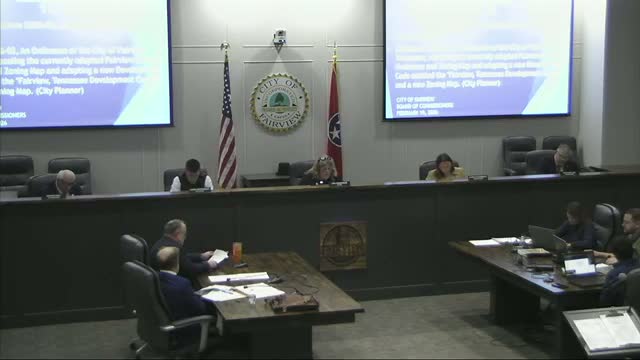
The Fairview Board of Commissioners spent the bulk of its Feb. 19 meeting on the first reading of a comprehensive new zoning ordinance prepared with Town Planning and Urban Design Collaborative (TPUDC). Staff stressed the meeting was a first reading only: a yes vote would move the draft forward for a second public hearing and a second reading but would not adopt the code.
Tom Greer and TPUDC representatives Bill Wright and Anna Blevins walked the board through the timeline of public engagement and a packet of Planning Commission recommendations. The planning panel submitted nine suggested changes, including a requirement that the 25-foot strip adjacent to parks remain undisturbed within a 50-foot buffer for developments that abut Bowie Nature Park, traffic-study thresholds tied to subdivisions of 30 or more homes in some cases, and revised steep-slope disturbance percentages.
A contentious discussion focused on a large privately owned parcel (identified by staff as tax map 46, parcel 08700, often described in the meeting as the Sullivan property). Commissioners and TPUDC debated whether the matrix and map should designate the parcel as CD4C (allowing up to 16 units per acre) or CD4 (6 units per acre). Staff said the matrix originally mapped the parcel to CD4C and the property owner raised a color/matrix inconsistency; the mayor noted part of the parcel had been sold to Williamson County for an elementary school and argued higher-density housing near a school could provide more affordable, “income aligned” housing for teachers and first-time buyers.
Vice Mayor McDonald moved to amend the zoning map to change that parcel from CD4C to CD4. After a second, the motion passed 4–1 (Mayor Anderson opposed). Later, after reviewing multiple recommended amendments and saying more public review was warranted, the board voted 5–0 to defer further action for 30 days so staff can compile detailed amendments and schedule a work session.
Board members debated whether proposed buffers should cover “all parks” or be limited to specific larger parks after TPUDC warned a blanket “all parks” rule could force impractical buffers around pocket parks. Commissioners asked staff to prepare clearer language and to circulate an explicit list of recommended amendments before the next meeting. The March 5 public hearing remains advertised; the first-reading item will return for resume and possible second reading after the work session and staff updates.
What happens next: Staff will compile the Planning Commission items and proposed amendments into a distributed packet, schedule a public work session (staff suggested a weekday morning to allow extended discussion) and bring the ordinance back to the board in roughly 30 days for resumed first-reading debate and a potential second reading thereafter.
Tom Greer and TPUDC representatives Bill Wright and Anna Blevins walked the board through the timeline of public engagement and a packet of Planning Commission recommendations. The planning panel submitted nine suggested changes, including a requirement that the 25-foot strip adjacent to parks remain undisturbed within a 50-foot buffer for developments that abut Bowie Nature Park, traffic-study thresholds tied to subdivisions of 30 or more homes in some cases, and revised steep-slope disturbance percentages.
A contentious discussion focused on a large privately owned parcel (identified by staff as tax map 46, parcel 08700, often described in the meeting as the Sullivan property). Commissioners and TPUDC debated whether the matrix and map should designate the parcel as CD4C (allowing up to 16 units per acre) or CD4 (6 units per acre). Staff said the matrix originally mapped the parcel to CD4C and the property owner raised a color/matrix inconsistency; the mayor noted part of the parcel had been sold to Williamson County for an elementary school and argued higher-density housing near a school could provide more affordable, “income aligned” housing for teachers and first-time buyers.
Vice Mayor McDonald moved to amend the zoning map to change that parcel from CD4C to CD4. After a second, the motion passed 4–1 (Mayor Anderson opposed). Later, after reviewing multiple recommended amendments and saying more public review was warranted, the board voted 5–0 to defer further action for 30 days so staff can compile detailed amendments and schedule a work session.
Board members debated whether proposed buffers should cover “all parks” or be limited to specific larger parks after TPUDC warned a blanket “all parks” rule could force impractical buffers around pocket parks. Commissioners asked staff to prepare clearer language and to circulate an explicit list of recommended amendments before the next meeting. The March 5 public hearing remains advertised; the first-reading item will return for resume and possible second reading after the work session and staff updates.
What happens next: Staff will compile the Planning Commission items and proposed amendments into a distributed packet, schedule a public work session (staff suggested a weekday morning to allow extended discussion) and bring the ordinance back to the board in roughly 30 days for resumed first-reading debate and a potential second reading thereafter.
View the Full Meeting & All Its Details
This article offers just a summary. Unlock complete video, transcripts, and insights as a Founder Member.
✓
Watch full, unedited meeting videos
✓
Search every word spoken in unlimited transcripts
✓
AI summaries & real-time alerts (all government levels)
✓
Permanent access to expanding government content
30-day money-back guarantee
