City transit changes and council bills; board members raise concerns about TOD quality
February 14, 2026 | Honolulu County, Hawaii
This article was created by AI summarizing key points discussed. AI makes mistakes, so for full details and context, please refer to the video of the full meeting. Please report any errors so we can fix them. Report an error »
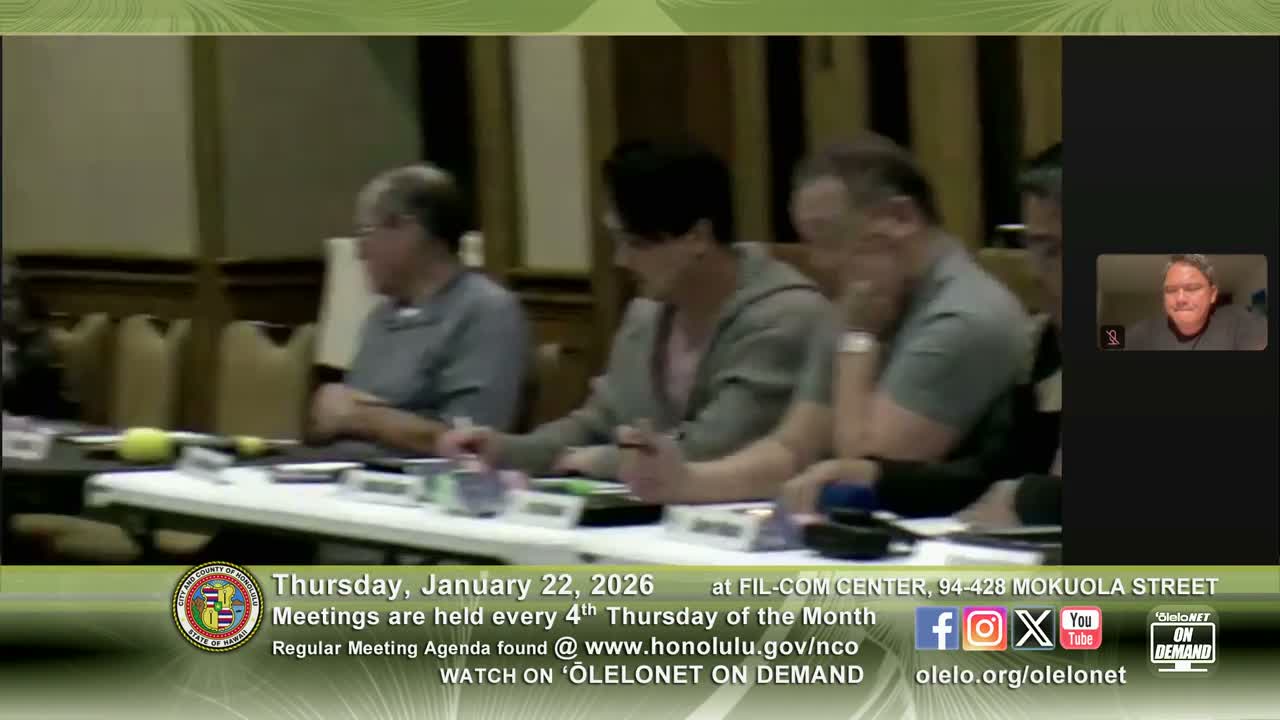
City and council representatives briefed the Waipahu Neighborhood Board on transit service changes, citywide administrative updates and several council bills; board members pressed city officials on the quality of transit-oriented development in Waipahu.
Roger Babcock (Department of Environmental Services) summarized mayor’s newsletter items and described the city’s launch of an updated HNL 311 mobile app and website (launched Dec. 1) to report and track service requests. He also relayed a DTS decision to modify the U‑Line bus that connects the Skyline to University of Hawai‘i transfers: effective Sunday, March 1, 2026, the U‑Line will operate every 40 minutes instead of 60, with routing unchanged. DTS will analyze transfer travel times to evaluate impacts on student ridership.
Representatives from council offices outlined recent and pending bills, including measures on budget reporting and transparency (Bill 64 2025; Bill 65 2025), HPD public-information requirements (Bill 46 2025), taxicab regulation (Bill 42 2025) and proposed updates to fare structure and rental-housing programs (Bill 54; Bill 55; Bill 63). Pua Smith Kauhane (Council Member Okimoto’s office) also reviewed a traffic-calming investigation that recommended speed-feedback trailers and additional HPD monitoring.
Board member Richard Oshiro criticized early Waipahu TOD projects that, he said, override TOD height limits and convert low-density retail into 18–19 story towers with small units and low-wage jobs. He urged city officials and elected representatives to prioritize quality control and the community impact of redevelopment along the rail corridor.
Council representatives said they would follow up on constituent issues such as overgrowth and private-property trash; the meeting record shows several offices offered to track constituent requests and return with updates.
Roger Babcock (Department of Environmental Services) summarized mayor’s newsletter items and described the city’s launch of an updated HNL 311 mobile app and website (launched Dec. 1) to report and track service requests. He also relayed a DTS decision to modify the U‑Line bus that connects the Skyline to University of Hawai‘i transfers: effective Sunday, March 1, 2026, the U‑Line will operate every 40 minutes instead of 60, with routing unchanged. DTS will analyze transfer travel times to evaluate impacts on student ridership.
Representatives from council offices outlined recent and pending bills, including measures on budget reporting and transparency (Bill 64 2025; Bill 65 2025), HPD public-information requirements (Bill 46 2025), taxicab regulation (Bill 42 2025) and proposed updates to fare structure and rental-housing programs (Bill 54; Bill 55; Bill 63). Pua Smith Kauhane (Council Member Okimoto’s office) also reviewed a traffic-calming investigation that recommended speed-feedback trailers and additional HPD monitoring.
Board member Richard Oshiro criticized early Waipahu TOD projects that, he said, override TOD height limits and convert low-density retail into 18–19 story towers with small units and low-wage jobs. He urged city officials and elected representatives to prioritize quality control and the community impact of redevelopment along the rail corridor.
Council representatives said they would follow up on constituent issues such as overgrowth and private-property trash; the meeting record shows several offices offered to track constituent requests and return with updates.
Don't Miss a Word: See the Full Meeting!
Go beyond summaries. Unlock every video, transcript, and key insight with a Founder Membership.
✓
Get instant access to full meeting videos
✓
Search and clip any phrase from complete transcripts
✓
Receive AI-powered summaries & custom alerts
✓
Enjoy lifetime, unrestricted access to government data
30-day money-back guarantee
