House reads dozens of bills across education, agriculture, veterans and audits; most referred to committee
February 16, 2026 | 2026 House of Representatives, Legislative, Iowa
This article was created by AI summarizing key points discussed. AI makes mistakes, so for full details and context, please refer to the video of the full meeting. Please report any errors so we can fix them. Report an error »
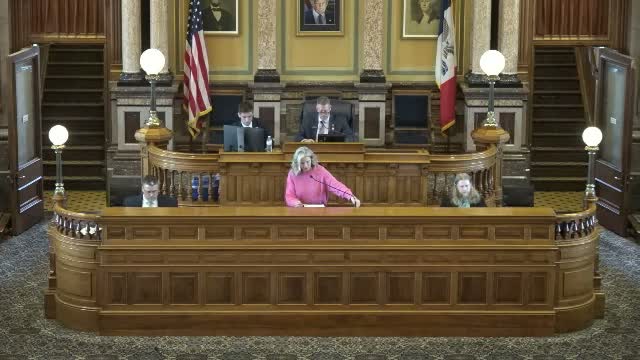
On President's Day the 2026 House of Representatives opened with prayer and then proceeded to a prolonged series of first readings and introductions of bills and joint resolutions covering a wide range of policy areas.
The clerk read sponsors and short titles for measures that the chamber classified as "first reading." Notable items announced on the floor included a joint resolution proposing a constitutional amendment related to term limits (sponsored by Gilhert Gil Gearhart), multiple measures addressing public retirement system provisions (sponsored by Bagneski), bills on nonpublic school transportation claims and related appropriations, and several education-related proposals (including bills to modify the Teach Iowa scholar program and to establish preschool-related funding and eligibility changes). Agriculture-related bills were read concerning manure management and food sales and distribution. Other first-read measures included bills about wind energy conversion facilities, data centers and energy reporting, and new pilots for computer-science instruction.
Several bills were explicitly referred to standing committees by the presiding officer as part of routine procedure: education, commerce, natural resources, appropriations, state government, veterans affairs, and health and human services were among committees named on the floor.
The House recorded the journal as approved earlier in the session and otherwise took no final votes on any of the many measures introduced; first readings establish committee referral and begin the formal process rather than enact policy.
What happens next: most of the measures announced will proceed to committee hearings where members and staff may solicit testimony, draft amendments and decide whether to forward the bills for further floor action.
The clerk read sponsors and short titles for measures that the chamber classified as "first reading." Notable items announced on the floor included a joint resolution proposing a constitutional amendment related to term limits (sponsored by Gilhert Gil Gearhart), multiple measures addressing public retirement system provisions (sponsored by Bagneski), bills on nonpublic school transportation claims and related appropriations, and several education-related proposals (including bills to modify the Teach Iowa scholar program and to establish preschool-related funding and eligibility changes). Agriculture-related bills were read concerning manure management and food sales and distribution. Other first-read measures included bills about wind energy conversion facilities, data centers and energy reporting, and new pilots for computer-science instruction.
Several bills were explicitly referred to standing committees by the presiding officer as part of routine procedure: education, commerce, natural resources, appropriations, state government, veterans affairs, and health and human services were among committees named on the floor.
The House recorded the journal as approved earlier in the session and otherwise took no final votes on any of the many measures introduced; first readings establish committee referral and begin the formal process rather than enact policy.
What happens next: most of the measures announced will proceed to committee hearings where members and staff may solicit testimony, draft amendments and decide whether to forward the bills for further floor action.
View the Full Meeting & All Its Details
This article offers just a summary. Unlock complete video, transcripts, and insights as a Founder Member.
✓
Watch full, unedited meeting videos
✓
Search every word spoken in unlimited transcripts
✓
AI summaries & real-time alerts (all government levels)
✓
Permanent access to expanding government content
30-day money-back guarantee
