WJCC superintendent outlines FY27 budget, warns of $1.92M gap and seeks $1.9M above baseline
February 07, 2026 | Williamsburg City, James City County, Virginia
This article was created by AI summarizing key points discussed. AI makes mistakes, so for full details and context, please refer to the video of the full meeting. Please report any errors so we can fix them. Report an error »
Dr. Kiefer, superintendent of Williamsburg–James City County Schools, presented the division's proposed fiscal year 2027 budget at a joint meeting in Williamsburg, saying the plan prioritizes staff compensation, student supports and long‑term stability.
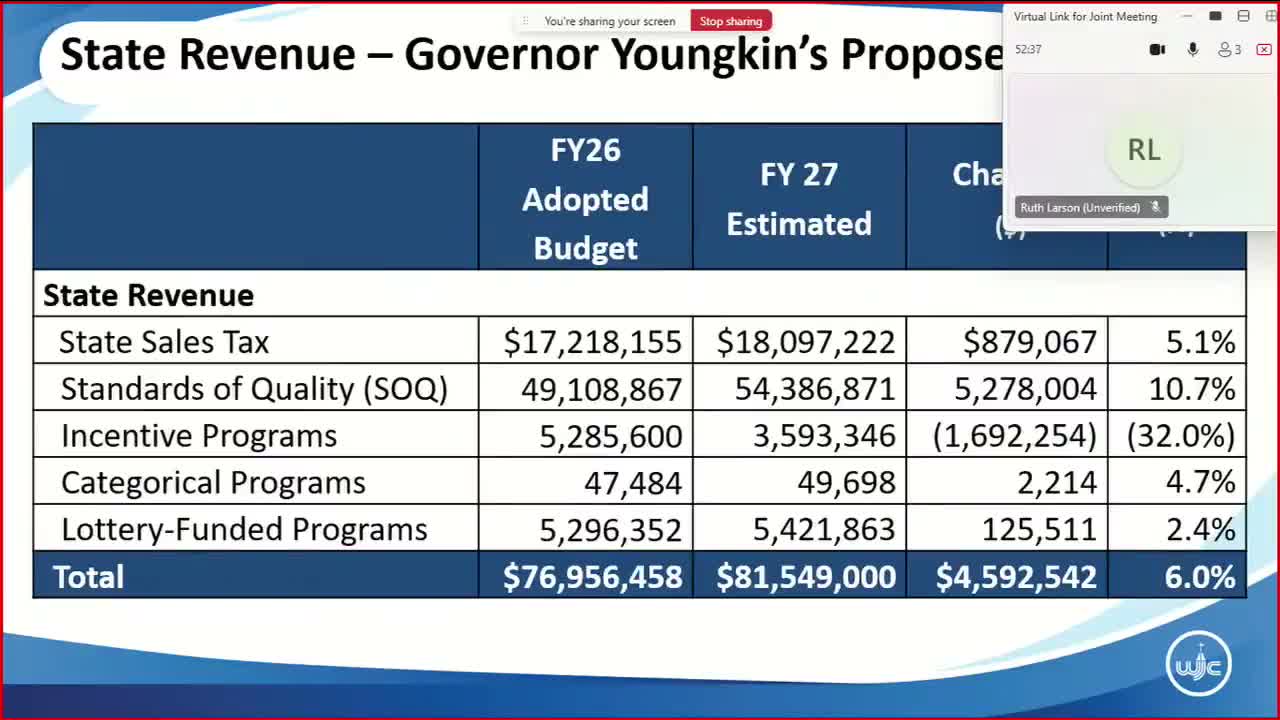
The superintendent told the assembled City Council, Board of Supervisors and school board that the proposal assumes about $4.6 million in additional state revenue based on Governor Youngkin's proposed budget and $6.0 million from the joint local funding agreement, producing approximately $10.6 million in new revenue. Expenditure needs total roughly $12.6 million, leaving an estimated gap of about $1,920,000 that could prompt an above‑baseline request to the localities.
"This proposed budget is not, from my perspective, numbers on a page," Dr. Kiefer said. "It's about creating the conditions for students to learn, for students to belong, and for students to thrive." He framed the package as a budget of need that emphasizes human capital and alignment with the Elevate '28 strategic plan.
Why it matters: The administration said the largest single investment is in compensation. The plan layers a 2% state‑funded raise with additional dollars from a district compensation study (Bolton), yielding an average increase on the bachelor teacher scale of roughly 4.3% with ranges across steps. District leaders said full implementation of Bolton's remaining recommendations is estimated at $6.8 million over two additional years (approximately $3.4 million per year).
Key numbers and proposals: The division reported a cohort of 985 students in 2025, an FGI (federal graduation indicator) of 91.2% and a CCR (cohort completion rate) of 96.9. Superintendent and staff cited workforce pressures: roughly 137 teachers departed the division last year out of about 995 total employees, with almost half of departures occurring within the first 10 years of service — a central justification for the retention focus in the budget.
Other budget components called out by administration include:
- A projected 16% renewal increase for health insurance, which the division's consultant estimated could add about $2.7 million under a 70/30 cost‑sharing scenario (with about $2.0 million affecting the operating fund).
- A placeholder of $380,000 to address stipend competitiveness across sports, clubs and department leads.
- Transitioning several positions from federal grant funding into the operating budget, including special‑education teachers and speech‑language pathologists.
- Restoring seven bus‑driver FTEs removed the prior year after staffing shortages; those positions were temporary this year and are being returned to the operating budget for FY27.
Programs and one‑time items: The presentation also lists programmatic investments — for example, a $250,000 math innovation grant and a $60,000 middle‑school math acceleration grant already awarded to the division — and potential new items that could be included in an above‑baseline request if additional state/local revenue is available (special‑education related services, additional staffing, and program expansions).
Open questions and next steps: Board members pressed for measurable outcomes to show the return on compensation investments, and Dr. Kiefer pointed to graduation and reading metrics, exhibitions of student learning and a public data dashboard aligned to the division's KPIs. The administration said it will continue to refine the above‑baseline request as the General Assembly budget process clarifies state funding; Dr. Kiefer expressed hope for firmer numbers in the coming weeks.
The joint bodies did not take a formal vote on budget requests during the session; the presentation was provided for review and discussion, and the district indicated it will return with follow‑up reports and recommendations.
The superintendent told the assembled City Council, Board of Supervisors and school board that the proposal assumes about $4.6 million in additional state revenue based on Governor Youngkin's proposed budget and $6.0 million from the joint local funding agreement, producing approximately $10.6 million in new revenue. Expenditure needs total roughly $12.6 million, leaving an estimated gap of about $1,920,000 that could prompt an above‑baseline request to the localities.
"This proposed budget is not, from my perspective, numbers on a page," Dr. Kiefer said. "It's about creating the conditions for students to learn, for students to belong, and for students to thrive." He framed the package as a budget of need that emphasizes human capital and alignment with the Elevate '28 strategic plan.
Why it matters: The administration said the largest single investment is in compensation. The plan layers a 2% state‑funded raise with additional dollars from a district compensation study (Bolton), yielding an average increase on the bachelor teacher scale of roughly 4.3% with ranges across steps. District leaders said full implementation of Bolton's remaining recommendations is estimated at $6.8 million over two additional years (approximately $3.4 million per year).
Key numbers and proposals: The division reported a cohort of 985 students in 2025, an FGI (federal graduation indicator) of 91.2% and a CCR (cohort completion rate) of 96.9. Superintendent and staff cited workforce pressures: roughly 137 teachers departed the division last year out of about 995 total employees, with almost half of departures occurring within the first 10 years of service — a central justification for the retention focus in the budget.
Other budget components called out by administration include:
- A projected 16% renewal increase for health insurance, which the division's consultant estimated could add about $2.7 million under a 70/30 cost‑sharing scenario (with about $2.0 million affecting the operating fund).
- A placeholder of $380,000 to address stipend competitiveness across sports, clubs and department leads.
- Transitioning several positions from federal grant funding into the operating budget, including special‑education teachers and speech‑language pathologists.
- Restoring seven bus‑driver FTEs removed the prior year after staffing shortages; those positions were temporary this year and are being returned to the operating budget for FY27.
Programs and one‑time items: The presentation also lists programmatic investments — for example, a $250,000 math innovation grant and a $60,000 middle‑school math acceleration grant already awarded to the division — and potential new items that could be included in an above‑baseline request if additional state/local revenue is available (special‑education related services, additional staffing, and program expansions).
Open questions and next steps: Board members pressed for measurable outcomes to show the return on compensation investments, and Dr. Kiefer pointed to graduation and reading metrics, exhibitions of student learning and a public data dashboard aligned to the division's KPIs. The administration said it will continue to refine the above‑baseline request as the General Assembly budget process clarifies state funding; Dr. Kiefer expressed hope for firmer numbers in the coming weeks.
The joint bodies did not take a formal vote on budget requests during the session; the presentation was provided for review and discussion, and the district indicated it will return with follow‑up reports and recommendations.
View the Full Meeting & All Its Details
This article offers just a summary. Unlock complete video, transcripts, and insights as a Founder Member.
✓
Watch full, unedited meeting videos
✓
Search every word spoken in unlimited transcripts
✓
AI summaries & real-time alerts (all government levels)
✓
Permanent access to expanding government content
30-day money-back guarantee
