Butte County officials recount Camp Fire lessons: evacuation failures, long recovery and need for permitting and biomass solutions
May 31, 2024 | Nevada County, California
This article was created by AI summarizing key points discussed. AI makes mistakes, so for full details and context, please refer to the video of the full meeting. Please report any errors so we can fix them. Report an error »
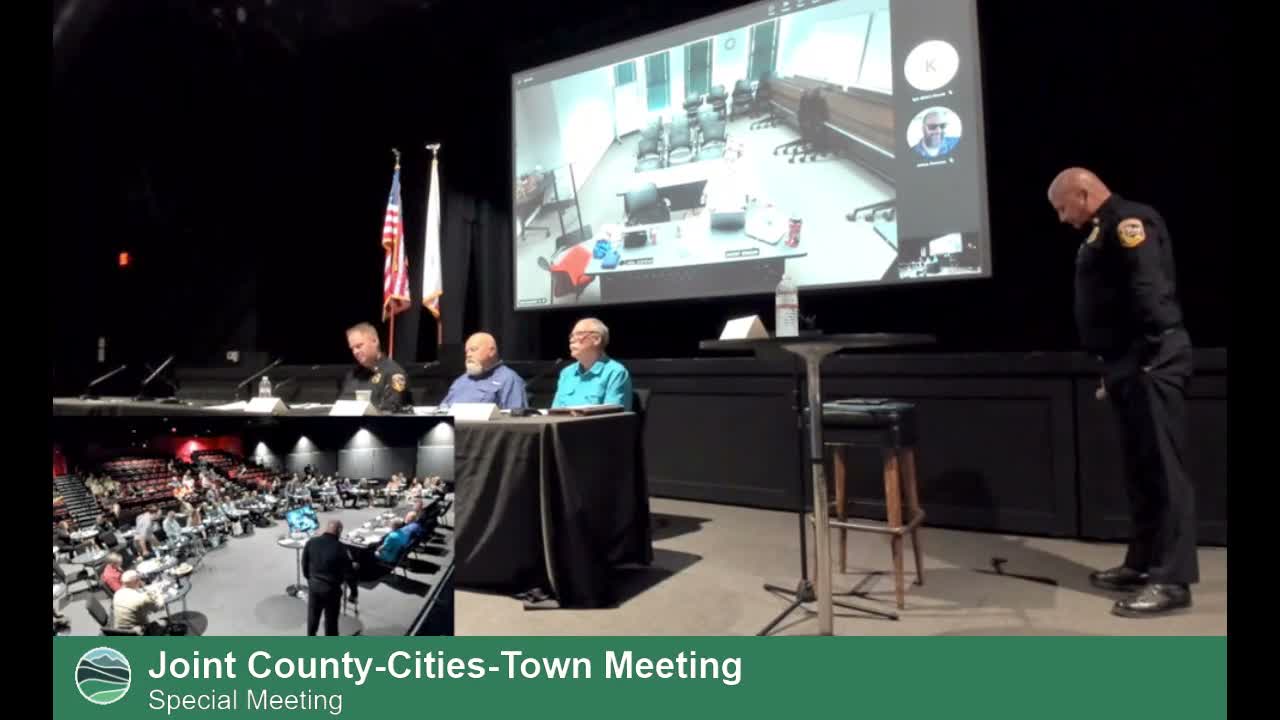
Guest officials from Butte County and Paradise described post‑Camp Fire lessons and recovery challenges to Nevada County officials, underscoring the long fiscal and social tail of catastrophic wildfire.
Steve Crowder, Paradise council member, recounted the operational failures witnessed during the Camp Fire: communications outages, overwhelmed evacuation routes and the consequences of dead‑end streets and blocked egress. "We had 50,000 people trying to go down Skyway," Crowder said, describing how the scale of evacuations can overwhelm on‑the‑ground plans.
Bill Conley (Butte County board chair) and others outlined resilience measures adopted after the fires: redundant, localized alerting strategies (battery FM radios and sirens in rural pockets), lists for vulnerable residents to ensure direct outreach, and a collaborative mapping process to align Fire Safe Councils’ projects and avoid competing for the same grants. Conley urged investment in maintenance programs for treated fuel breaks, warning that vegetation regrowth without sustained maintenance will recreate hazards.
Panelists said recovery is both resource‑intensive and slow. Officials described protracted debris‑removal and infrastructure damage timelines, difficulties with temporary on‑site housing, and complications when insurance coverage or FEMA reimbursement criteria do not match locals’ needs.
Several guests and elected officials argued CEQA and NEPA reviews are a practical barrier to timely vegetation work and post‑fire maintenance. Cal FIRE and local chiefs acknowledged the regulatory challenge and said agencies are pursuing countywide approaches and aggregated CEQA clearance where feasible, while urging state and federal partners for more streamlined pathways.
Speakers also raised the problem of what to do with large volumes of cleared biomass. Officials said controlled burns are not always viable; permitting, economic feasibility and air‑quality constraints limit the viability of biomass facilities, which leaves disposal as a barrier to scaling fuel‑reduction projects.
Nonprofit recovery partners at the meeting urged officials to plan for long‑term recovery now. Nora Esders of Connecting Point described active FEMA-funded case management for survivors and asked local governments to build enduring local recovery capacity rather than rely solely on disaster declarations.
Butte County speakers closed with a practical admonition: prevention and maintenance are as vital as initial response. They urged Nevada County officials to pair project funding with maintenance plans, to prepare for long recovery timelines and to use regional coordination to make legislative requests more effective.
No formal motions were made; the account was presented to inform Nevada County’s next steps on evacuation, vegetation management, green‑waste handling and recovery planning.
Steve Crowder, Paradise council member, recounted the operational failures witnessed during the Camp Fire: communications outages, overwhelmed evacuation routes and the consequences of dead‑end streets and blocked egress. "We had 50,000 people trying to go down Skyway," Crowder said, describing how the scale of evacuations can overwhelm on‑the‑ground plans.
Bill Conley (Butte County board chair) and others outlined resilience measures adopted after the fires: redundant, localized alerting strategies (battery FM radios and sirens in rural pockets), lists for vulnerable residents to ensure direct outreach, and a collaborative mapping process to align Fire Safe Councils’ projects and avoid competing for the same grants. Conley urged investment in maintenance programs for treated fuel breaks, warning that vegetation regrowth without sustained maintenance will recreate hazards.
Panelists said recovery is both resource‑intensive and slow. Officials described protracted debris‑removal and infrastructure damage timelines, difficulties with temporary on‑site housing, and complications when insurance coverage or FEMA reimbursement criteria do not match locals’ needs.
Several guests and elected officials argued CEQA and NEPA reviews are a practical barrier to timely vegetation work and post‑fire maintenance. Cal FIRE and local chiefs acknowledged the regulatory challenge and said agencies are pursuing countywide approaches and aggregated CEQA clearance where feasible, while urging state and federal partners for more streamlined pathways.
Speakers also raised the problem of what to do with large volumes of cleared biomass. Officials said controlled burns are not always viable; permitting, economic feasibility and air‑quality constraints limit the viability of biomass facilities, which leaves disposal as a barrier to scaling fuel‑reduction projects.
Nonprofit recovery partners at the meeting urged officials to plan for long‑term recovery now. Nora Esders of Connecting Point described active FEMA-funded case management for survivors and asked local governments to build enduring local recovery capacity rather than rely solely on disaster declarations.
Butte County speakers closed with a practical admonition: prevention and maintenance are as vital as initial response. They urged Nevada County officials to pair project funding with maintenance plans, to prepare for long recovery timelines and to use regional coordination to make legislative requests more effective.
No formal motions were made; the account was presented to inform Nevada County’s next steps on evacuation, vegetation management, green‑waste handling and recovery planning.
Don't Miss a Word: See the Full Meeting!
Go beyond summaries. Unlock every video, transcript, and key insight with a Founder Membership.
✓
Get instant access to full meeting videos
✓
Search and clip any phrase from complete transcripts
✓
Receive AI-powered summaries & custom alerts
✓
Enjoy lifetime, unrestricted access to government data
30-day money-back guarantee
