Board authorizes ballots, sets $130 annual parcel charge for proposed North San Juan fire suppression district
May 14, 2024 | Nevada County, California
This article was created by AI summarizing key points discussed. AI makes mistakes, so for full details and context, please refer to the video of the full meeting. Please report any errors so we can fix them. Report an error »
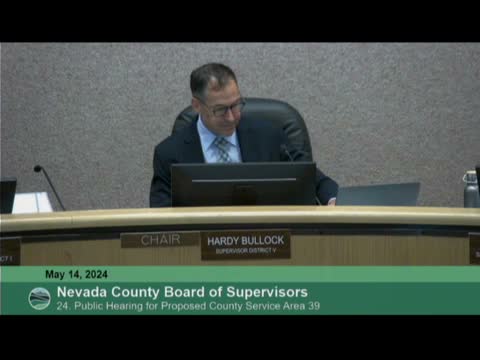
Nevada County supervisors on May 14 authorized mailing ballots to property owners to form County Service Area 39, a proposed maintenance district to fund a community fire suppression system in North San Juan. County staff said the ballot measure is the district step needed before the county can secure construction funding for a system that would add a water storage tank, roughly 4,200 feet of 12‑inch water main, a supply well and about 10 fire hydrants serving the downtown area.
Pat Perkins, a principal engineer with Public Works, told the board the project would make hydrants and fire flows available where none exist now, easing an economic barrier for local buildings that otherwise must install internal suppression systems. Michelle Garcia, the county project manager, said design is about 60–75% complete and that the tank sizing follows California Fire Code requirements tied to the largest building in the area. She said the zone of benefit includes parcels within about 1,000 feet of proposed hydrants; the assessment roll lists 142 parcels and staff proposed a maintenance fee of about $130 per parcel per year to cover operations and maintenance.
Perkins and Garcia described CEQA work already completed (an adopted mitigated negative declaration) and mitigation steps including one year of groundwater monitoring tied to tank filling, with provisions to pause filling if groundwater drops by more than one foot from historical levels. County staff also said they had worked with LAFCO and received a conditional approval contingent on at least 51% support from returned ballots; the county will open ballots publicly on July 9 and report results to the board.
Public commenters, including North San Juan business and property owners, largely supported the project as a way to protect historic downtown buildings and improve wildfire resilience, though speakers asked whether the presence of hydrants would reliably lower insurance rates. Project engineers and a deputy fire chief said hydrants and measured water supply are factors ISO and insurers consider but noted there is no guarantee of uniform rate reductions because private insurers use differing methodologies.
Supervisor comments emphasized the next steps: ballots to property owners within the zone, public outreach before ballots are mailed, and continued coordination with LAFCO and funding partners. The board voted to approve the resolution authorizing ballots, scheduling the ballot opening for July 9, and establishing the proposed parcel charge for the CSA. The measure will advance only if a majority of returned ballots supports formation and the assessment.
If the ballot fails, staff said the project would be paused and county staff would explore alternative maintenance‑funding mechanisms or put the project on hold until a maintenance entity can be formed.
Pat Perkins, a principal engineer with Public Works, told the board the project would make hydrants and fire flows available where none exist now, easing an economic barrier for local buildings that otherwise must install internal suppression systems. Michelle Garcia, the county project manager, said design is about 60–75% complete and that the tank sizing follows California Fire Code requirements tied to the largest building in the area. She said the zone of benefit includes parcels within about 1,000 feet of proposed hydrants; the assessment roll lists 142 parcels and staff proposed a maintenance fee of about $130 per parcel per year to cover operations and maintenance.
Perkins and Garcia described CEQA work already completed (an adopted mitigated negative declaration) and mitigation steps including one year of groundwater monitoring tied to tank filling, with provisions to pause filling if groundwater drops by more than one foot from historical levels. County staff also said they had worked with LAFCO and received a conditional approval contingent on at least 51% support from returned ballots; the county will open ballots publicly on July 9 and report results to the board.
Public commenters, including North San Juan business and property owners, largely supported the project as a way to protect historic downtown buildings and improve wildfire resilience, though speakers asked whether the presence of hydrants would reliably lower insurance rates. Project engineers and a deputy fire chief said hydrants and measured water supply are factors ISO and insurers consider but noted there is no guarantee of uniform rate reductions because private insurers use differing methodologies.
Supervisor comments emphasized the next steps: ballots to property owners within the zone, public outreach before ballots are mailed, and continued coordination with LAFCO and funding partners. The board voted to approve the resolution authorizing ballots, scheduling the ballot opening for July 9, and establishing the proposed parcel charge for the CSA. The measure will advance only if a majority of returned ballots supports formation and the assessment.
If the ballot fails, staff said the project would be paused and county staff would explore alternative maintenance‑funding mechanisms or put the project on hold until a maintenance entity can be formed.
View the Full Meeting & All Its Details
This article offers just a summary. Unlock complete video, transcripts, and insights as a Founder Member.
✓
Watch full, unedited meeting videos
✓
Search every word spoken in unlimited transcripts
✓
AI summaries & real-time alerts (all government levels)
✓
Permanent access to expanding government content
30-day money-back guarantee
