Jackson County commission debates data-center rules: decommissioning, e‑waste, enforcement and noise limits
February 20, 2026 | Jackson County, Iowa
This article was created by AI summarizing key points discussed. AI makes mistakes, so for full details and context, please refer to the video of the full meeting. Please report any errors so we can fix them. Report an error »
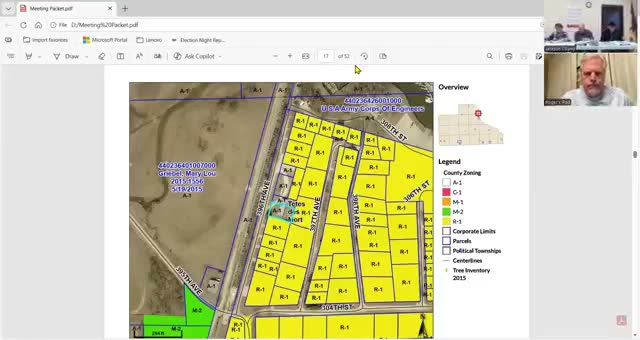
Jackson County Zoning Commission members spent an extended work session reviewing a proposed ordinance for high-density computing facilities (data centers and related operations), debating how to balance reuse opportunities, environmental safeguards and the county’s legal authority.
Staff framed the draft and pointed commissioners to key provisions. The draft would require removal and proper management of servers, monitors, batteries and other electronic components "in compliance with Iowa Code chapter 455B and all applicable state and federal solid and hazardous waste regulations," a staff speaker said. Commissioners debated whether to require full interior decommissioning or to allow reuse of a structurally sound shell once hazardous materials and e-waste are handled.
Why it matters: Data centers raise land-use questions distinct from typical industrial or retail uses — large concrete pads, cooling and generator infrastructure, and potential hazardous or electronic-waste streams. Local rules can shape whether operators are required to remove infrastructure, how noise is measured, and who bears the cost of utility upgrades.
Decommissioning and e‑waste: Several commissioners argued that the county can reasonably regulate exterior and visual remediation but not internal hazardous-material remediation, which is the DNR’s domain. One member said the county should "allow and encourage the reuse of the building shell and foundation if strictly structurally sound and code compliant." Staff recommended keeping an explicit e-waste obligation in the ordinance’s definitions and decommissioning section and cited Iowa Code chapter 455B as the compliance standard.
Enforcement and shutdowns: Draft language permitting temporary shutdown orders for facilities posing an imminent threat prompted concern. Commissioners warned that language giving the county authority to order shutdowns could create liability and recommended rewording to emphasize coordination with state agencies. One commissioner said the county’s role should be to act as liaison and work on DNR or EPA advice rather than unilaterally shutting a facility.
Noise and parking: The draft carries a 50 dBA property-line noise limit consistent with the county’s existing wind ordinance (WECS); one member favored lowering it to 45 dBA, but others urged consistency across county ordinances to avoid regulatory confusion. Commissioners discussed parking standards and landed on a practical approach used elsewhere: one space for every two employees on the maximum shift plus one space per company vehicle, with a minimum baseline.
Utilities and load confirmation: Staff recommended retaining a "load confirmation" requirement so operators document that the facility can be served without materially degrading service to existing customers, and to make any required distribution upgrades the operator’s responsibility. Several commissioners questioned whether the county could enforce utility-level decisions and suggested the clause remain as a safeguard for public information and operator responsibility rather than as a county-controlled technical requirement.
Next steps: Commissioners asked staff to refine the draft, remove or rephrase county-shutdown language, add a clear e-waste definition, and consult the county attorney on legal exposure. Staff proposed continuing review in March, fine-tuning in April, and a joint public hearing with the Board of Supervisors in May; the commission agreed to continue the process and to discuss rules of procedure at the March meeting.
The commission did not take a final vote on the ordinance; the draft will be revised and returned for further consideration and a possible joint public hearing with the Board of Supervisors.
Staff framed the draft and pointed commissioners to key provisions. The draft would require removal and proper management of servers, monitors, batteries and other electronic components "in compliance with Iowa Code chapter 455B and all applicable state and federal solid and hazardous waste regulations," a staff speaker said. Commissioners debated whether to require full interior decommissioning or to allow reuse of a structurally sound shell once hazardous materials and e-waste are handled.
Why it matters: Data centers raise land-use questions distinct from typical industrial or retail uses — large concrete pads, cooling and generator infrastructure, and potential hazardous or electronic-waste streams. Local rules can shape whether operators are required to remove infrastructure, how noise is measured, and who bears the cost of utility upgrades.
Decommissioning and e‑waste: Several commissioners argued that the county can reasonably regulate exterior and visual remediation but not internal hazardous-material remediation, which is the DNR’s domain. One member said the county should "allow and encourage the reuse of the building shell and foundation if strictly structurally sound and code compliant." Staff recommended keeping an explicit e-waste obligation in the ordinance’s definitions and decommissioning section and cited Iowa Code chapter 455B as the compliance standard.
Enforcement and shutdowns: Draft language permitting temporary shutdown orders for facilities posing an imminent threat prompted concern. Commissioners warned that language giving the county authority to order shutdowns could create liability and recommended rewording to emphasize coordination with state agencies. One commissioner said the county’s role should be to act as liaison and work on DNR or EPA advice rather than unilaterally shutting a facility.
Noise and parking: The draft carries a 50 dBA property-line noise limit consistent with the county’s existing wind ordinance (WECS); one member favored lowering it to 45 dBA, but others urged consistency across county ordinances to avoid regulatory confusion. Commissioners discussed parking standards and landed on a practical approach used elsewhere: one space for every two employees on the maximum shift plus one space per company vehicle, with a minimum baseline.
Utilities and load confirmation: Staff recommended retaining a "load confirmation" requirement so operators document that the facility can be served without materially degrading service to existing customers, and to make any required distribution upgrades the operator’s responsibility. Several commissioners questioned whether the county could enforce utility-level decisions and suggested the clause remain as a safeguard for public information and operator responsibility rather than as a county-controlled technical requirement.
Next steps: Commissioners asked staff to refine the draft, remove or rephrase county-shutdown language, add a clear e-waste definition, and consult the county attorney on legal exposure. Staff proposed continuing review in March, fine-tuning in April, and a joint public hearing with the Board of Supervisors in May; the commission agreed to continue the process and to discuss rules of procedure at the March meeting.
The commission did not take a final vote on the ordinance; the draft will be revised and returned for further consideration and a possible joint public hearing with the Board of Supervisors.
Don't Miss a Word: See the Full Meeting!
Go beyond summaries. Unlock every video, transcript, and key insight with a Founder Membership.
✓
Get instant access to full meeting videos
✓
Search and clip any phrase from complete transcripts
✓
Receive AI-powered summaries & custom alerts
✓
Enjoy lifetime, unrestricted access to government data
30-day money-back guarantee
