Inslee, Ecology officials say Climate Commitment Act pairs a legally binding cap with investments to cut pollution
May 13, 2024 | Governor's Office - Boards & Commissions, Executive, Washington
This article was created by AI summarizing key points discussed. AI makes mistakes, so for full details and context, please refer to the video of the full meeting. Please report any errors so we can fix them. Report an error »
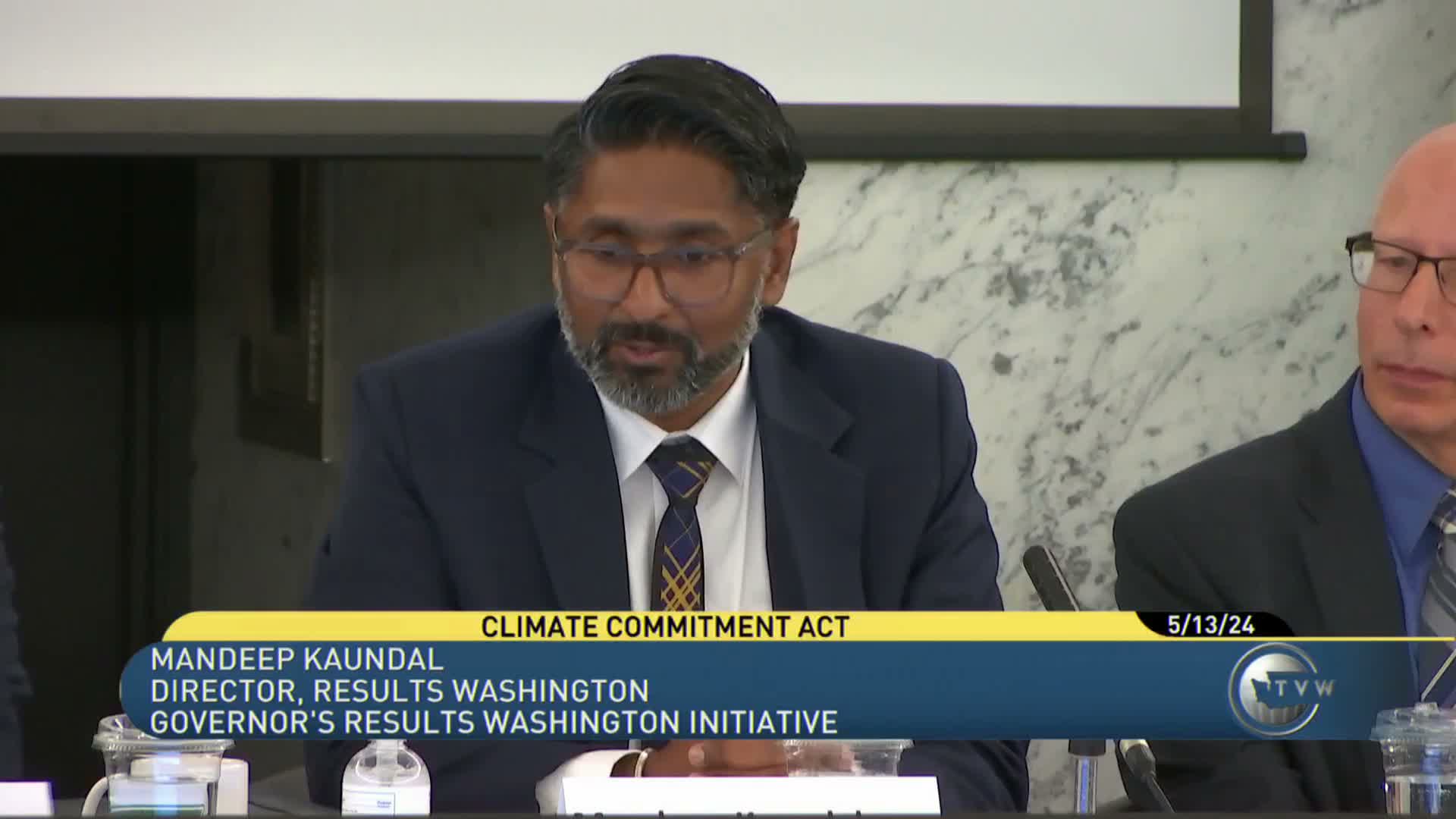
Governor Jay Inslee and senior Department of Ecology staff outlined how Washington’s Climate Commitment Act (CCA) is designed to both cap greenhouse-gas pollution and channel revenue into projects that reduce emissions and support overburdened communities.
"The basic fundamental purpose of this program... is to reduce pollution," Inslee said during a public performance review, framing the law as having two complementary parts: a legally binding cap that limits the total amount of pollution and an investment component that funds projects, from school-air upgrades to ferry electrification.
Ecology officials said the cap is set annually and lowered over time using scientific assessments. "Our cap is set to those levels and every year it gets lower," Joel Cresswell, climate pollution reduction program manager, said, adding that the state reviewed Intergovernmental Panel on Climate Change and national climate-assessment findings to determine Washington’s portion of necessary reductions.
Andrew Hayes, cap-and-invest policy section manager, described the mechanics: regulated companies must obtain allowances equal to their emissions; the Department of Ecology sells allowances at quarterly auctions while fewer allowances are made available each year. "One allowance equals one metric ton of carbon dioxide or the equivalent in other greenhouse gases," Hayes said.
On enforcement, Ecology said participating companies are required to report emissions annually and that the agency has legal authority to pursue enforcement when firms do not comply. "We require all of the companies that participate in the program to report their emissions to us every year," Cresswell said.
Ecology also outlined an intention to link Washington's market with larger programs in California and Quebec to promote more stable pricing over time. Laura Watson, Ecology director, said the state declared mutual intent to link in March but stressed the linkage is not yet final.
Why it matters: Officials said the dual design guarantees a limit on pollution while using revenue to finance projects that deliver public-health and economic benefits across the state. During the session, speakers emphasized that the cap’s legal force is central to delivering air-quality improvements.
What comes next: Ecology officials said they will continue reporting outcomes, pursue market linkage discussions and execute enforcement and monitoring as the program matures. The governor asked for regular reporting on how the cap is set and how enforcement is applied to ensure pollution declines as intended.
"The basic fundamental purpose of this program... is to reduce pollution," Inslee said during a public performance review, framing the law as having two complementary parts: a legally binding cap that limits the total amount of pollution and an investment component that funds projects, from school-air upgrades to ferry electrification.
Ecology officials said the cap is set annually and lowered over time using scientific assessments. "Our cap is set to those levels and every year it gets lower," Joel Cresswell, climate pollution reduction program manager, said, adding that the state reviewed Intergovernmental Panel on Climate Change and national climate-assessment findings to determine Washington’s portion of necessary reductions.
Andrew Hayes, cap-and-invest policy section manager, described the mechanics: regulated companies must obtain allowances equal to their emissions; the Department of Ecology sells allowances at quarterly auctions while fewer allowances are made available each year. "One allowance equals one metric ton of carbon dioxide or the equivalent in other greenhouse gases," Hayes said.
On enforcement, Ecology said participating companies are required to report emissions annually and that the agency has legal authority to pursue enforcement when firms do not comply. "We require all of the companies that participate in the program to report their emissions to us every year," Cresswell said.
Ecology also outlined an intention to link Washington's market with larger programs in California and Quebec to promote more stable pricing over time. Laura Watson, Ecology director, said the state declared mutual intent to link in March but stressed the linkage is not yet final.
Why it matters: Officials said the dual design guarantees a limit on pollution while using revenue to finance projects that deliver public-health and economic benefits across the state. During the session, speakers emphasized that the cap’s legal force is central to delivering air-quality improvements.
What comes next: Ecology officials said they will continue reporting outcomes, pursue market linkage discussions and execute enforcement and monitoring as the program matures. The governor asked for regular reporting on how the cap is set and how enforcement is applied to ensure pollution declines as intended.
View the Full Meeting & All Its Details
This article offers just a summary. Unlock complete video, transcripts, and insights as a Founder Member.
✓
Watch full, unedited meeting videos
✓
Search every word spoken in unlimited transcripts
✓
AI summaries & real-time alerts (all government levels)
✓
Permanent access to expanding government content
30-day money-back guarantee
