Ecology outlines expanded air monitoring in 16 overburdened communities; Beacon Hill partner says data will document harms
May 13, 2024 | Governor's Office - Boards & Commissions, Executive, Washington
This article was created by AI summarizing key points discussed. AI makes mistakes, so for full details and context, please refer to the video of the full meeting. Please report any errors so we can fix them. Report an error »
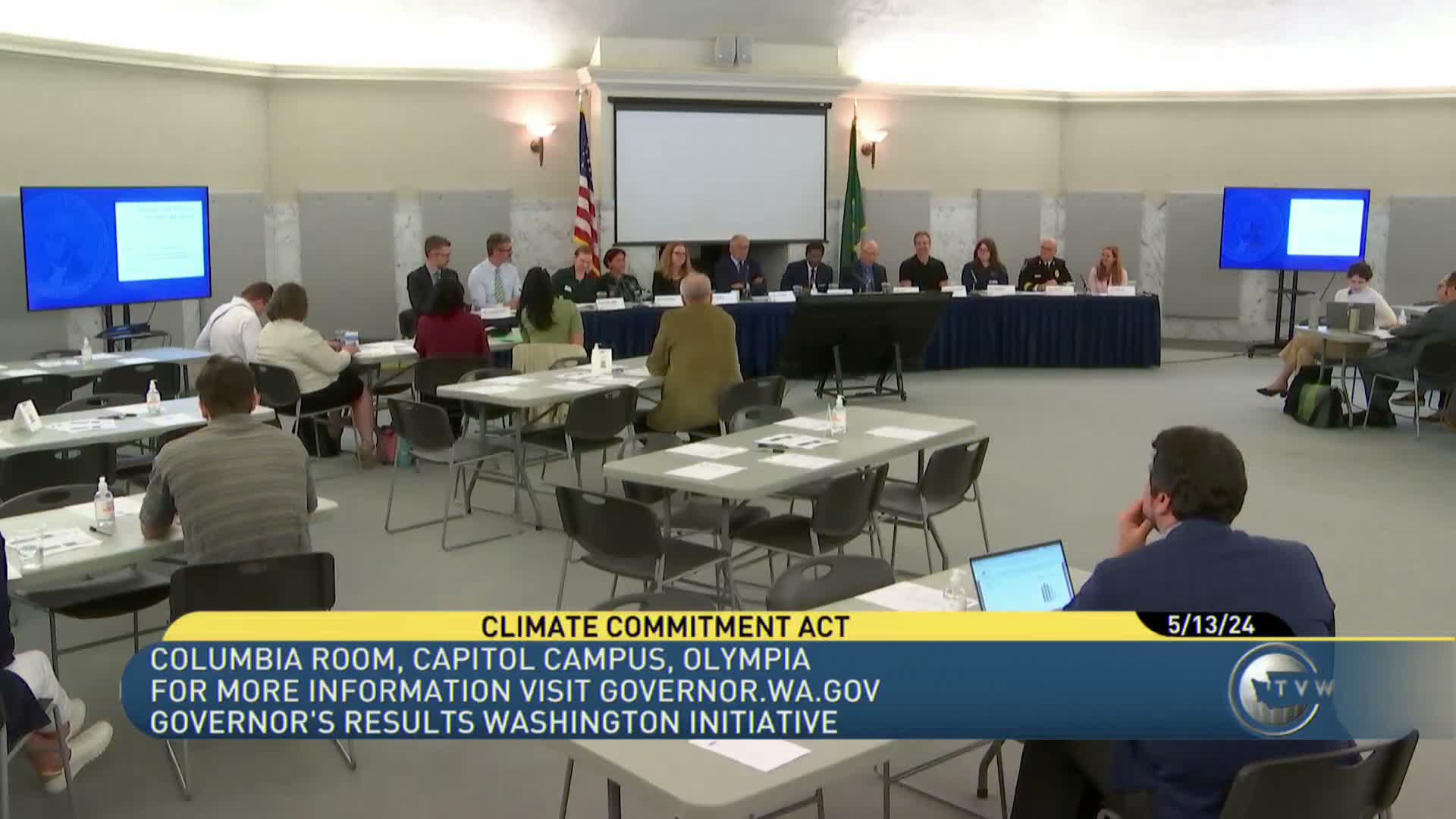
The Washington State Department of Ecology told Governor Jay Inslee and attendees that it is expanding air-quality monitoring under the Climate Commitment Act to better measure pollution in 16 overburdened communities and inform local mitigation.
"We are engaging with 16 communities across Washington to improve air quality as part of the CCA environmental justice initiative," Jill Schulte, ambient air monitoring coordinator at Ecology, said during the review. She described a program that includes expanded long-term monitors, a $10 million high-resolution snapshot study of multiple pollutants, a $10 million community grant program launched in 2024, and biennial reporting on air pollution and health data. Schulte said Ecology released an initial baseline report in December 2023.
Ecology described a new portable sensor, the SENSOA, designed to measure fine particulate matter (PM2.5). Schulte said the device is solar-powered, cellular-enabled and small enough for flexible site placement; the agency plans to install at least 50 SENSOAs this year and to prioritize central community locations such as schools and libraries.
Spokane Valley was highlighted as an early deployment success: the area will increase monitoring density from three preexisting sites to 13 sites using a combination of reference monitors and SENSOA devices, in collaboration with the Spokane Regional Clean Air Agency, Spokane Public Schools and the local library system.
Maria Badiola, chair of the Beacon Hill Council, described Beacon Hill as a largely immigrant, majority people-of-color neighborhood facing air and noise pollution, gentrification and heat. "It will allow us to get cumulative scientific data so the EPA can see us and also, hopefully, the Climate Commitment Act ... can benefit from mitigation of our community impacts," she said.
Why it matters: Ecology said the network will reveal neighborhood-level differences in pollution exposure, support targeted investments (for example, HVAC upgrades in schools), and help evaluate whether investments reduce health risks over time.
What comes next: Ecology will continue site identification, install SENSOA devices, publish expanded monitoring data through a new website and report biennially on air pollution and health metrics for the 16 communities.
"We are engaging with 16 communities across Washington to improve air quality as part of the CCA environmental justice initiative," Jill Schulte, ambient air monitoring coordinator at Ecology, said during the review. She described a program that includes expanded long-term monitors, a $10 million high-resolution snapshot study of multiple pollutants, a $10 million community grant program launched in 2024, and biennial reporting on air pollution and health data. Schulte said Ecology released an initial baseline report in December 2023.
Ecology described a new portable sensor, the SENSOA, designed to measure fine particulate matter (PM2.5). Schulte said the device is solar-powered, cellular-enabled and small enough for flexible site placement; the agency plans to install at least 50 SENSOAs this year and to prioritize central community locations such as schools and libraries.
Spokane Valley was highlighted as an early deployment success: the area will increase monitoring density from three preexisting sites to 13 sites using a combination of reference monitors and SENSOA devices, in collaboration with the Spokane Regional Clean Air Agency, Spokane Public Schools and the local library system.
Maria Badiola, chair of the Beacon Hill Council, described Beacon Hill as a largely immigrant, majority people-of-color neighborhood facing air and noise pollution, gentrification and heat. "It will allow us to get cumulative scientific data so the EPA can see us and also, hopefully, the Climate Commitment Act ... can benefit from mitigation of our community impacts," she said.
Why it matters: Ecology said the network will reveal neighborhood-level differences in pollution exposure, support targeted investments (for example, HVAC upgrades in schools), and help evaluate whether investments reduce health risks over time.
What comes next: Ecology will continue site identification, install SENSOA devices, publish expanded monitoring data through a new website and report biennially on air pollution and health metrics for the 16 communities.
View the Full Meeting & All Its Details
This article offers just a summary. Unlock complete video, transcripts, and insights as a Founder Member.
✓
Watch full, unedited meeting videos
✓
Search every word spoken in unlimited transcripts
✓
AI summaries & real-time alerts (all government levels)
✓
Permanent access to expanding government content
30-day money-back guarantee
