Washington unveils 'EV instant rebate' to expand access for low- and moderate-income households
April 23, 2024 | Governor's Office - Boards & Commissions, Executive, Washington
This article was created by AI summarizing key points discussed. AI makes mistakes, so for full details and context, please refer to the video of the full meeting. Please report any errors so we can fix them. Report an error »
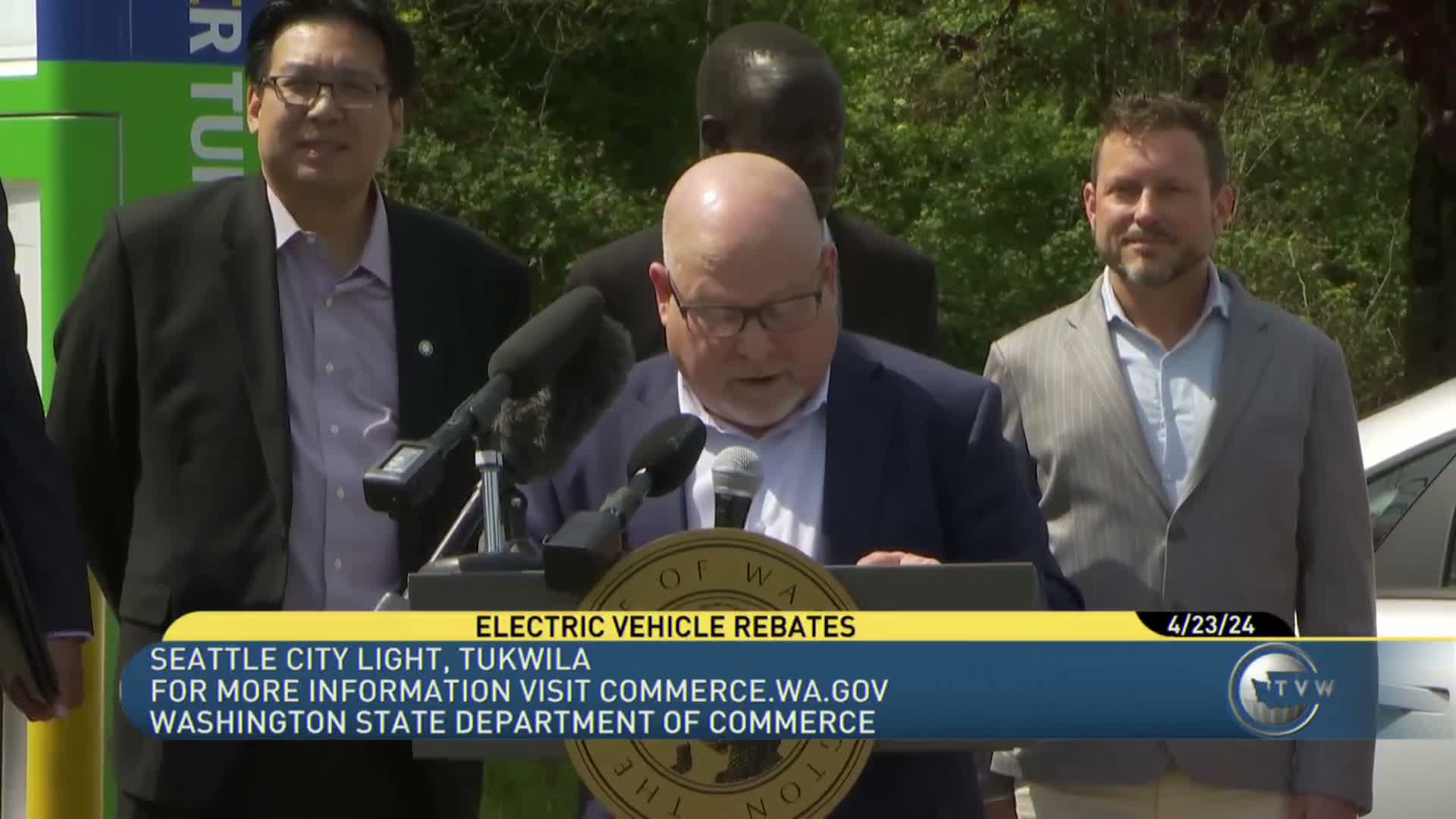
Governor Jay Inslee, joined by Mayor Tom McLeod and Washington State Department of Commerce Director Mike Fong, announced a new Washington state "EV instant rebate" program in Tukwila that officials said is designed to make electric vehicles more affordable for low- and moderate-income households.
The program will be administered by the Department of Commerce and, according to officials, aims to launch at dealerships in August. Commerce Director Mike Fong described the plan as a first-in-the-nation model that prioritizes a low-cost leasing option to reach households that have not benefited from earlier federal and state incentives.
"We're democratizing EVs," Inslee said, noting strong adoption in Washington and stressing equity. He and Commerce officials said the initial appropriation includes $50,000,000 to support the program, and nearly $100,000,000 remains reserved in the account for future biennia to sustain and expand the effort.
Fong summarized the rebate tiers Commerce plans to offer: up to $9,000 tied to an affordable three-year leasing option for income-eligible households; a $5,000 rebate for new EV purchases or leases; and a $2,500 rebate for used EVs. Eligibility will be income-based: Fong said the program targets households earning up to 300% of the federal poverty level (equating roughly to about $45,000 for a single individual and about $93,000 for a family of four, per Commerce remarks).
Nonprofit partner Fourth and drivers' representatives framed the program as an equity measure. Ian Sargent of Fourth said the organization ran listening sessions across urban and rural communities to center the needs of people with the greatest barriers to EV adoption. A drivers' union representative and union president Peter Quill said drivers welcome the rebate but emphasized two persistent obstacles: the upfront price of vehicles and the availability of fast, reliable charging.
Officials said the rebate focuses on the vehicle cost rather than home charging hardware in its initial rollout. When asked whether home charging equipment would be provided as part of the rebate, Fong said the short answer was no, explaining the agency is prioritizing vehicle access first; Commerce officials said they are pursuing separate investments and programs to expand charger availability — including a separate initiative to bring charging infrastructure to apartments and additional public chargers across the state.
Inslee and Commerce officials also described complementary investments: officials said the state will deploy about 5,000 new charging units funded through the Climate Commitment Act and that federal funding is helping add chargers along major corridors. Inslee highlighted related Climate Commitment Act–funded programs, including electric school buses, solar panels and home heat pumps, as part of a wider electrification strategy.
Officials said the program will work with dealerships to provide an on-site, near-instant discount or rebate for eligible buyers or lessees. Commerce said outreach to dealers, community groups and stakeholders helped shape the program; Fong credited Commerce staff and community partners for developing the design.
Next steps: Commerce intends to finalize program rules and dealer processes ahead of an August rollout; officials said additional funds remain available to continue or expand the program in future fiscal periods.
The program will be administered by the Department of Commerce and, according to officials, aims to launch at dealerships in August. Commerce Director Mike Fong described the plan as a first-in-the-nation model that prioritizes a low-cost leasing option to reach households that have not benefited from earlier federal and state incentives.
"We're democratizing EVs," Inslee said, noting strong adoption in Washington and stressing equity. He and Commerce officials said the initial appropriation includes $50,000,000 to support the program, and nearly $100,000,000 remains reserved in the account for future biennia to sustain and expand the effort.
Fong summarized the rebate tiers Commerce plans to offer: up to $9,000 tied to an affordable three-year leasing option for income-eligible households; a $5,000 rebate for new EV purchases or leases; and a $2,500 rebate for used EVs. Eligibility will be income-based: Fong said the program targets households earning up to 300% of the federal poverty level (equating roughly to about $45,000 for a single individual and about $93,000 for a family of four, per Commerce remarks).
Nonprofit partner Fourth and drivers' representatives framed the program as an equity measure. Ian Sargent of Fourth said the organization ran listening sessions across urban and rural communities to center the needs of people with the greatest barriers to EV adoption. A drivers' union representative and union president Peter Quill said drivers welcome the rebate but emphasized two persistent obstacles: the upfront price of vehicles and the availability of fast, reliable charging.
Officials said the rebate focuses on the vehicle cost rather than home charging hardware in its initial rollout. When asked whether home charging equipment would be provided as part of the rebate, Fong said the short answer was no, explaining the agency is prioritizing vehicle access first; Commerce officials said they are pursuing separate investments and programs to expand charger availability — including a separate initiative to bring charging infrastructure to apartments and additional public chargers across the state.
Inslee and Commerce officials also described complementary investments: officials said the state will deploy about 5,000 new charging units funded through the Climate Commitment Act and that federal funding is helping add chargers along major corridors. Inslee highlighted related Climate Commitment Act–funded programs, including electric school buses, solar panels and home heat pumps, as part of a wider electrification strategy.
Officials said the program will work with dealerships to provide an on-site, near-instant discount or rebate for eligible buyers or lessees. Commerce said outreach to dealers, community groups and stakeholders helped shape the program; Fong credited Commerce staff and community partners for developing the design.
Next steps: Commerce intends to finalize program rules and dealer processes ahead of an August rollout; officials said additional funds remain available to continue or expand the program in future fiscal periods.
Don't Miss a Word: See the Full Meeting!
Go beyond summaries. Unlock every video, transcript, and key insight with a Founder Membership.
✓
Get instant access to full meeting videos
✓
Search and clip any phrase from complete transcripts
✓
Receive AI-powered summaries & custom alerts
✓
Enjoy lifetime, unrestricted access to government data
30-day money-back guarantee
