State officials announce major Solar for All award for Washington, pair it with state funds to expand rooftop and community solar
April 22, 2024 | Governor's Office - Boards & Commissions, Executive, Washington
This article was created by AI summarizing key points discussed. AI makes mistakes, so for full details and context, please refer to the video of the full meeting. Please report any errors so we can fix them. Report an error »
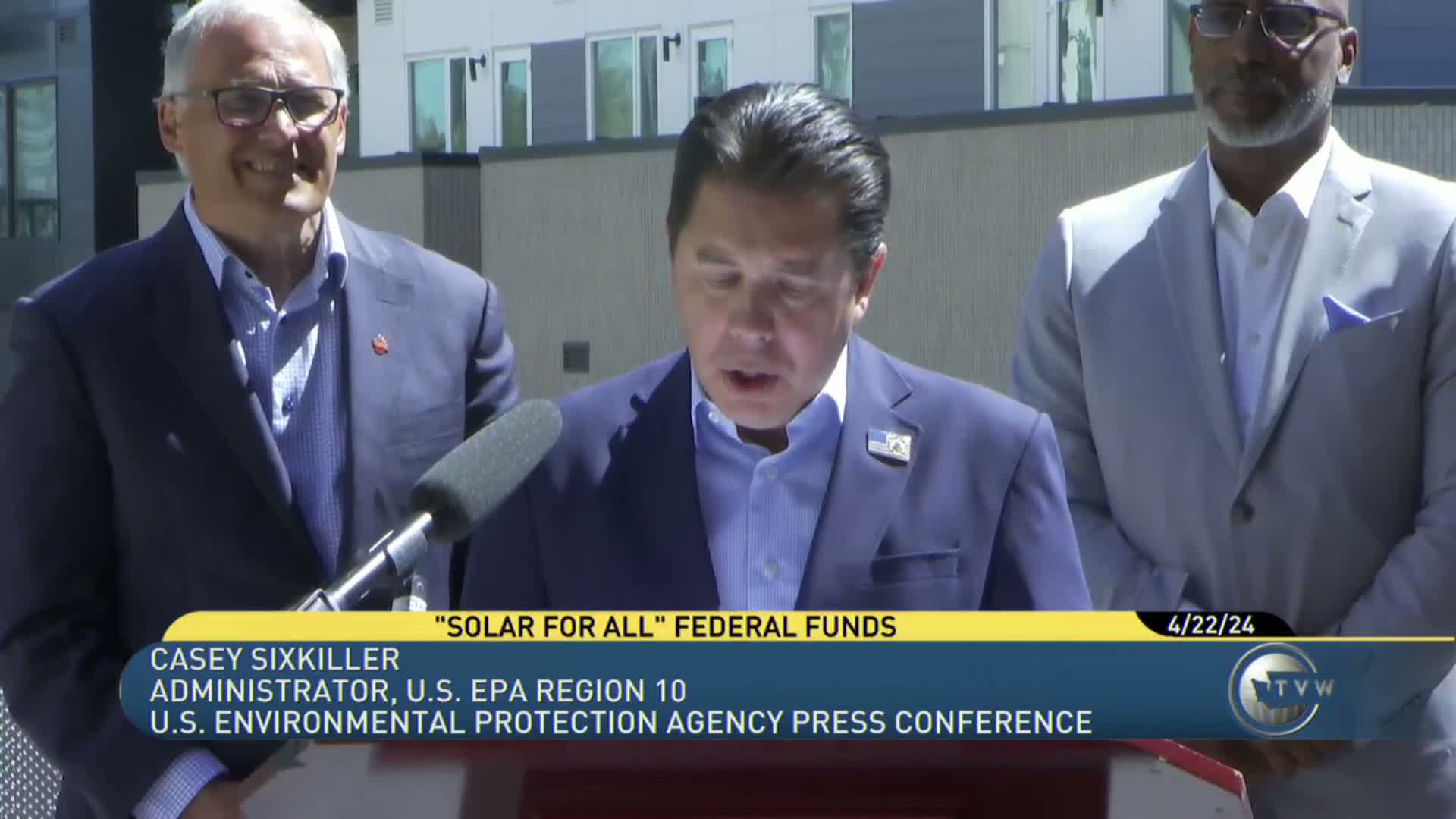
Gov. Jay Inslee and federal and state officials announced on a visit to Seattle Housing Authority's Yesler Terrace that Washington will receive a federal Solar for All award and will pair that money with state Climate Commitment Act funds to expand solar access for low- and moderate-income residents.
The U.S. Environmental Protection Agency's regional administrator, Casey Sixkiller, said the national Solar for All competition totals $7 billion and "includes a $150,000,000 to the state of Washington," and described the program as intended to deploy residential solar to hundreds of thousands of households and reduce significant amounts of carbon emissions. "It will deliver residential solar projects to 900,000 households nationwide and reduce 30,000,000 metric tons of carbon dioxide equivalent emissions from over 4 gigawatts of clean energy," Sixkiller said.
Why it matters: State and federal officials said the combined investment will target households that have historically faced barriers to solar, including renters and residents of multifamily affordable housing, and will fund workforce development tied to local contractors and unions.
Gov. Inslee said Washington will join the federal award with "over a $100,000,000 of money from the Climate Commitment Act," and highlighted examples of residents who have reduced or eliminated utility bills after solar or heat pump installations. He also framed broader state priorities, saying Washington is pursuing electric ferries and a state climate corps alongside residential solar efforts. "On top of this $159,000,000 of federal money, we are joining it with our over a $100,000,000 of money from the Climate Commitment Act," Inslee said.
State implementation: Mike Fong, who is leading the Department of Commerce effort, said the state will deploy the combined funding through four program tracks over the coming years: affordable homeowner installations, multifamily affordable housing upgrades, community solar projects that benefit renters or those without suitable roofs, and dedicated tribal funding. "We will be able to deploy this funding in four programs in the coming years," Fong said, and he emphasized workforce and job creation opportunities for local workers.
Local reaction: Seattle City Councilmember Tanya Wu, who said she grew up nearby, welcomed the funding and stressed equity goals. "I look out over the China International District, and I see slowly solar panels popping up on top of the roofs of buildings," Wu said, noting the award will help reach historically marginalized communities and renters.
Numbers and next steps: Officials cited several program figures during remarks. The EPA regional administrator described the national Solar for All program as a $7 billion competition; in the same remarks he referenced both a $150 million and, later in the event, the governor used a $159 million figure when discussing the federal award combined with state funds. The Department of Commerce will lead deployment in Washington, and officials said project types include rooftop installations, multifamily and community solar credits and tribal projects. No formal vote or regulatory action was taken at the announcement; after remarks the group proceeded to a site tour at Yesler Terrace.
The event concluded with officials and guests moving to a tour of the redevelopment site; Commerce and EPA staff will oversee the next steps of program design and application of funds.
The U.S. Environmental Protection Agency's regional administrator, Casey Sixkiller, said the national Solar for All competition totals $7 billion and "includes a $150,000,000 to the state of Washington," and described the program as intended to deploy residential solar to hundreds of thousands of households and reduce significant amounts of carbon emissions. "It will deliver residential solar projects to 900,000 households nationwide and reduce 30,000,000 metric tons of carbon dioxide equivalent emissions from over 4 gigawatts of clean energy," Sixkiller said.
Why it matters: State and federal officials said the combined investment will target households that have historically faced barriers to solar, including renters and residents of multifamily affordable housing, and will fund workforce development tied to local contractors and unions.
Gov. Inslee said Washington will join the federal award with "over a $100,000,000 of money from the Climate Commitment Act," and highlighted examples of residents who have reduced or eliminated utility bills after solar or heat pump installations. He also framed broader state priorities, saying Washington is pursuing electric ferries and a state climate corps alongside residential solar efforts. "On top of this $159,000,000 of federal money, we are joining it with our over a $100,000,000 of money from the Climate Commitment Act," Inslee said.
State implementation: Mike Fong, who is leading the Department of Commerce effort, said the state will deploy the combined funding through four program tracks over the coming years: affordable homeowner installations, multifamily affordable housing upgrades, community solar projects that benefit renters or those without suitable roofs, and dedicated tribal funding. "We will be able to deploy this funding in four programs in the coming years," Fong said, and he emphasized workforce and job creation opportunities for local workers.
Local reaction: Seattle City Councilmember Tanya Wu, who said she grew up nearby, welcomed the funding and stressed equity goals. "I look out over the China International District, and I see slowly solar panels popping up on top of the roofs of buildings," Wu said, noting the award will help reach historically marginalized communities and renters.
Numbers and next steps: Officials cited several program figures during remarks. The EPA regional administrator described the national Solar for All program as a $7 billion competition; in the same remarks he referenced both a $150 million and, later in the event, the governor used a $159 million figure when discussing the federal award combined with state funds. The Department of Commerce will lead deployment in Washington, and officials said project types include rooftop installations, multifamily and community solar credits and tribal projects. No formal vote or regulatory action was taken at the announcement; after remarks the group proceeded to a site tour at Yesler Terrace.
The event concluded with officials and guests moving to a tour of the redevelopment site; Commerce and EPA staff will oversee the next steps of program design and application of funds.
Don't Miss a Word: See the Full Meeting!
Go beyond summaries. Unlock every video, transcript, and key insight with a Founder Membership.
✓
Get instant access to full meeting videos
✓
Search and clip any phrase from complete transcripts
✓
Receive AI-powered summaries & custom alerts
✓
Enjoy lifetime, unrestricted access to government data
30-day money-back guarantee
