Encampment Resolution Program credited with high move‑in rates; officials say funding shortfall limits expansion
March 27, 2024 | Governor's Office - Boards & Commissions, Executive, Washington
This article was created by AI summarizing key points discussed. AI makes mistakes, so for full details and context, please refer to the video of the full meeting. Please report any errors so we can fix them. Report an error »
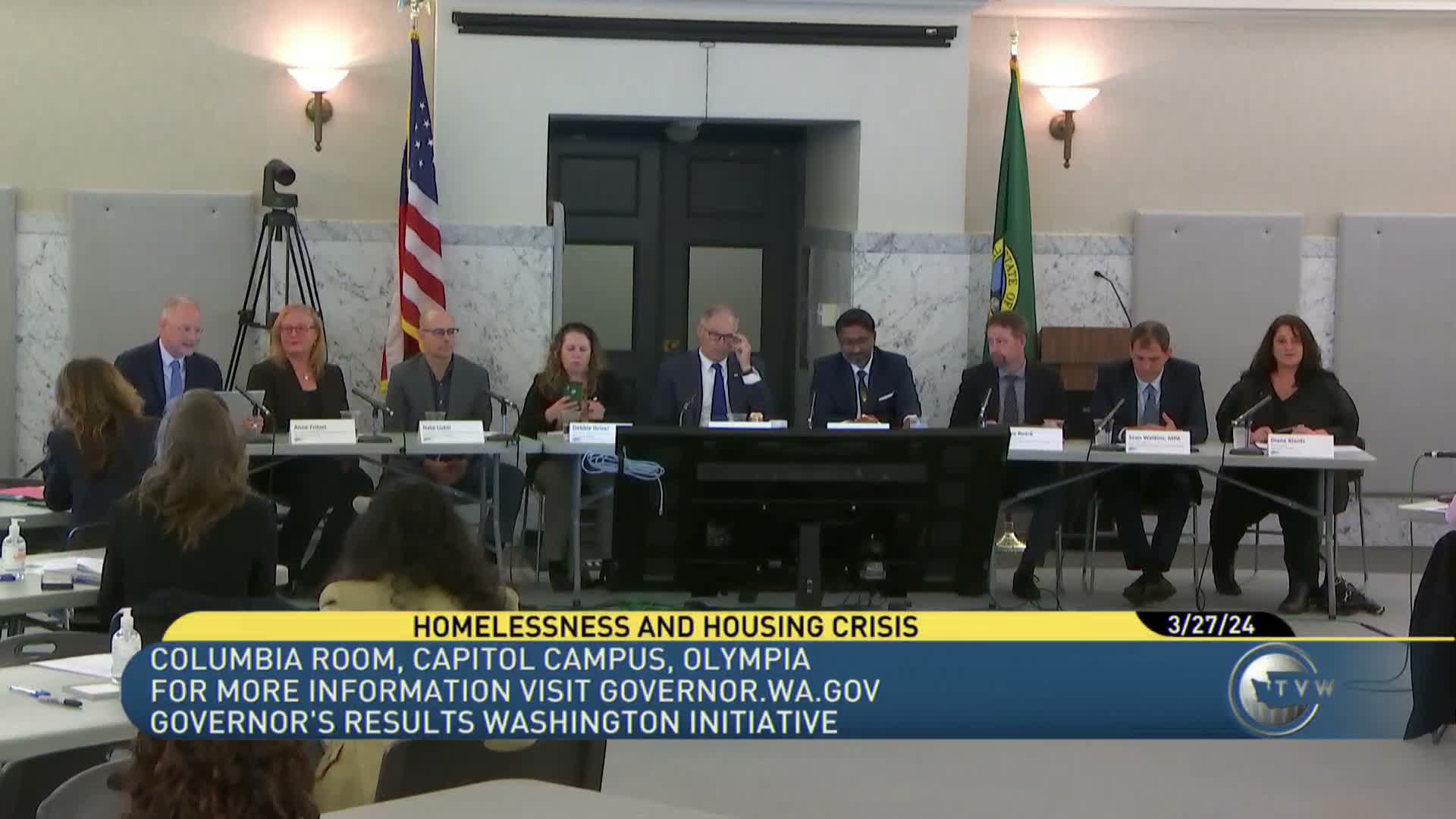
State and county officials described a multiagency Encampment Resolution Program (ERP) that they say has produced above‑average results but now faces funding constraints that could limit future site work.
Ted Kelleher, housing policy director at the Department of Commerce, described the ERP launched in 2022 and said it has addressed more than 34 sites and moved more than 1,000 people inside; he said about 83% of people engaged at typical ERP sites moved into shelter or housing, well above historic averages. "We found new ways to work with one another," Kelleher said, describing on‑site service delivery, ID and benefits assistance, and conversions of hotels into long‑term housing.
Steve Rourke, regional administrator at the Washington State Department of Transportation (WSDOT), described DOT’s role in site identification, debris removal, vegetation control and monitoring after site clearance. He said WSDOT applies a "least cost, least invasive" approach to site modifications and that maintenance and monitoring are ongoing responsibilities.
Sean Watkins, senior policy adviser with the King County Homelessness Authority, told the panel King County resolved 11 major encampments along state rights‑of‑way, moving over 360 people indoors and reporting an 89% acceptance rate among those engaged. Watkins said much of ERP funding in King County has gone to acquire or master‑lease buildings for permanent supportive housing.
A program participant, Sarah Eskew, described receiving outreach, training and services through CoLead and said she completed a pre‑apprenticeship, achieved sobriety and expected to move into permanent housing soon. Her testimony was praised by Governor Inslee as illustrative of program success.
Officials warned that funding is a constraint: Kelleher and others said the Legislature provided less than requested and that WSDOT received $2,000,000 for site work while staff estimated $10,000,000 would better support expansion. Commerce cautioned that after contracted acquisitions are occupied it will be hard to continue at scale without further appropriations.
Panelists recommended continued interagency coordination, local leadership to site projects and legislative action to sustain and scale ERP and related housing investments.
Ted Kelleher, housing policy director at the Department of Commerce, described the ERP launched in 2022 and said it has addressed more than 34 sites and moved more than 1,000 people inside; he said about 83% of people engaged at typical ERP sites moved into shelter or housing, well above historic averages. "We found new ways to work with one another," Kelleher said, describing on‑site service delivery, ID and benefits assistance, and conversions of hotels into long‑term housing.
Steve Rourke, regional administrator at the Washington State Department of Transportation (WSDOT), described DOT’s role in site identification, debris removal, vegetation control and monitoring after site clearance. He said WSDOT applies a "least cost, least invasive" approach to site modifications and that maintenance and monitoring are ongoing responsibilities.
Sean Watkins, senior policy adviser with the King County Homelessness Authority, told the panel King County resolved 11 major encampments along state rights‑of‑way, moving over 360 people indoors and reporting an 89% acceptance rate among those engaged. Watkins said much of ERP funding in King County has gone to acquire or master‑lease buildings for permanent supportive housing.
A program participant, Sarah Eskew, described receiving outreach, training and services through CoLead and said she completed a pre‑apprenticeship, achieved sobriety and expected to move into permanent housing soon. Her testimony was praised by Governor Inslee as illustrative of program success.
Officials warned that funding is a constraint: Kelleher and others said the Legislature provided less than requested and that WSDOT received $2,000,000 for site work while staff estimated $10,000,000 would better support expansion. Commerce cautioned that after contracted acquisitions are occupied it will be hard to continue at scale without further appropriations.
Panelists recommended continued interagency coordination, local leadership to site projects and legislative action to sustain and scale ERP and related housing investments.
View the Full Meeting & All Its Details
This article offers just a summary. Unlock complete video, transcripts, and insights as a Founder Member.
✓
Watch full, unedited meeting videos
✓
Search every word spoken in unlimited transcripts
✓
AI summaries & real-time alerts (all government levels)
✓
Permanent access to expanding government content
30-day money-back guarantee
