Governor signs broad package of bills on public health, transportation, labor and local incentives
March 14, 2024 | Governor's Office - Boards & Commissions, Executive, Washington
This article was created by AI summarizing key points discussed. AI makes mistakes, so for full details and context, please refer to the video of the full meeting. Please report any errors so we can fix them. Report an error »
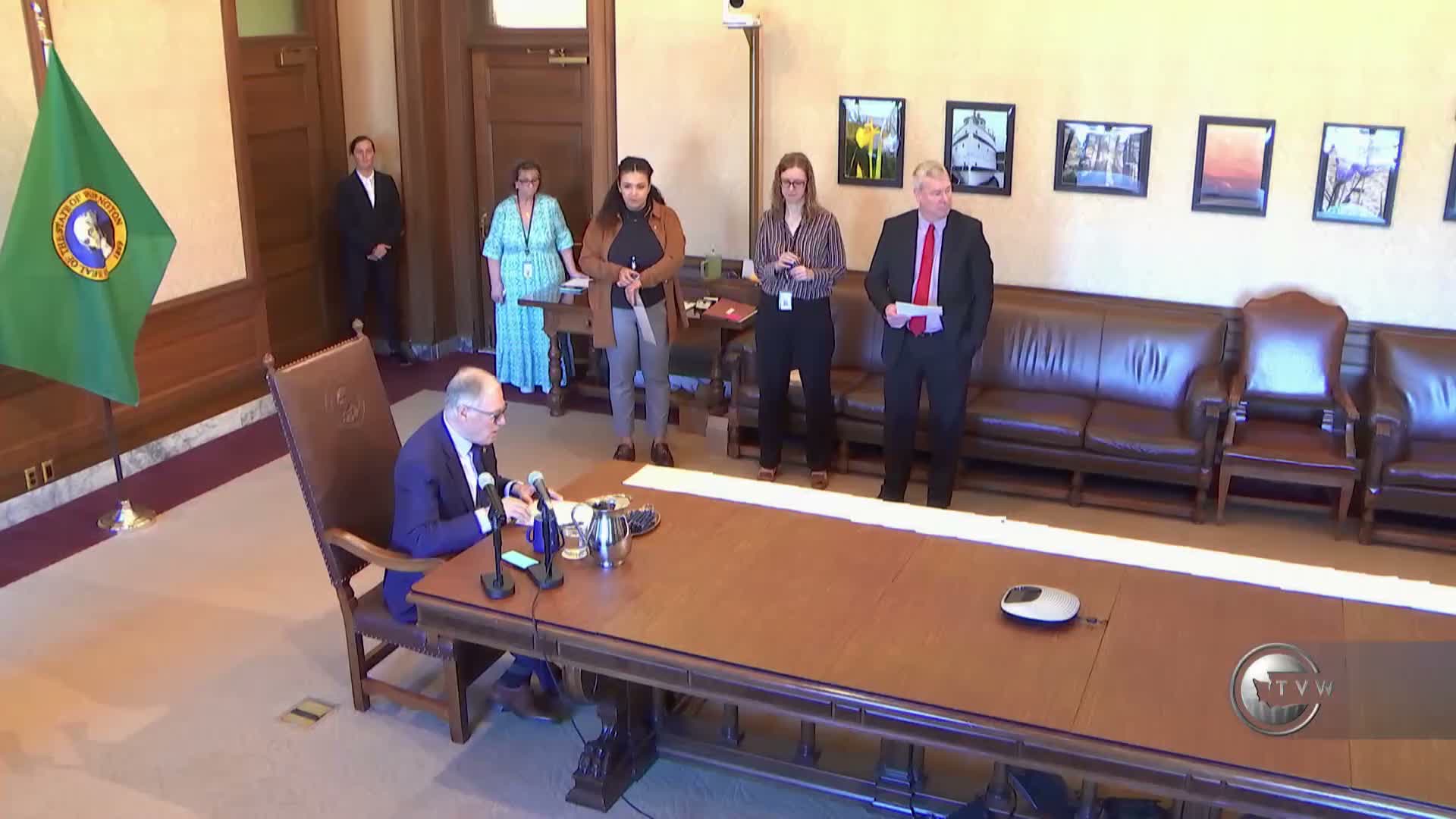
The governor onstage introduced and signed a large package of bills covering public health, transportation, labor and local economic incentives, saying the measures will improve access, streamline processes and reduce burdens for residents and businesses.
Among the bills the governor highlighted were House Bill 1608, which "requires the Department of Health to issue a statewide standing order for medications to treat allergic reactions, allowing easier access to these lifesaving medications in schools," and Senate Bill 6079, which "ensures coordination of health care for persons confined in county juvenile detention facilities," the governor said during remarks. He also introduced legislation directing the State Board of Health to consider adding BCKDK to the newborn-screening panel and a bill to raise awareness of congenital cytomegalovirus and its risks for pregnant Washingtonians.
Why it matters: The bills address a mix of immediate public-health access (school allergy medication and juvenile-detention care coordination), workforce and economic issues (plumber trainee expansions, electronic signatures for union formation, and RV dealer-manufacturer agreements), and local-government tools (flexibility on transit-match requirements and interlocal sales-tax sharing for large retail recruitment). Several measures are technical clarifications intended to speed implementation by state and local agencies.
Details and notable provisions
• Medical access in schools: House Bill 1608 creates a statewide standing order from the Department of Health so school nurses and trained staff can administer medications for severe allergic reactions. The governor said the change ‘‘allow[s] easier access to these lifesaving medications in schools.’’
• Newborn screening and newborn health: Senate Bill 5829 and the related directive to the State Board of Health would increase attention to congenital cytomegalovirus (CMV). A clinician from Seattle Children’s Hospital described CMV’s range of impacts—hearing loss, microcephaly, prematurity and developmental disabilities—and said universal newborn screening is the preferred approach, per the exchange at the event.
• Public-safety and enforcement: House Bill 1963 would prohibit the use of license-plate covers that can prevent toll and traffic cameras from identifying vehicles; the governor said the measure is intended to help law enforcement and ensure vehicle accountability on roadways.
• Broadband, transit and climate-related funding: House Bill 1982 (authorizing the Community Economic Revitalization Board to make broadband loans/grants for rural/underserved areas) and Senate Bill 6229 (allowing Transportation greater match flexibility on Climate Commitment Act green-transit grants) aim to expand access to broadband and support electrification of bus fleets. The governor noted the state’s goal of universal broadband accessibility by 2028.
• Economic and administrative changes: Other bills signed or introduced include tax and filing simplifications (estate tax return relief), expanded vet/military student registration priority, changes to how local counties may add district court judges, elimination of an expiration date for a climate-connected community program, and authorization for temporary relocation of liquor-license sales during emergencies. The Main Street tax credit bill permits participants to use up to an additional $90,000 per program in remaining statewide contribution credits.
What the ceremony did not include: The event was a ceremonial signing and introduction; no roll-call votes or committee actions were taken onstage and the governor’s remarks were largely introductory and grateful in tone. Where the transcript included detailed medical descriptions, those were attributed to a medical practitioner; no legislative opponents or roll-call tallies were recorded in the transcript.
Next steps: Most bills described are now in the implementation or administrative phase; several require rule-making or agency action (for example, the Department of Health is directed to issue standing orders under House Bill 1608, and the State Board of Health will review new screening additions per the bill directing that review). The governor closed the event and attendees posed for photographs.
Among the bills the governor highlighted were House Bill 1608, which "requires the Department of Health to issue a statewide standing order for medications to treat allergic reactions, allowing easier access to these lifesaving medications in schools," and Senate Bill 6079, which "ensures coordination of health care for persons confined in county juvenile detention facilities," the governor said during remarks. He also introduced legislation directing the State Board of Health to consider adding BCKDK to the newborn-screening panel and a bill to raise awareness of congenital cytomegalovirus and its risks for pregnant Washingtonians.
Why it matters: The bills address a mix of immediate public-health access (school allergy medication and juvenile-detention care coordination), workforce and economic issues (plumber trainee expansions, electronic signatures for union formation, and RV dealer-manufacturer agreements), and local-government tools (flexibility on transit-match requirements and interlocal sales-tax sharing for large retail recruitment). Several measures are technical clarifications intended to speed implementation by state and local agencies.
Details and notable provisions
• Medical access in schools: House Bill 1608 creates a statewide standing order from the Department of Health so school nurses and trained staff can administer medications for severe allergic reactions. The governor said the change ‘‘allow[s] easier access to these lifesaving medications in schools.’’
• Newborn screening and newborn health: Senate Bill 5829 and the related directive to the State Board of Health would increase attention to congenital cytomegalovirus (CMV). A clinician from Seattle Children’s Hospital described CMV’s range of impacts—hearing loss, microcephaly, prematurity and developmental disabilities—and said universal newborn screening is the preferred approach, per the exchange at the event.
• Public-safety and enforcement: House Bill 1963 would prohibit the use of license-plate covers that can prevent toll and traffic cameras from identifying vehicles; the governor said the measure is intended to help law enforcement and ensure vehicle accountability on roadways.
• Broadband, transit and climate-related funding: House Bill 1982 (authorizing the Community Economic Revitalization Board to make broadband loans/grants for rural/underserved areas) and Senate Bill 6229 (allowing Transportation greater match flexibility on Climate Commitment Act green-transit grants) aim to expand access to broadband and support electrification of bus fleets. The governor noted the state’s goal of universal broadband accessibility by 2028.
• Economic and administrative changes: Other bills signed or introduced include tax and filing simplifications (estate tax return relief), expanded vet/military student registration priority, changes to how local counties may add district court judges, elimination of an expiration date for a climate-connected community program, and authorization for temporary relocation of liquor-license sales during emergencies. The Main Street tax credit bill permits participants to use up to an additional $90,000 per program in remaining statewide contribution credits.
What the ceremony did not include: The event was a ceremonial signing and introduction; no roll-call votes or committee actions were taken onstage and the governor’s remarks were largely introductory and grateful in tone. Where the transcript included detailed medical descriptions, those were attributed to a medical practitioner; no legislative opponents or roll-call tallies were recorded in the transcript.
Next steps: Most bills described are now in the implementation or administrative phase; several require rule-making or agency action (for example, the Department of Health is directed to issue standing orders under House Bill 1608, and the State Board of Health will review new screening additions per the bill directing that review). The governor closed the event and attendees posed for photographs.
Don't Miss a Word: See the Full Meeting!
Go beyond summaries. Unlock every video, transcript, and key insight with a Founder Membership.
✓
Get instant access to full meeting videos
✓
Search and clip any phrase from complete transcripts
✓
Receive AI-powered summaries & custom alerts
✓
Enjoy lifetime, unrestricted access to government data
30-day money-back guarantee
