Governor signs package of bills on elections security, juvenile debt, housing and more
March 13, 2024 | Governor's Office - Boards & Commissions, Executive, Washington
This article was created by AI summarizing key points discussed. AI makes mistakes, so for full details and context, please refer to the video of the full meeting. Please report any errors so we can fix them. Report an error »
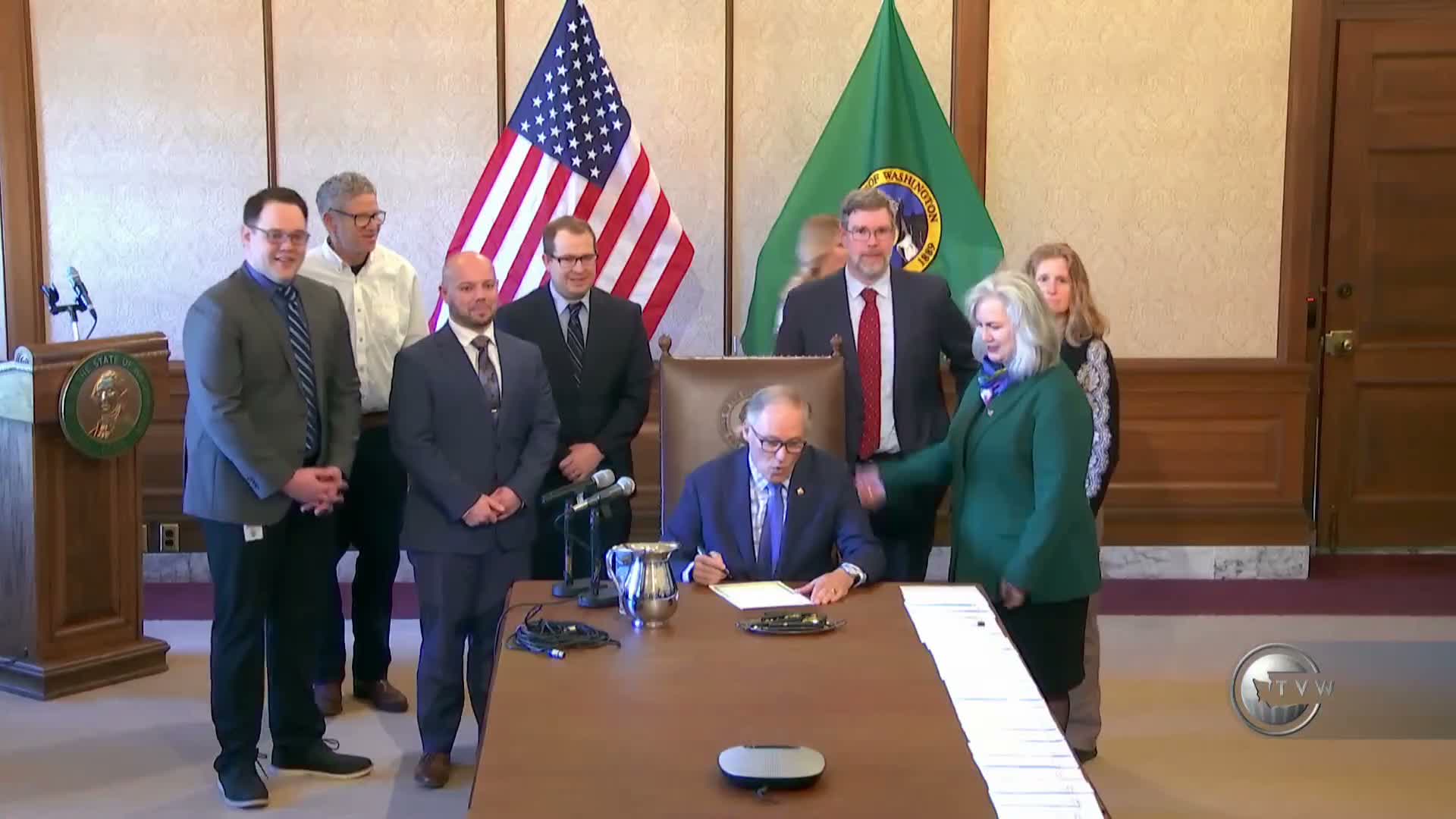
The governor signed a broad package of bills at a public signing in Olympia that included measures on election security, juvenile debt relief, housing planning, and public-safety funding.
The most high-profile among the bills, Senate Bill 5843, requires counties to use intrusion detection systems to monitor voting-system networks and authorizes the secretary of state to certify results if a county refuses to certify an election without cause. The governor framed the measure as a response to “persistent disinformation” campaigns and cited recent FBI and CISA warnings about threats to government infrastructure. No county-level votes or objections were recorded in the signing event transcript.
Other bills the governor signed include Senate Bill 5974, which establishes a process for courts to cancel outstanding juvenile fines and fees issued before July 1, 2023, so those debts no longer automatically affect credit or background checks; Senate Bill 5834, which allows cities and counties to swap underperforming urban growth area lands to increase land availability for housing; and House Bill 2165, which preserves recreational immunity for the Department of Natural Resources when charging fees for recreational permits. The governor also signed bills expanding tools for the Office of the Insurance Commissioner, clarifying building-code treatment of temporary personal greenhouses, extending counsel protections in dependency proceedings, and adjusting allowable uses for firefighter safety grants, among many others.
Sponsors and advocacy groups were repeatedly acknowledged during the event. The transcript records thanks to individual legislators (for example, Senator Wynne for SB 5843; Senator Grama and the Mockingbird Society for child-counsel measures) and to agencies and community partners. Several bills included technical fixes or clarifications to prior legislation (for example, clarifying gate money for those released to partial confinement and defining the class of construction workers eligible to cash out sick leave).
The signing was informal in tone: the transcript includes repeated exchanges about pens and photos, brief interactions with attendees (including students and advocates), and multiple “smile for a second” prompts. The transcript does not record legislative vote tallies, vetoes, or formal legislative debate; it records the governor’s statements of purpose for each bill and expressions of thanks to sponsors and stakeholders.
What happens next: most bills become law following the governor’s signature according to existing statutory effective-date rules unless otherwise specified in the legislation. The transcript does not record specific effective dates for individual bills or any additional administrative steps required for implementation; those details are not specified in the signing remarks and would appear in the bills themselves or subsequent agency rulemaking.
The most high-profile among the bills, Senate Bill 5843, requires counties to use intrusion detection systems to monitor voting-system networks and authorizes the secretary of state to certify results if a county refuses to certify an election without cause. The governor framed the measure as a response to “persistent disinformation” campaigns and cited recent FBI and CISA warnings about threats to government infrastructure. No county-level votes or objections were recorded in the signing event transcript.
Other bills the governor signed include Senate Bill 5974, which establishes a process for courts to cancel outstanding juvenile fines and fees issued before July 1, 2023, so those debts no longer automatically affect credit or background checks; Senate Bill 5834, which allows cities and counties to swap underperforming urban growth area lands to increase land availability for housing; and House Bill 2165, which preserves recreational immunity for the Department of Natural Resources when charging fees for recreational permits. The governor also signed bills expanding tools for the Office of the Insurance Commissioner, clarifying building-code treatment of temporary personal greenhouses, extending counsel protections in dependency proceedings, and adjusting allowable uses for firefighter safety grants, among many others.
Sponsors and advocacy groups were repeatedly acknowledged during the event. The transcript records thanks to individual legislators (for example, Senator Wynne for SB 5843; Senator Grama and the Mockingbird Society for child-counsel measures) and to agencies and community partners. Several bills included technical fixes or clarifications to prior legislation (for example, clarifying gate money for those released to partial confinement and defining the class of construction workers eligible to cash out sick leave).
The signing was informal in tone: the transcript includes repeated exchanges about pens and photos, brief interactions with attendees (including students and advocates), and multiple “smile for a second” prompts. The transcript does not record legislative vote tallies, vetoes, or formal legislative debate; it records the governor’s statements of purpose for each bill and expressions of thanks to sponsors and stakeholders.
What happens next: most bills become law following the governor’s signature according to existing statutory effective-date rules unless otherwise specified in the legislation. The transcript does not record specific effective dates for individual bills or any additional administrative steps required for implementation; those details are not specified in the signing remarks and would appear in the bills themselves or subsequent agency rulemaking.
Don't Miss a Word: See the Full Meeting!
Go beyond summaries. Unlock every video, transcript, and key insight with a Founder Membership.
✓
Get instant access to full meeting videos
✓
Search and clip any phrase from complete transcripts
✓
Receive AI-powered summaries & custom alerts
✓
Enjoy lifetime, unrestricted access to government data
30-day money-back guarantee
