Leaders cite housing progress but flag local resistance as key barrier to homelessness and TOD goals
March 07, 2024 | Governor's Office - Boards & Commissions, Executive, Washington
This article was created by AI summarizing key points discussed. AI makes mistakes, so for full details and context, please refer to the video of the full meeting. Please report any errors so we can fix them. Report an error »
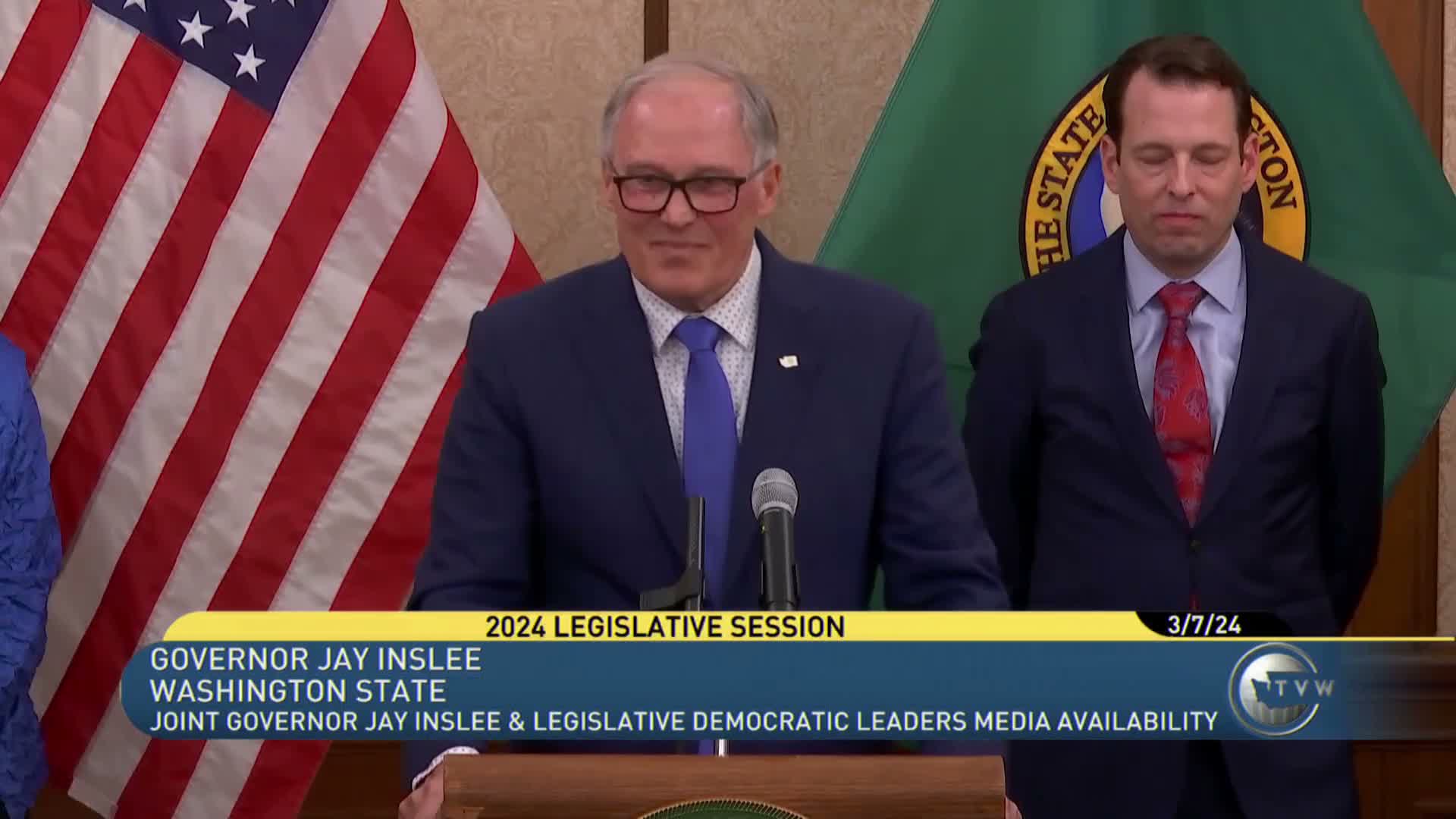
State leaders acknowledged housing progress this session but cautioned that local resistance and inter‑chamber disagreements limited what lawmakers could finish in 60 days.
Governor Inslee said an additional $150,000,000 was included to advance housing but expressed disappointment that a transit‑oriented development (TOD) financing bill did not pass because the two chambers could not agree on how much financing to dedicate to low‑income units. “This is one of these things that takes multiple years to get done,” he said.
Reporters pressed the governor about local governments and NIMBY opposition. Inslee named examples — a proposed 100+ unit project in Kenmore he said was quashed and initial neighborhood pushback to a Tacoma tiny‑home village that later integrated into the neighborhood — to underline his point that local leadership is essential to site behavioral‑health facilities and housing funded by the state.
On homelessness operations, officials said the right‑of‑way encampment program will continue to the extent financing is available; the governor said some money exists and credited progress along highways where outreach and shelter placements have helped many people, while acknowledging more funding would have helped.
Senators and House leaders also described the legislative process and intra‑caucus diversity as factors explaining why rent stabilization advanced further than in past years but ultimately did not reach the governor’s desk. Senate Bill 6175, an incentive for converting commercial space to housing, was cited as a complementary measure that passed and could increase downtown housing supply.
Officials urged local leaders to engage communities to reduce opposition to siting and to work with the state to put funded facilities in place. They said continued interim work will be needed to resolve financing and siting questions in advance of the next session.
Governor Inslee said an additional $150,000,000 was included to advance housing but expressed disappointment that a transit‑oriented development (TOD) financing bill did not pass because the two chambers could not agree on how much financing to dedicate to low‑income units. “This is one of these things that takes multiple years to get done,” he said.
Reporters pressed the governor about local governments and NIMBY opposition. Inslee named examples — a proposed 100+ unit project in Kenmore he said was quashed and initial neighborhood pushback to a Tacoma tiny‑home village that later integrated into the neighborhood — to underline his point that local leadership is essential to site behavioral‑health facilities and housing funded by the state.
On homelessness operations, officials said the right‑of‑way encampment program will continue to the extent financing is available; the governor said some money exists and credited progress along highways where outreach and shelter placements have helped many people, while acknowledging more funding would have helped.
Senators and House leaders also described the legislative process and intra‑caucus diversity as factors explaining why rent stabilization advanced further than in past years but ultimately did not reach the governor’s desk. Senate Bill 6175, an incentive for converting commercial space to housing, was cited as a complementary measure that passed and could increase downtown housing supply.
Officials urged local leaders to engage communities to reduce opposition to siting and to work with the state to put funded facilities in place. They said continued interim work will be needed to resolve financing and siting questions in advance of the next session.
Don't Miss a Word: See the Full Meeting!
Go beyond summaries. Unlock every video, transcript, and key insight with a Founder Membership.
✓
Get instant access to full meeting videos
✓
Search and clip any phrase from complete transcripts
✓
Receive AI-powered summaries & custom alerts
✓
Enjoy lifetime, unrestricted access to government data
30-day money-back guarantee
