Health department warns lead, mercury, arsenic and cadmium in baby food can cause lasting harm; suggests AGO enforce compliance
February 21, 2026 | Agriculture, Food Resiliency, & Forestry, HOUSE OF REPRESENTATIVES, Committees, Legislative , Vermont
This article was created by AI summarizing key points discussed. AI makes mistakes, so for full details and context, please refer to the video of the full meeting. Please report any errors so we can fix them. Report an error »
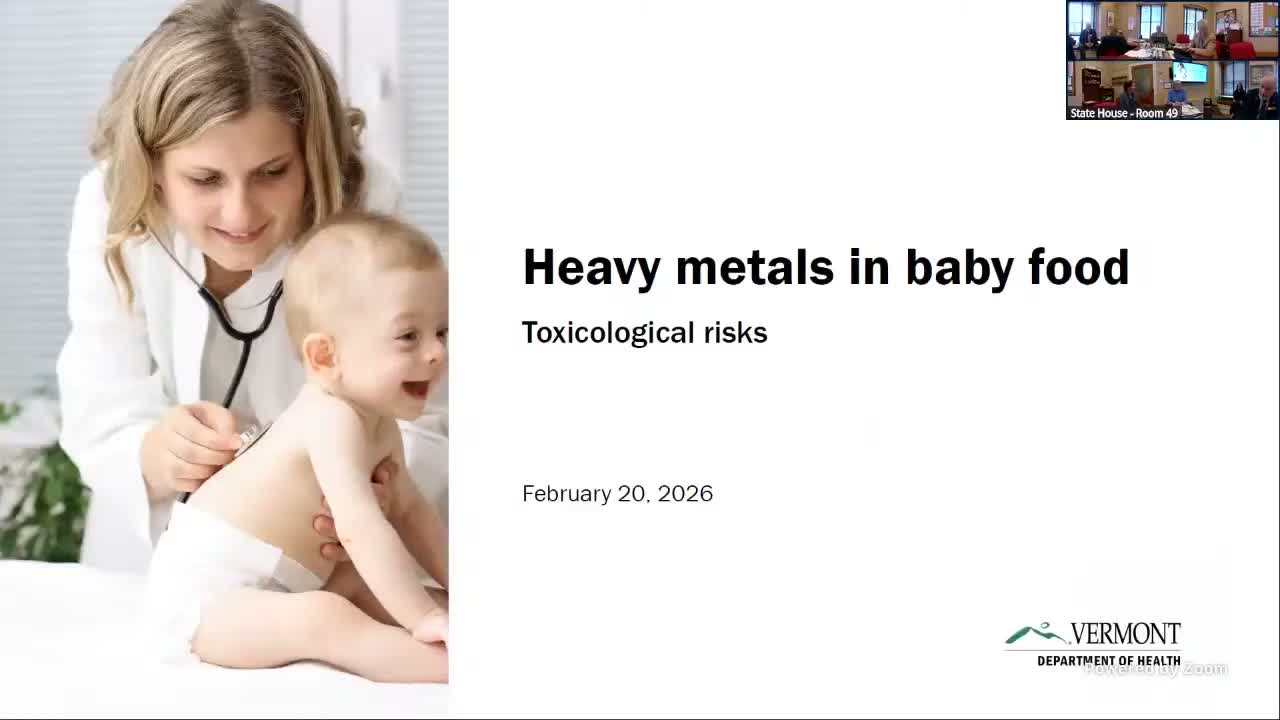
Julia Rell, deputy commissioner at the Vermont Department of Health, and Andrea Kirk, the state toxicologist, told the committee that lead, mercury, arsenic and cadmium found in baby food can harm infants and young children and that combined exposures can have synergistic effects.
“There is no safe level of lead in the body,” Rell said, describing lead’s ability even at low levels to impair development, damage brain and nervous system function, and affect learning and behavior. The pair told the committee that methylmercury (commonly associated with fish) can affect hearing, coordination and heart function; arsenic exposures can impair neurodevelopment and increase cancer risks; and cadmium can damage kidneys and alter brain development.
On persistence, Andrea Kirk said some metals remain in the body: “Lead will go mostly into people's bones, and it can cycle out as calcium needs change… Arsenic is water soluble… Mercury will also stay depending on the form that it's in.” Committee members asked whether infant formula should be included in legislation; Rell said metals have been found in infant formula and stressed formula can be a concentrated sole source of exposure for infants.
Rell also noted the bill currently gives the health commissioner responsibility to receive complaints and manufacturer sample results but suggested enforcement authority may be more appropriate with the Attorney General's Office: "Given that the AGO is responsible for the enforcement of the requirements of the bill, we would just say it feels more appropriate that those rest with the AGO's office than the health department." The department expressed support for the bill’s intent to reduce infant exposure but said it has not taken an official position pending further study of other states’ experiences.
Next steps: the committee will continue to hear witnesses and examine how other states’ measures have performed; the health department will continue to research impacts and legislative outcomes in states that have enacted similar laws.
“There is no safe level of lead in the body,” Rell said, describing lead’s ability even at low levels to impair development, damage brain and nervous system function, and affect learning and behavior. The pair told the committee that methylmercury (commonly associated with fish) can affect hearing, coordination and heart function; arsenic exposures can impair neurodevelopment and increase cancer risks; and cadmium can damage kidneys and alter brain development.
On persistence, Andrea Kirk said some metals remain in the body: “Lead will go mostly into people's bones, and it can cycle out as calcium needs change… Arsenic is water soluble… Mercury will also stay depending on the form that it's in.” Committee members asked whether infant formula should be included in legislation; Rell said metals have been found in infant formula and stressed formula can be a concentrated sole source of exposure for infants.
Rell also noted the bill currently gives the health commissioner responsibility to receive complaints and manufacturer sample results but suggested enforcement authority may be more appropriate with the Attorney General's Office: "Given that the AGO is responsible for the enforcement of the requirements of the bill, we would just say it feels more appropriate that those rest with the AGO's office than the health department." The department expressed support for the bill’s intent to reduce infant exposure but said it has not taken an official position pending further study of other states’ experiences.
Next steps: the committee will continue to hear witnesses and examine how other states’ measures have performed; the health department will continue to research impacts and legislative outcomes in states that have enacted similar laws.
Don't Miss a Word: See the Full Meeting!
Go beyond summaries. Unlock every video, transcript, and key insight with a Founder Membership.
✓
Get instant access to full meeting videos
✓
Search and clip any phrase from complete transcripts
✓
Receive AI-powered summaries & custom alerts
✓
Enjoy lifetime, unrestricted access to government data
30-day money-back guarantee
