Vermont Agency of Education outlines strategic plan to improve special education delivery
February 20, 2026 | Education, SENATE, Committees, Legislative , Vermont
This article was created by AI summarizing key points discussed. AI makes mistakes, so for full details and context, please refer to the video of the full meeting. Please report any errors so we can fix them. Report an error »
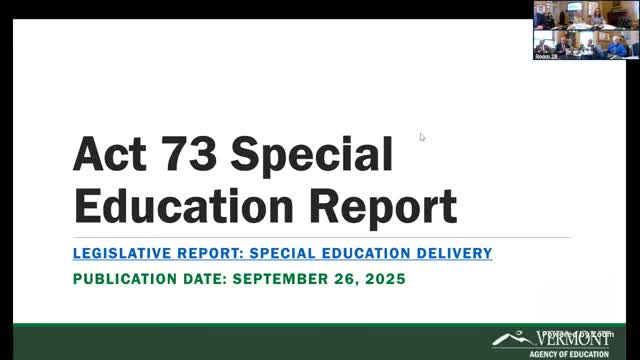
The Vermont Agency of Education on Feb. 20 told the Senate Education Committee it is moving from analysis to implementation on a statewide strategic plan to improve special education delivery, compliance and outcomes.
Zoe Saunders, identified herself as Secretary of Education during the session, and the agency team described the plan as an implementation of the Act 73 requirement to both report on special education delivery and build a strategic plan with measurable outcomes and timelines. "We used the data and findings from the first report to inform our strategic direction," a presenting official said.
Agency leaders said they reorganized staff to elevate special education: they added a chief academic officer (Dr. Aaron Davis), elevated the special education director to division director, created a special education finance director post and established a grants division to better manage IDEA funds and federal compliance.
Officials emphasized the need to strengthen Tier 1 (grade'level, first'time) instruction and to develop coherent statewide monitoring tools. The presenters said Vermont lacks a consistent instrument to evaluate Tier 1 quality and will develop KPIs and early indicators so progress can be measured before final outcome data are available.
The plan organizes work across five pillars: academic excellence; college and career readiness; safe and healthy schools; operational effectiveness; and enhanced special education and differentiated supports. The agency said priorities include reducing chronic absenteeism and dropout rates, tracking suspensions and restraint/seclusion, improving assessment reporting timelines and increasing federal grant utilization.
Agency officials acknowledged resource constraints for scaling statewide professional learning and said the governor's budget includes a modest request to support literacy and training expansion. They invited stakeholders to engage through the special education advisory panel and steering committees as implementation proceeds.
Committee members asked about measuring progress in transition years and instructional leadership; the agency pointed to local continuous improvement plans and statewide alignment efforts as mechanisms to benchmark student progress across grades.
Agency staff said the next six months will focus on refining measurable targets, implementation planning, and progress monitoring, and they committed to regular updates with advisory bodies and the Legislature.
Zoe Saunders, identified herself as Secretary of Education during the session, and the agency team described the plan as an implementation of the Act 73 requirement to both report on special education delivery and build a strategic plan with measurable outcomes and timelines. "We used the data and findings from the first report to inform our strategic direction," a presenting official said.
Agency leaders said they reorganized staff to elevate special education: they added a chief academic officer (Dr. Aaron Davis), elevated the special education director to division director, created a special education finance director post and established a grants division to better manage IDEA funds and federal compliance.
Officials emphasized the need to strengthen Tier 1 (grade'level, first'time) instruction and to develop coherent statewide monitoring tools. The presenters said Vermont lacks a consistent instrument to evaluate Tier 1 quality and will develop KPIs and early indicators so progress can be measured before final outcome data are available.
The plan organizes work across five pillars: academic excellence; college and career readiness; safe and healthy schools; operational effectiveness; and enhanced special education and differentiated supports. The agency said priorities include reducing chronic absenteeism and dropout rates, tracking suspensions and restraint/seclusion, improving assessment reporting timelines and increasing federal grant utilization.
Agency officials acknowledged resource constraints for scaling statewide professional learning and said the governor's budget includes a modest request to support literacy and training expansion. They invited stakeholders to engage through the special education advisory panel and steering committees as implementation proceeds.
Committee members asked about measuring progress in transition years and instructional leadership; the agency pointed to local continuous improvement plans and statewide alignment efforts as mechanisms to benchmark student progress across grades.
Agency staff said the next six months will focus on refining measurable targets, implementation planning, and progress monitoring, and they committed to regular updates with advisory bodies and the Legislature.
View the Full Meeting & All Its Details
This article offers just a summary. Unlock complete video, transcripts, and insights as a Founder Member.
✓
Watch full, unedited meeting videos
✓
Search every word spoken in unlimited transcripts
✓
AI summaries & real-time alerts (all government levels)
✓
Permanent access to expanding government content
30-day money-back guarantee
