Subcommittee examines Michigan corrections budget, flags staffing gaps and overtime costs
February 20, 2026 | 2025-2026 House Legislature MI, Michigan
This article was created by AI summarizing key points discussed. AI makes mistakes, so for full details and context, please refer to the video of the full meeting. Please report any errors so we can fix them. Report an error »
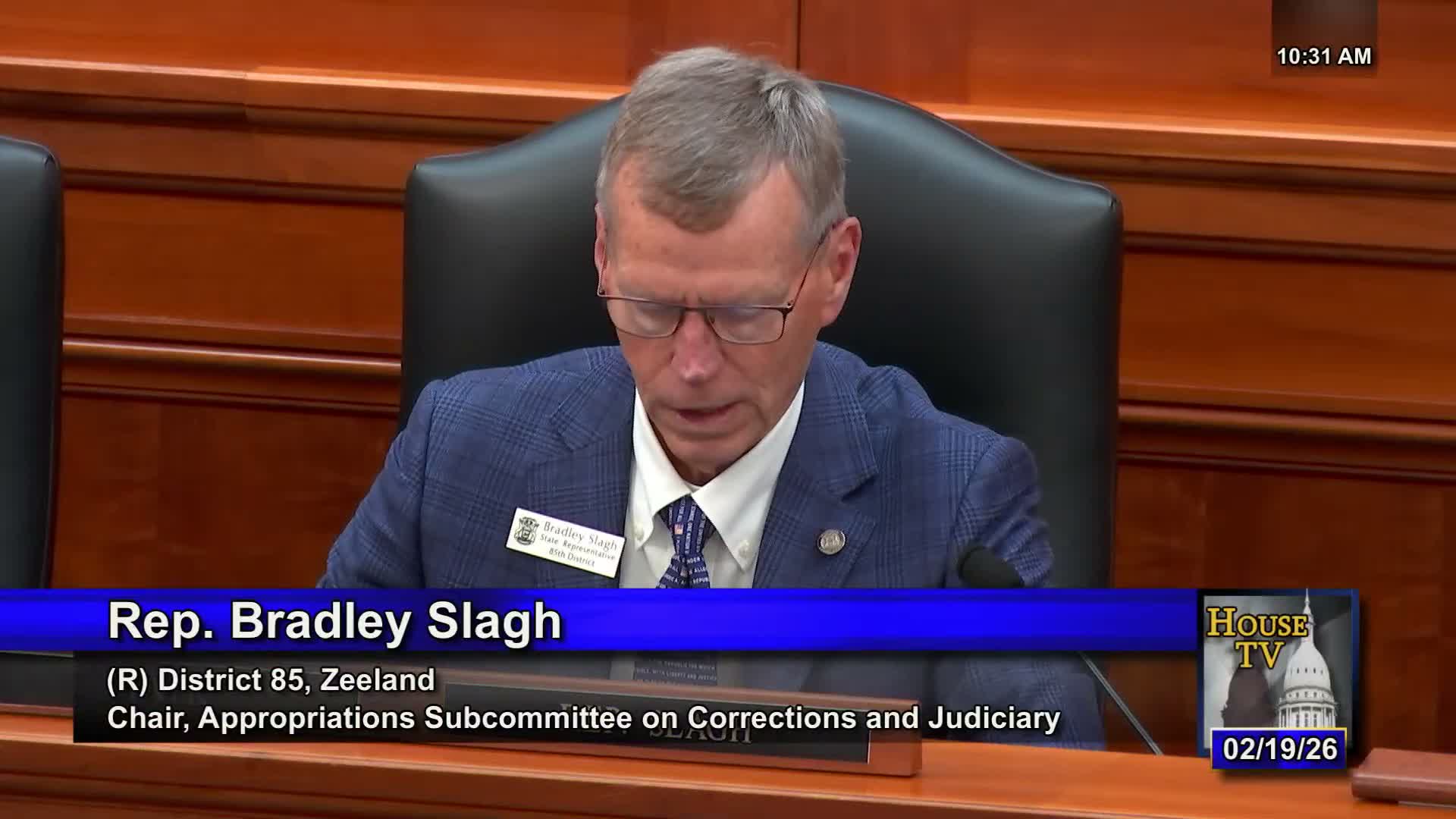
Robin Risco, budget analyst with the House Fiscal Agency, told the House Appropriations Subcommittee on Corrections and Judiciary on Feb. 19 that the Michigan Department of Corrections remains one of the state's largest general-fund budgets and continues to face staffing shortfalls.
"As of December 25, there were 829 correction officer vacancies, 393 health care staff vacancies, and 166 central staff vacancies," Risco said while walking members through the corrections slides. She said overtime in fiscal year 25 amounted to roughly $126,900,000.
The presentation placed the corrections budget in context: Risco reported that corrections represents 3% of the state's $74,600,000,000 adjusted gross budget and about 15% of the state's $14,100,000,000 general fund budget. She also described federal relief received during the pandemic period, noting $1,762,800,000 in federal relief dollars were used to offset payroll and frontline worker costs between fiscal years 2020 and 2024.
Risco outlined program- and line-item changes between fiscal years. Among the items she highlighted: one-time general-fund additions in prior years for prisoner health care services and contracted nursing staff; additions of FTEs for facility-level programs such as the Thumb Correctional Education Center; and the inclusion and removal of various one-time program funds in the FY25 and FY26 budgets. She said prison operations — including physical and mental health care for prisoners — make up the largest share of the corrections appropriation.
Representative O'Neil praised the improved reporting and urged continued focus on employee safety, retention and education programs. "You always do an excellent job of explaining in detail these budgets," he said, and argued investing in education and reentry helps reduce recidivism and long-term costs. He added a rough estimate that the annual "cost of stay" per prisoner is "close to, what, 50,000 or 40,000," and asked staff to provide more detailed figures.
Members asked for historical overtime data and for the specific slide with current vacancy counts; Risco agreed to provide the historical overtime information and to share the vacancy slide with committee members.
Risco also noted a series of new and revised boilerplate reporting sections included in the current-year budget, for example requirements for reports on work project appropriations, federal policy impact, medical parole status, prisoner co-payments, prisoner deaths and contraband prevention efforts.
No formal vote on policy or appropriations occurred at the hearing; discussion was limited to the agency budget overview and member questions. The committee then moved to the judiciary overview later in the meeting.
"As of December 25, there were 829 correction officer vacancies, 393 health care staff vacancies, and 166 central staff vacancies," Risco said while walking members through the corrections slides. She said overtime in fiscal year 25 amounted to roughly $126,900,000.
The presentation placed the corrections budget in context: Risco reported that corrections represents 3% of the state's $74,600,000,000 adjusted gross budget and about 15% of the state's $14,100,000,000 general fund budget. She also described federal relief received during the pandemic period, noting $1,762,800,000 in federal relief dollars were used to offset payroll and frontline worker costs between fiscal years 2020 and 2024.
Risco outlined program- and line-item changes between fiscal years. Among the items she highlighted: one-time general-fund additions in prior years for prisoner health care services and contracted nursing staff; additions of FTEs for facility-level programs such as the Thumb Correctional Education Center; and the inclusion and removal of various one-time program funds in the FY25 and FY26 budgets. She said prison operations — including physical and mental health care for prisoners — make up the largest share of the corrections appropriation.
Representative O'Neil praised the improved reporting and urged continued focus on employee safety, retention and education programs. "You always do an excellent job of explaining in detail these budgets," he said, and argued investing in education and reentry helps reduce recidivism and long-term costs. He added a rough estimate that the annual "cost of stay" per prisoner is "close to, what, 50,000 or 40,000," and asked staff to provide more detailed figures.
Members asked for historical overtime data and for the specific slide with current vacancy counts; Risco agreed to provide the historical overtime information and to share the vacancy slide with committee members.
Risco also noted a series of new and revised boilerplate reporting sections included in the current-year budget, for example requirements for reports on work project appropriations, federal policy impact, medical parole status, prisoner co-payments, prisoner deaths and contraband prevention efforts.
No formal vote on policy or appropriations occurred at the hearing; discussion was limited to the agency budget overview and member questions. The committee then moved to the judiciary overview later in the meeting.
View the Full Meeting & All Its Details
This article offers just a summary. Unlock complete video, transcripts, and insights as a Founder Member.
✓
Watch full, unedited meeting videos
✓
Search every word spoken in unlimited transcripts
✓
AI summaries & real-time alerts (all government levels)
✓
Permanent access to expanding government content
30-day money-back guarantee
