Students, foundation and CCV describe 'Free Degree Promise' as low‑cost route to debt‑free associate degrees
February 20, 2026 | Education, HOUSE OF REPRESENTATIVES, Committees, Legislative , Vermont
This article was created by AI summarizing key points discussed. AI makes mistakes, so for full details and context, please refer to the video of the full meeting. Please report any errors so we can fix them. Report an error »
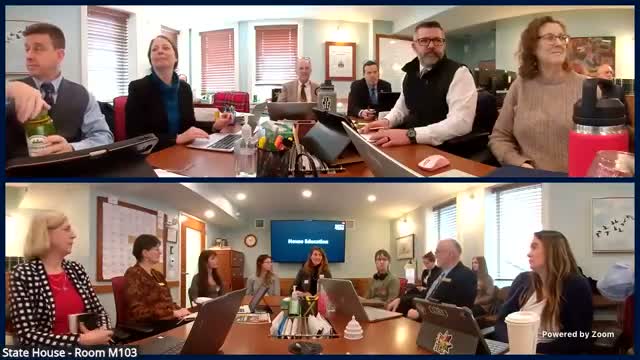
The Macquarie Foundation and students testified Feb. 20 before the Vermont House Education Committee that the Free Degree Promise, built on the state's early college program and delivered through the Community College of Vermont (CCV), is producing measurable enrollment and academic gains while requiring a modest ongoing investment.
Carolyn Weir, executive director of the Macquarie Foundation, told the committee the Free Degree Promise pairs the state's early college pathway with wraparound advising and direct student supports. "The Free Degree Promise basically takes that means testing support and makes it universal," Weir said, describing the model as a last‑dollar program that builds on Pell, the Vermont State Grant and 802 Opportunity supports.
Why it matters: Weir said the approach has produced substantive shifts for low‑income students. Since the Promise began four years ago, she said CCV has tripled the number of low‑income students enrolled in early college and now reports that about half of the current early college cohort is low income. "This past fall semester, the early college cohort had a 90 course success rate and record breaking overall, term GPA of 3.2," she said, and more than 70 students graduated debt‑free with associate degrees last June.
Student testimony underscored those points. "Taking real college classrooms while still in high school changed how I approached learning," said Emiliana Bedrosian of Burlington, who credited CCV classes with directing her toward political science and economics and with providing vocational skills such as ceramics that led to paid work. Lila Piazza said two years at CCV saved her roughly $120,000 compared with specialized dental hygiene programs she estimated cost about $60,000 per year; Piazza said she is using CCV credits to try to transfer into a dental hygiene bachelor program.
Accessibility and advising were recurring themes. Heather McClure, an academic advisor at CCV's Newport site, said many families of early college students do not qualify for Pell, and that removing cost barriers has lowered CCV's average student age by attracting teenagers who otherwise would not enroll. "When we take down that barrier and they see that that's no longer there, we're seeing more and more younger students," McClure said.
Cost and scale: Weir told the committee that the Macquarie Foundation committed support to the program for the Vermont high school classes of 2023 through 2028. She estimated the foundation's contribution to scale a universal, accelerated community‑college pathway—covering last‑dollar tuition and fees, direct student stipends, and institutional support for advising and administration—at about $775,000 per year. The foundation said that investment supports several hundred early college students per year and described the model as high return on investment.
Program design and limits: Weir clarified that the Free Degree Promise is not means tested and that early college coursework must be completed at CCV for a student to qualify for the program's second year of benefits. She said the model intentionally centers the state's access institution (CCV) because it provides integrated academic and career advising, work‑based learning and student supports that together promote persistence.
Legislative context and origins: Weir also noted that a bill was introduced to the House addressing the Higher Education Trust Fund and proposing a different fund split intended to better support institutions serving high numbers of low‑income students. She traced the Promise's origin to a June 2020 COVID‑era offering that provided one free CCV course to graduating seniors; roughly 600 students accepted that initial offer, prompting the foundation to expand support and formalize the pathway.
What remains open: Students and presenters discussed transfer questions (whether CCV course credits will transfer to specific out‑of‑state or specialized programs), and several students said final transfer decisions and acceptances were still in process. Committee members asked for a clear visual summary of how the early college, the Free Degree Promise and other state aid sources stack together; Weir and her organization said they will follow up with pathway visuals, numbers and financing details.
The committee recessed for five minutes after the testimony; no votes or formal committee actions were recorded in the transcript.
Carolyn Weir, executive director of the Macquarie Foundation, told the committee the Free Degree Promise pairs the state's early college pathway with wraparound advising and direct student supports. "The Free Degree Promise basically takes that means testing support and makes it universal," Weir said, describing the model as a last‑dollar program that builds on Pell, the Vermont State Grant and 802 Opportunity supports.
Why it matters: Weir said the approach has produced substantive shifts for low‑income students. Since the Promise began four years ago, she said CCV has tripled the number of low‑income students enrolled in early college and now reports that about half of the current early college cohort is low income. "This past fall semester, the early college cohort had a 90 course success rate and record breaking overall, term GPA of 3.2," she said, and more than 70 students graduated debt‑free with associate degrees last June.
Student testimony underscored those points. "Taking real college classrooms while still in high school changed how I approached learning," said Emiliana Bedrosian of Burlington, who credited CCV classes with directing her toward political science and economics and with providing vocational skills such as ceramics that led to paid work. Lila Piazza said two years at CCV saved her roughly $120,000 compared with specialized dental hygiene programs she estimated cost about $60,000 per year; Piazza said she is using CCV credits to try to transfer into a dental hygiene bachelor program.
Accessibility and advising were recurring themes. Heather McClure, an academic advisor at CCV's Newport site, said many families of early college students do not qualify for Pell, and that removing cost barriers has lowered CCV's average student age by attracting teenagers who otherwise would not enroll. "When we take down that barrier and they see that that's no longer there, we're seeing more and more younger students," McClure said.
Cost and scale: Weir told the committee that the Macquarie Foundation committed support to the program for the Vermont high school classes of 2023 through 2028. She estimated the foundation's contribution to scale a universal, accelerated community‑college pathway—covering last‑dollar tuition and fees, direct student stipends, and institutional support for advising and administration—at about $775,000 per year. The foundation said that investment supports several hundred early college students per year and described the model as high return on investment.
Program design and limits: Weir clarified that the Free Degree Promise is not means tested and that early college coursework must be completed at CCV for a student to qualify for the program's second year of benefits. She said the model intentionally centers the state's access institution (CCV) because it provides integrated academic and career advising, work‑based learning and student supports that together promote persistence.
Legislative context and origins: Weir also noted that a bill was introduced to the House addressing the Higher Education Trust Fund and proposing a different fund split intended to better support institutions serving high numbers of low‑income students. She traced the Promise's origin to a June 2020 COVID‑era offering that provided one free CCV course to graduating seniors; roughly 600 students accepted that initial offer, prompting the foundation to expand support and formalize the pathway.
What remains open: Students and presenters discussed transfer questions (whether CCV course credits will transfer to specific out‑of‑state or specialized programs), and several students said final transfer decisions and acceptances were still in process. Committee members asked for a clear visual summary of how the early college, the Free Degree Promise and other state aid sources stack together; Weir and her organization said they will follow up with pathway visuals, numbers and financing details.
The committee recessed for five minutes after the testimony; no votes or formal committee actions were recorded in the transcript.
Don't Miss a Word: See the Full Meeting!
Go beyond summaries. Unlock every video, transcript, and key insight with a Founder Membership.
✓
Get instant access to full meeting videos
✓
Search and clip any phrase from complete transcripts
✓
Receive AI-powered summaries & custom alerts
✓
Enjoy lifetime, unrestricted access to government data
30-day money-back guarantee
