Washington legislative leaders say balanced budgets reached after tough tradeoffs; rent stabilization and school funding among top wins
April 27, 2025 | Press Conferences, Executive, Washington
This article was created by AI summarizing key points discussed. AI makes mistakes, so for full details and context, please refer to the video of the full meeting. Please report any errors so we can fix them. Report an error »
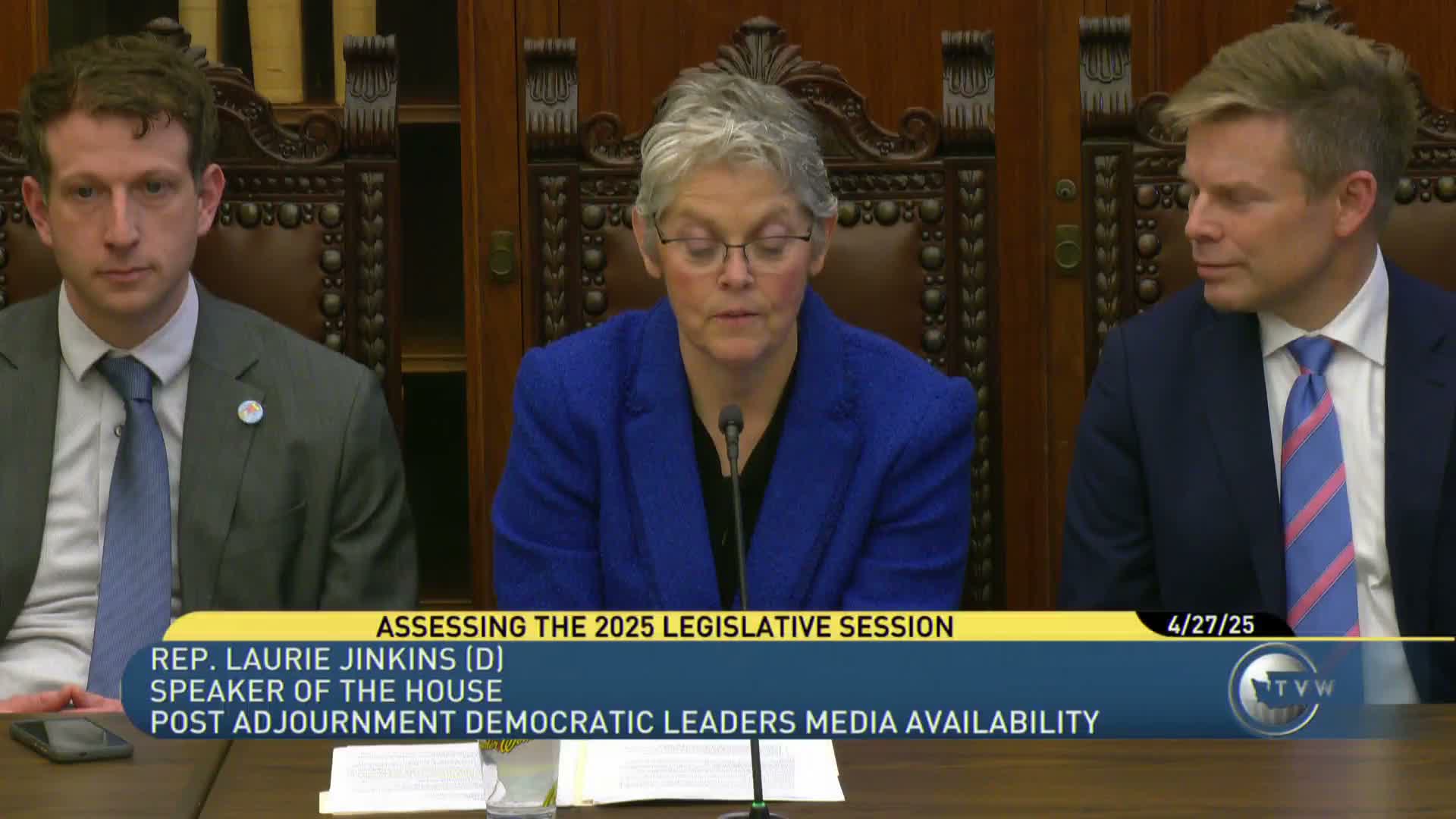
Legislative leaders gathered at a post‑session press conference to describe the outcomes of the 2025 legislative session, saying they approved balanced operating and transportation budgets while making painful program cuts and adopting several high‑profile policy changes.
Speaker of the House Laurie Jenkins said the session began with severe fiscal gaps — “our operating budget was out of balance by $16,000,000,000 and our transportation budget was out of balance by $8,000,000,000” — and credited cross‑chamber collaboration for producing what she called a “very balanced” approach to those shortfalls. She said leaders sought solutions that protected vulnerable Washingtonians and sustained economic growth.
Senate Majority Leader Jamie Peterson highlighted two major priorities the senate pursued: “a significant increase in funding for public schools” and action on housing affordability and supply. Peterson said lawmakers secured unanimous agreement on additional special‑education funding and that “$1,400,000,000 of additional money will be flowing to our school districts across the state.”
Lawmakers also said they passed a House bill to stabilize rents, which Peterson described as benefiting roughly 40% of residents who rent. The package included complementary measures intended to increase housing supply — changes to parking minimums, lot splitting and enforcement of middle‑housing reforms — which leaders said are intended to work over time to expand affordable options.
Leaders acknowledged several painful cuts and service reductions that could be visible to residents: delays to a child‑support pass‑through and other cash benefits, reductions in state support for four‑year universities and community and technical colleges, reduced state financial aid at independent colleges, increased co‑payments and fewer slots for state childcare programs, and the planned closure of one prison and four reentry centers operated by the Department of Corrections.
Reporters pressed leaders about a late addition of $100,000,000 in law‑enforcement funding that Governor Ferguson requested; Peterson described that allocation as a one‑time addition in 2026 and framed it as part of a broader discussion of public safety and local flexibility. Jenkins pointed to Deborah Enteman’s bill (identified in the press as “20 15”) as creating additional options for communities to fund community safety tailored to local needs.
On tax changes, House leaders said they pursued a strategic, progressive approach that includes modest increases for certain businesses and new sales‑tax treatment of some services to reflect Washington’s service‑oriented economy. Peterson and other leaders said the idea of a wealth tax remains active in caucus discussions: he noted a senate version “passed off of the senate floor today” and that further work is expected next year and during the interim.
Leaders declined to predict which bills the governor will sign or veto. They said the governor’s office and the state Office of Financial Management are conducting a careful review and that legislative and executive staff have been in close communication. Jenkins and Peterson said they had made clear to the governor that significant investment in public schools and support for special needs and school materials were must‑have priorities.
The leaders repeatedly framed the session as unusually difficult because of the size of the budget gap, a new governor and national uncertainties, and noted recent personal losses among lawmakers and staff. Despite those challenges, they said the legislature reached agreement and adjourned on day 105.
Votes at a glance
- Operating and transportation budgets: Approved (details and roll‑call tallies not specified in the transcript). Leaders described combined revenue and reduction measures that produced a balanced package.
- Additional special‑education funding: Adopted; leaders said the chambers agreed unanimously on this investment (roll‑call tallies not specified).
- Rent‑stabilization House bill: Passed (bill text and vote tallies not specified in the transcript).
- Wealth tax: Senate passage reported; transcript indicates the senate passed a version that day (final status, governor action and House concurrence not specified).
- One‑time $100,000,000 law‑enforcement allocation for 2026: Included as a one‑time funding item at the governor’s request (vote tallies not specified).
What happens next
Leaders said the governor will review the bills and budgets and may line‑item veto or request clarifications; they emphasized continued communication between legislative budget teams and the governor’s office during that review period. No specific gubernatorial actions were reported during the press availability.
Quotes
“I am very pleased to say that both our operating and transportation budgets…walk that narrow path, and we achieved a balanced, a very balanced approach,” Speaker Laurie Jenkins said at the press availability.
“We passed it,” Senate Majority Leader Jamie Peterson said of the wealth‑tax measure when asked whether that idea was finished; he added that further work on the idea remains likely.
Additional details
The leaders listed several programmatic reductions and service changes that may be visible to residents, including delayed benefit pass‑throughs, cuts to higher‑education support, Medicaid/managed‑care payment reductions, child‑care slot reductions, and closures of reentry facilities. Where the press availability did not provide a numerical roll call or complete bill identifiers, those details are reported as not specified in the transcript.
Speaker of the House Laurie Jenkins said the session began with severe fiscal gaps — “our operating budget was out of balance by $16,000,000,000 and our transportation budget was out of balance by $8,000,000,000” — and credited cross‑chamber collaboration for producing what she called a “very balanced” approach to those shortfalls. She said leaders sought solutions that protected vulnerable Washingtonians and sustained economic growth.
Senate Majority Leader Jamie Peterson highlighted two major priorities the senate pursued: “a significant increase in funding for public schools” and action on housing affordability and supply. Peterson said lawmakers secured unanimous agreement on additional special‑education funding and that “$1,400,000,000 of additional money will be flowing to our school districts across the state.”
Lawmakers also said they passed a House bill to stabilize rents, which Peterson described as benefiting roughly 40% of residents who rent. The package included complementary measures intended to increase housing supply — changes to parking minimums, lot splitting and enforcement of middle‑housing reforms — which leaders said are intended to work over time to expand affordable options.
Leaders acknowledged several painful cuts and service reductions that could be visible to residents: delays to a child‑support pass‑through and other cash benefits, reductions in state support for four‑year universities and community and technical colleges, reduced state financial aid at independent colleges, increased co‑payments and fewer slots for state childcare programs, and the planned closure of one prison and four reentry centers operated by the Department of Corrections.
Reporters pressed leaders about a late addition of $100,000,000 in law‑enforcement funding that Governor Ferguson requested; Peterson described that allocation as a one‑time addition in 2026 and framed it as part of a broader discussion of public safety and local flexibility. Jenkins pointed to Deborah Enteman’s bill (identified in the press as “20 15”) as creating additional options for communities to fund community safety tailored to local needs.
On tax changes, House leaders said they pursued a strategic, progressive approach that includes modest increases for certain businesses and new sales‑tax treatment of some services to reflect Washington’s service‑oriented economy. Peterson and other leaders said the idea of a wealth tax remains active in caucus discussions: he noted a senate version “passed off of the senate floor today” and that further work is expected next year and during the interim.
Leaders declined to predict which bills the governor will sign or veto. They said the governor’s office and the state Office of Financial Management are conducting a careful review and that legislative and executive staff have been in close communication. Jenkins and Peterson said they had made clear to the governor that significant investment in public schools and support for special needs and school materials were must‑have priorities.
The leaders repeatedly framed the session as unusually difficult because of the size of the budget gap, a new governor and national uncertainties, and noted recent personal losses among lawmakers and staff. Despite those challenges, they said the legislature reached agreement and adjourned on day 105.
Votes at a glance
- Operating and transportation budgets: Approved (details and roll‑call tallies not specified in the transcript). Leaders described combined revenue and reduction measures that produced a balanced package.
- Additional special‑education funding: Adopted; leaders said the chambers agreed unanimously on this investment (roll‑call tallies not specified).
- Rent‑stabilization House bill: Passed (bill text and vote tallies not specified in the transcript).
- Wealth tax: Senate passage reported; transcript indicates the senate passed a version that day (final status, governor action and House concurrence not specified).
- One‑time $100,000,000 law‑enforcement allocation for 2026: Included as a one‑time funding item at the governor’s request (vote tallies not specified).
What happens next
Leaders said the governor will review the bills and budgets and may line‑item veto or request clarifications; they emphasized continued communication between legislative budget teams and the governor’s office during that review period. No specific gubernatorial actions were reported during the press availability.
Quotes
“I am very pleased to say that both our operating and transportation budgets…walk that narrow path, and we achieved a balanced, a very balanced approach,” Speaker Laurie Jenkins said at the press availability.
“We passed it,” Senate Majority Leader Jamie Peterson said of the wealth‑tax measure when asked whether that idea was finished; he added that further work on the idea remains likely.
Additional details
The leaders listed several programmatic reductions and service changes that may be visible to residents, including delayed benefit pass‑throughs, cuts to higher‑education support, Medicaid/managed‑care payment reductions, child‑care slot reductions, and closures of reentry facilities. Where the press availability did not provide a numerical roll call or complete bill identifiers, those details are reported as not specified in the transcript.
Don't Miss a Word: See the Full Meeting!
Go beyond summaries. Unlock every video, transcript, and key insight with a Founder Membership.
✓
Get instant access to full meeting videos
✓
Search and clip any phrase from complete transcripts
✓
Receive AI-powered summaries & custom alerts
✓
Enjoy lifetime, unrestricted access to government data
30-day money-back guarantee
