Board upholds Planning Commission and denies River Club cell‑tower appeal, 3–2
February 15, 2026 | San Joaquin County, California
This article was created by AI summarizing key points discussed. AI makes mistakes, so for full details and context, please refer to the video of the full meeting. Please report any errors so we can fix them. Report an error »
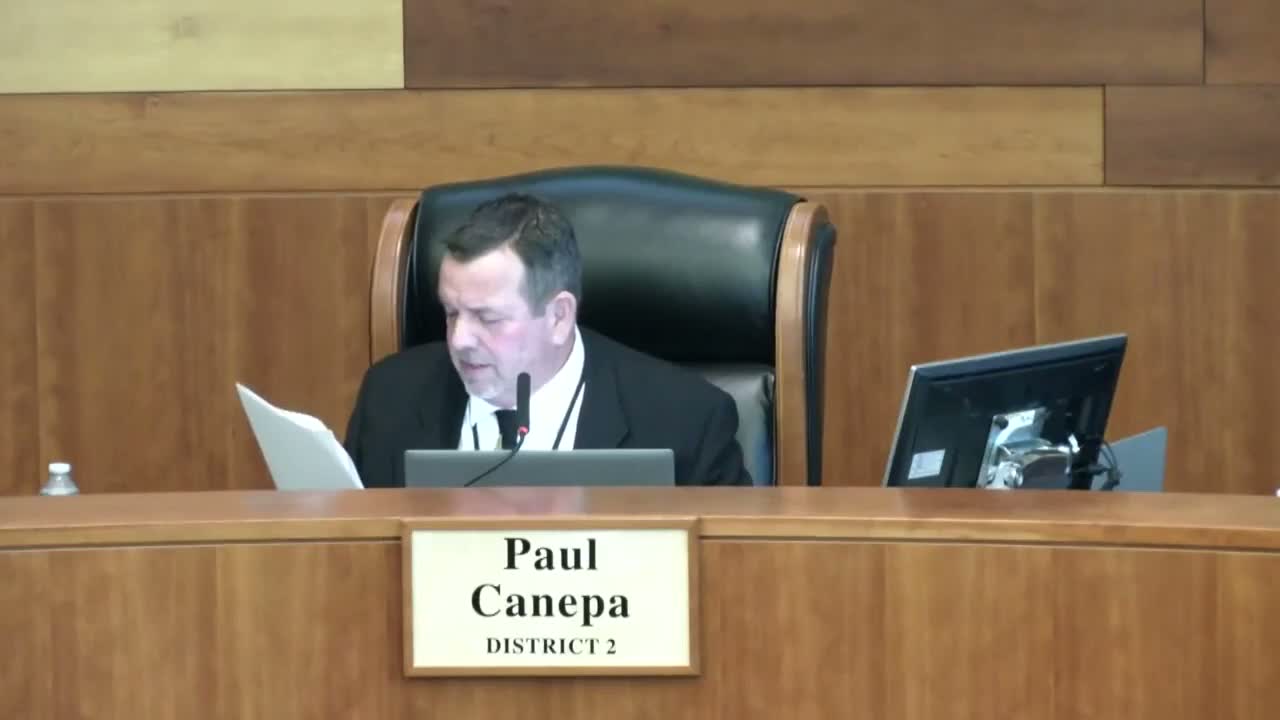
The San Joaquin County Board of Supervisors on Feb. 11 voted 3–2 to deny an appeal from Vertical Bridge and T‑Mobile seeking approval for a 100‑foot telecommunications tower at the San Joaquin River Club. The Planning Commission had earlier denied the administrative use permit, citing compatibility concerns; the applicant argued a significant coverage gap existed and that federal law (Telecommunications Act of 1996) limits local denials if an applicant demonstrates that a proposed tower is the least intrusive means to close a coverage gap.
Planning staff and the applicant presented a lengthy alternative‑site analysis and coverage maps showing a local gap in reliable in‑building cellular coverage. applicant representatives stated they had reviewed nine potential alternative locations and concluded the River Club site was the only viable option willing to host the facility; they also presented an RF exposure analysis saying predicted ground‑level exposure would be far below FCC limits.
More than two dozen River Club residents attended the hearing and submitted statements; speakers were divided. Opponents raised procedural and governance concerns (questions about how the River Club board approved a lease), potential impacts to community character, safety and health concerns, floodplain and levee proximity, and the fairness of an on‑site arrangement on a not‑for‑profit club property. Supporters and members of the River Club board argued the area is underserved for mobile coverage and that the tower is needed for safety and access to modern wireless services.
Board discussion focused on the federal law standard (whether a coverage gap exists and whether the proposed location is the least intrusive alternative), the applicant
ocumentation of alternatives, local flood and access constraints for alternatives, and emerging changes in wireless delivery technology. Supervisor Rickman moved to deny the appeal on two grounds: that the proposed location was not the least intrusive given its siting near a densely populated portion of the River Club, and that technologically feasible alternatives exist (the motion cited commercial satellite options such as beta satellite services described in public advertisements). The motion, seconded by Supervisor Dean, passed 3–2.
County counsel advised the board that denial must be supported by substantial evidence that the denial does not conflict with federal law; the motion language the board adopted cites the lack of least‑intrusive justification and the existence of plausible alternatives as the basis for the denial. The board
lso accepted the Planning Commission record and findings as sufficient to support upholding the denial.
The decision preserves the Planning Commission denial and rejects the administrative use permit for the subject site. The applicant may pursue appellate remedies in court; county counsel noted that federal Telecommunications Act claims often turn on the factual sufficiency of an applicant's alternatives analysis and that judicial review is available to any party.
Planning staff and the applicant presented a lengthy alternative‑site analysis and coverage maps showing a local gap in reliable in‑building cellular coverage. applicant representatives stated they had reviewed nine potential alternative locations and concluded the River Club site was the only viable option willing to host the facility; they also presented an RF exposure analysis saying predicted ground‑level exposure would be far below FCC limits.
More than two dozen River Club residents attended the hearing and submitted statements; speakers were divided. Opponents raised procedural and governance concerns (questions about how the River Club board approved a lease), potential impacts to community character, safety and health concerns, floodplain and levee proximity, and the fairness of an on‑site arrangement on a not‑for‑profit club property. Supporters and members of the River Club board argued the area is underserved for mobile coverage and that the tower is needed for safety and access to modern wireless services.
Board discussion focused on the federal law standard (whether a coverage gap exists and whether the proposed location is the least intrusive alternative), the applicant
ocumentation of alternatives, local flood and access constraints for alternatives, and emerging changes in wireless delivery technology. Supervisor Rickman moved to deny the appeal on two grounds: that the proposed location was not the least intrusive given its siting near a densely populated portion of the River Club, and that technologically feasible alternatives exist (the motion cited commercial satellite options such as beta satellite services described in public advertisements). The motion, seconded by Supervisor Dean, passed 3–2.
County counsel advised the board that denial must be supported by substantial evidence that the denial does not conflict with federal law; the motion language the board adopted cites the lack of least‑intrusive justification and the existence of plausible alternatives as the basis for the denial. The board
lso accepted the Planning Commission record and findings as sufficient to support upholding the denial.
The decision preserves the Planning Commission denial and rejects the administrative use permit for the subject site. The applicant may pursue appellate remedies in court; county counsel noted that federal Telecommunications Act claims often turn on the factual sufficiency of an applicant's alternatives analysis and that judicial review is available to any party.
Don't Miss a Word: See the Full Meeting!
Go beyond summaries. Unlock every video, transcript, and key insight with a Founder Membership.
✓
Get instant access to full meeting videos
✓
Search and clip any phrase from complete transcripts
✓
Receive AI-powered summaries & custom alerts
✓
Enjoy lifetime, unrestricted access to government data
30-day money-back guarantee
