State agencies and local providers scramble to prepare for expanded SNAP work requirements under HR1
January 23, 2026 | Board Council Commission Agencies , Executive, Washington
This article was created by AI summarizing key points discussed. AI makes mistakes, so for full details and context, please refer to the video of the full meeting. Please report any errors so we can fix them. Report an error »
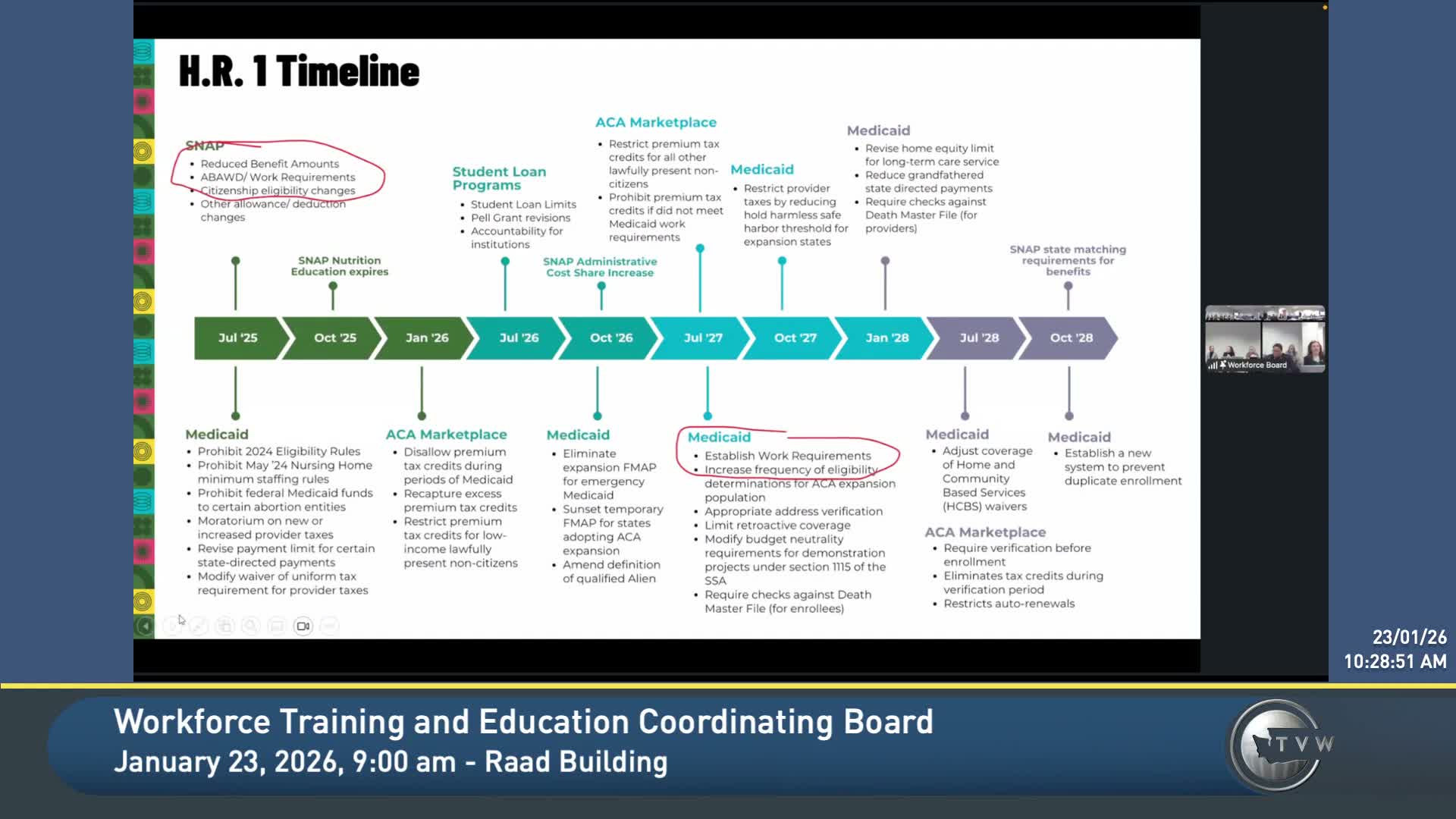
State social‑service and workforce officials warned the Washington Workforce Board that the new federal SNAP and Medicaid changes in H.R. 1 will sharply increase workload, cost and operational complexity for state and local partners.
Babs Roberts, senior adviser in the Department of Social and Health Services’ Economic Services Administration, gave a high‑level summary of the law’s effects: expanded populations subject to work requirements, fewer exemptions, more difficult geographic waivers and new citizenship eligibility limits. Roberts said an estimated 30,000 people may be shifted from federal to state‑funded food assistance in Washington and that the state faces rising administrative costs (DSHS staff cited about $60 million/year for the increased share of administration).
Roberts also highlighted a key fiscal risk: federal penalties tied to payment error rates. She said Washington’s official federal error rate was 6.06% in 2024 and is trending just above 7% for federal fiscal year 2025; if a state’s payment error rate exceeds 5.99%, federal rules can require the state to absorb between 5% and 15% of benefit costs depending on the error rate.
Panelists described how people can meet work requirements—80 hours a month (averaged), through paid work, volunteering, approved job‑training or education programs, or participation in approved SNAP Employment & Training (BFET) or WIOA services. Local workforce representatives and community college leaders said providers are already seeing referral surges and have limited capacity. Amy Martinez (local workforce board) and others said some WorkSource centers have increased walk‑ins and referrals fourfold in December and January and that colleges and nonprofit volunteers will be quickly stretched.
SBCTC staff and college partners said they expect 5,000–6,000 referrals to community and technical colleges as SNAP implementation ramps and cautioned that BFET and related programs require local match and are near capacity. Workforce partners urged standardized guidance from DSHS and fast federal clarifications on which programs and hours count toward the requirement.
Board direction: agencies will continue building the verification hub and IT surge capacity (Governor’s budget includes funding proposals), coordinate with local partners on capacity mapping and prioritize outreach to high‑impact communities. The board did not adopt policy at the meeting but agreed to keep SNAP/H.R. 1 implementation as a standing item for follow‑up.
Babs Roberts, senior adviser in the Department of Social and Health Services’ Economic Services Administration, gave a high‑level summary of the law’s effects: expanded populations subject to work requirements, fewer exemptions, more difficult geographic waivers and new citizenship eligibility limits. Roberts said an estimated 30,000 people may be shifted from federal to state‑funded food assistance in Washington and that the state faces rising administrative costs (DSHS staff cited about $60 million/year for the increased share of administration).
Roberts also highlighted a key fiscal risk: federal penalties tied to payment error rates. She said Washington’s official federal error rate was 6.06% in 2024 and is trending just above 7% for federal fiscal year 2025; if a state’s payment error rate exceeds 5.99%, federal rules can require the state to absorb between 5% and 15% of benefit costs depending on the error rate.
Panelists described how people can meet work requirements—80 hours a month (averaged), through paid work, volunteering, approved job‑training or education programs, or participation in approved SNAP Employment & Training (BFET) or WIOA services. Local workforce representatives and community college leaders said providers are already seeing referral surges and have limited capacity. Amy Martinez (local workforce board) and others said some WorkSource centers have increased walk‑ins and referrals fourfold in December and January and that colleges and nonprofit volunteers will be quickly stretched.
SBCTC staff and college partners said they expect 5,000–6,000 referrals to community and technical colleges as SNAP implementation ramps and cautioned that BFET and related programs require local match and are near capacity. Workforce partners urged standardized guidance from DSHS and fast federal clarifications on which programs and hours count toward the requirement.
Board direction: agencies will continue building the verification hub and IT surge capacity (Governor’s budget includes funding proposals), coordinate with local partners on capacity mapping and prioritize outreach to high‑impact communities. The board did not adopt policy at the meeting but agreed to keep SNAP/H.R. 1 implementation as a standing item for follow‑up.
View the Full Meeting & All Its Details
This article offers just a summary. Unlock complete video, transcripts, and insights as a Founder Member.
✓
Watch full, unedited meeting videos
✓
Search every word spoken in unlimited transcripts
✓
AI summaries & real-time alerts (all government levels)
✓
Permanent access to expanding government content
30-day money-back guarantee
