State staff warn workforce board of sharper federal WIOA accountability and sanctions risk
January 23, 2026 | Board Council Commission Agencies , Executive, Washington
This article was created by AI summarizing key points discussed. AI makes mistakes, so for full details and context, please refer to the video of the full meeting. Please report any errors so we can fix them. Report an error »
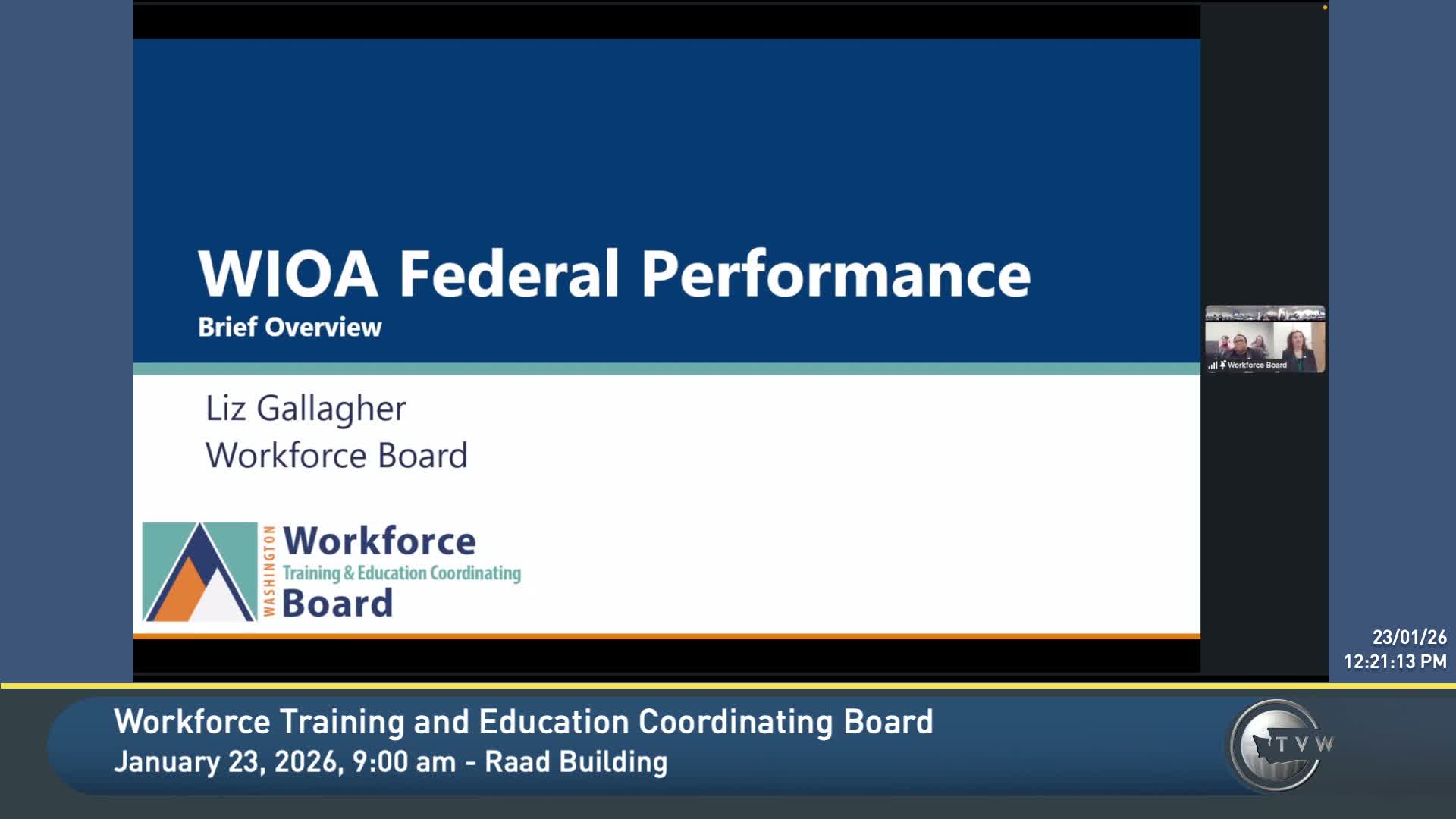
State workforce staff told the Washington Workforce Board that federal WIOA accountability changes materially raise the risk of sanctions for local boards and state programs unless data, reporting and negotiated targets are tightly managed.
Liz Gallagher, policy associate, said that beginning in July 2025 the Department of Labor began judging programs not only on individual indicators (which require 50% of target) but also on overall program and indicator averages that must reach 90% of negotiated targets. She said the statistical adjustment model (SAM) the federal government applies can change negotiated targets after the fact based on participants’ characteristics and economic conditions, making outcomes harder to predict.
Dave Wallace, head of research, walked members through examples where SAM substantially adjusted targets (notably in vocational rehabilitation measures), and noted that some program targets increased by double‑digit percentages from one cycle to the next. Gallagher and Wallace said mitigation steps include negotiating realistic targets with the Department of Labor, providing centralized technical assistance and data‑entry training for local providers, and migrating to the new WA Works system to clean data and reduce reporting errors.
Staff reminded the board that federal sanctions escalate: corrective action follows a first failure; two consecutive years of failure can trigger financial penalties (including potential reductions from the governor's reserve). The worst‑case example cited was an approximate $303,000 reduction to the governor’s reserve for two years of failure on the same metric.
Board staff said they will continue negotiating with federal partners, roll out central technical assistance on definitions and data entry by March, and present an evaluation/dashboard framework for board review at the February special meeting.
Liz Gallagher, policy associate, said that beginning in July 2025 the Department of Labor began judging programs not only on individual indicators (which require 50% of target) but also on overall program and indicator averages that must reach 90% of negotiated targets. She said the statistical adjustment model (SAM) the federal government applies can change negotiated targets after the fact based on participants’ characteristics and economic conditions, making outcomes harder to predict.
Dave Wallace, head of research, walked members through examples where SAM substantially adjusted targets (notably in vocational rehabilitation measures), and noted that some program targets increased by double‑digit percentages from one cycle to the next. Gallagher and Wallace said mitigation steps include negotiating realistic targets with the Department of Labor, providing centralized technical assistance and data‑entry training for local providers, and migrating to the new WA Works system to clean data and reduce reporting errors.
Staff reminded the board that federal sanctions escalate: corrective action follows a first failure; two consecutive years of failure can trigger financial penalties (including potential reductions from the governor's reserve). The worst‑case example cited was an approximate $303,000 reduction to the governor’s reserve for two years of failure on the same metric.
Board staff said they will continue negotiating with federal partners, roll out central technical assistance on definitions and data entry by March, and present an evaluation/dashboard framework for board review at the February special meeting.
View the Full Meeting & All Its Details
This article offers just a summary. Unlock complete video, transcripts, and insights as a Founder Member.
✓
Watch full, unedited meeting videos
✓
Search every word spoken in unlimited transcripts
✓
AI summaries & real-time alerts (all government levels)
✓
Permanent access to expanding government content
30-day money-back guarantee
