Sentencing panel adopts clarifying statutory language and two juvenile option B changes, delays others
January 09, 2026 | Board Council Commission Agencies , Executive, Washington
This article was created by AI summarizing key points discussed. AI makes mistakes, so for full details and context, please refer to the video of the full meeting. Please report any errors so we can fix them. Report an error »
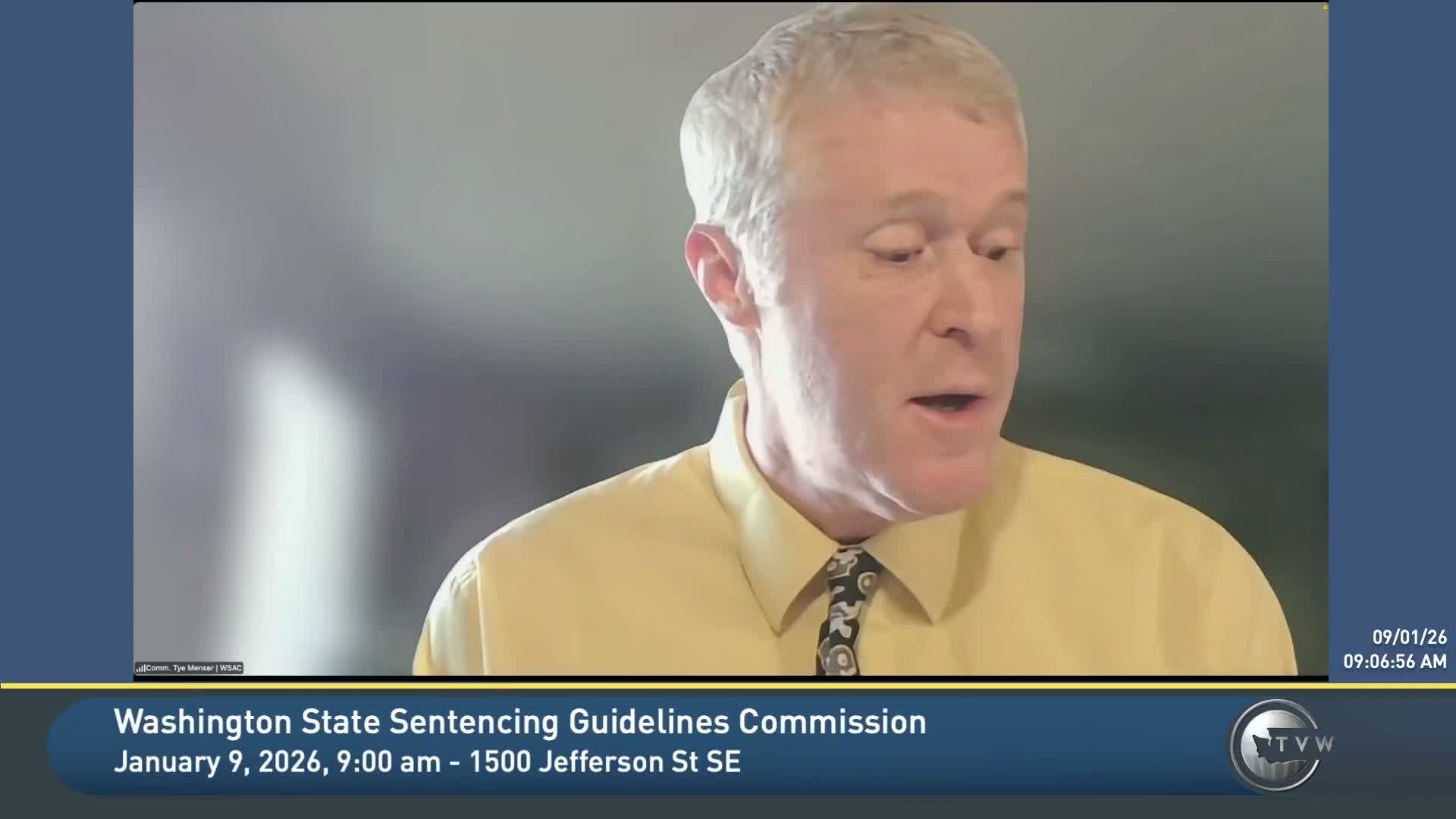
The Sentencing Guideline Commission on Jan. 9 adopted changes to juvenile sentencing recommendations from its juvenile committee while deferring several more complex items.
Vice Chair Ty Menzer, acting as chair, opened the meeting and staff presented five juvenile committee proposals involving the option B suspended‑disposition alternative. The commission voted to: adopt clarifying statutory language about references to "class A" in juvenile dispositions, and to make unlawful possession of a firearm eligible for option B; it also approved a motion to allow multiple option B disposals subject to parameters for judicial consideration to be developed later. The commission did not adopt an expansion to make assault‑2 and robbery‑1 categorically eligible and signaled more work was needed on those proposals.
The clarification adopted addresses inconsistent references that mix adult "class A" labels and juvenile category labels. Commissioner Ramona Brandes and others argued the current text risks misinterpretation under the rule of lenity, and the motion to adopt clarifying language passed with a majority and several abstentions. Staff will include the change in the commission’s forthcoming report on sentencing alternatives.
On firearm offenses the juvenile committee recommended treating unlawful possession of a firearm as eligible for option B consistent with how theft of a firearm and possession of a stolen firearm are handled. Supporters said the current exclusion creates an inequitable gap—possession alone can be punished more harshly than related offenses that require theft—while opponents urged caution and noted related charging practices. The commission adopted that recommendation by vote.
The most contested discussion centered on expanding option B eligibility to certain violent offenses (assault‑2 for youth 14 and older and robbery‑1 regardless of age). Representative Davis presented a recent assault‑2 case file with graphic allegations to illustrate potential harms; several judges and victims‑service advocates warned that assault‑2 encompasses a wide range of conduct and that making eligibility broader could produce inconsistent or inappropriate outcomes in serious cases. Other members, including defense and rehabilitation advocates and some judges, argued that judicial discretion plus clearer guideposts could allow individualized, rehabilitative sentences where appropriate.
After debate, the commission agreed to allow more than one option B in principle but adopted the change contingent on creating parameters for judicial consideration. Commissioners differed over whether subsequent‑option language should be mandatory (requiring findings to deny) or advisory; the body rejected compulsory language and approved a motion that supports multiple option B disposals provided parameters to guide judicial decision‑making are developed and brought back to the commission. Staff was asked to add the parameters to next month’s agenda.
What’s next: staff will include adopted recommendations and the commission’s votes in the official report on sentencing alternatives. The commission requested further data and legal review about assault‑2/diversion eligibility, prosecutorial charging patterns across counties, and fiscal impacts if option B caseloads expand.
Vice Chair Ty Menzer, acting as chair, opened the meeting and staff presented five juvenile committee proposals involving the option B suspended‑disposition alternative. The commission voted to: adopt clarifying statutory language about references to "class A" in juvenile dispositions, and to make unlawful possession of a firearm eligible for option B; it also approved a motion to allow multiple option B disposals subject to parameters for judicial consideration to be developed later. The commission did not adopt an expansion to make assault‑2 and robbery‑1 categorically eligible and signaled more work was needed on those proposals.
The clarification adopted addresses inconsistent references that mix adult "class A" labels and juvenile category labels. Commissioner Ramona Brandes and others argued the current text risks misinterpretation under the rule of lenity, and the motion to adopt clarifying language passed with a majority and several abstentions. Staff will include the change in the commission’s forthcoming report on sentencing alternatives.
On firearm offenses the juvenile committee recommended treating unlawful possession of a firearm as eligible for option B consistent with how theft of a firearm and possession of a stolen firearm are handled. Supporters said the current exclusion creates an inequitable gap—possession alone can be punished more harshly than related offenses that require theft—while opponents urged caution and noted related charging practices. The commission adopted that recommendation by vote.
The most contested discussion centered on expanding option B eligibility to certain violent offenses (assault‑2 for youth 14 and older and robbery‑1 regardless of age). Representative Davis presented a recent assault‑2 case file with graphic allegations to illustrate potential harms; several judges and victims‑service advocates warned that assault‑2 encompasses a wide range of conduct and that making eligibility broader could produce inconsistent or inappropriate outcomes in serious cases. Other members, including defense and rehabilitation advocates and some judges, argued that judicial discretion plus clearer guideposts could allow individualized, rehabilitative sentences where appropriate.
After debate, the commission agreed to allow more than one option B in principle but adopted the change contingent on creating parameters for judicial consideration. Commissioners differed over whether subsequent‑option language should be mandatory (requiring findings to deny) or advisory; the body rejected compulsory language and approved a motion that supports multiple option B disposals provided parameters to guide judicial decision‑making are developed and brought back to the commission. Staff was asked to add the parameters to next month’s agenda.
What’s next: staff will include adopted recommendations and the commission’s votes in the official report on sentencing alternatives. The commission requested further data and legal review about assault‑2/diversion eligibility, prosecutorial charging patterns across counties, and fiscal impacts if option B caseloads expand.
Don't Miss a Word: See the Full Meeting!
Go beyond summaries. Unlock every video, transcript, and key insight with a Founder Membership.
✓
Get instant access to full meeting videos
✓
Search and clip any phrase from complete transcripts
✓
Receive AI-powered summaries & custom alerts
✓
Enjoy lifetime, unrestricted access to government data
30-day money-back guarantee
