Washington, Cowlitz Tribe sign MOU to accelerate tribal clean‑energy projects
October 30, 2024 | Governor's Office - Boards & Commissions, Executive, Washington
This article was created by AI summarizing key points discussed. AI makes mistakes, so for full details and context, please refer to the video of the full meeting. Please report any errors so we can fix them. Report an error »
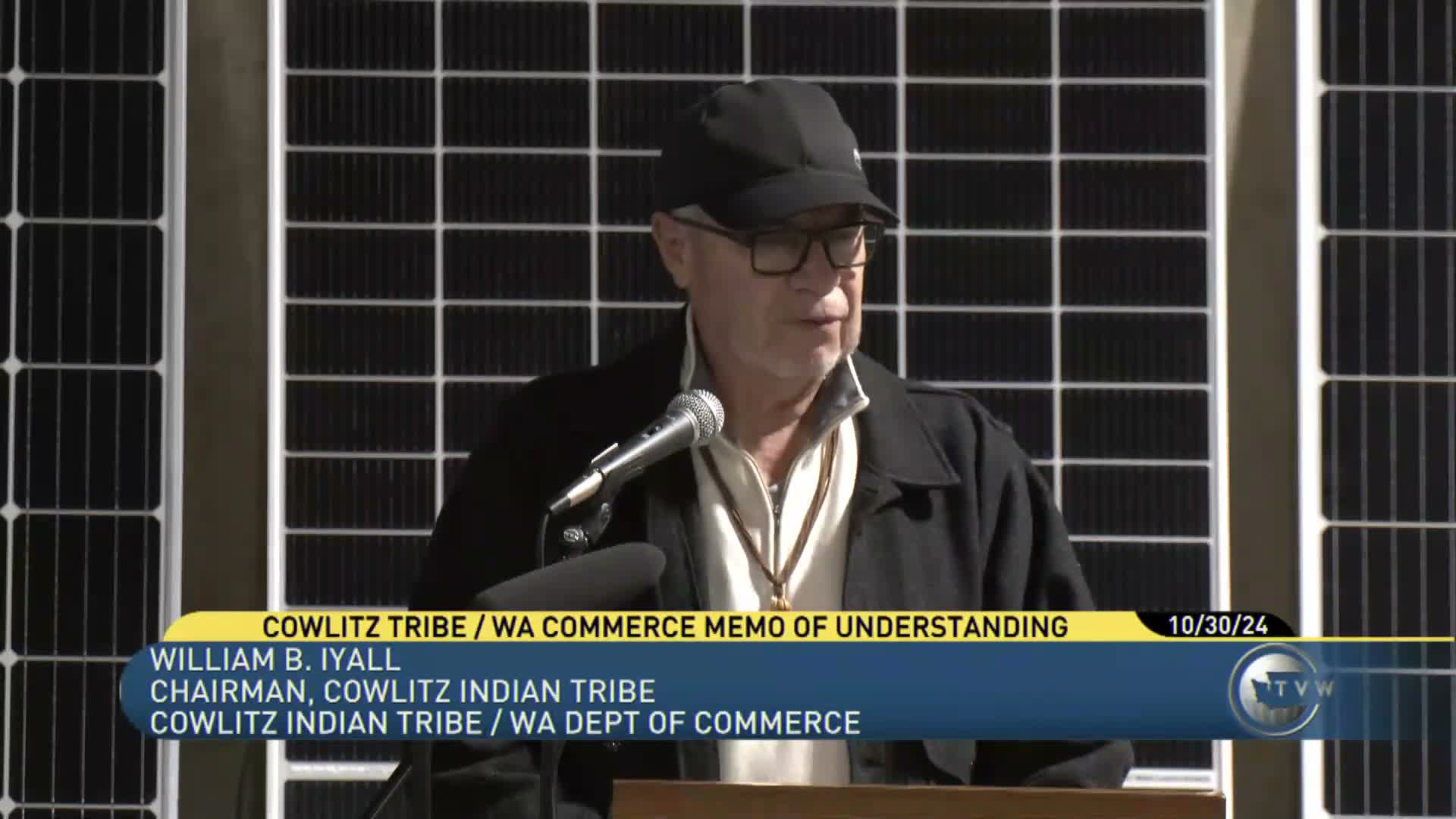
Gov. Jay Inslee and the Cowlitz Indian Tribe signed a memorandum of understanding with the Washington State Department of Commerce to speed delivery of tribal clean‑energy projects and streamline contracting.
The agreement, announced at a ceremony that included tribal council members and Commerce staff, aims to bundle funding and reduce paperwork so tribes can move more quickly from project concept to construction. “Just tell us what program and project you have in mind, and we will match it to the revenue source,” Commerce Director Fong said, describing a one‑application approach that draws from multiple state and federal streams.
Why it matters: the MOU is intended to make state resources easier for tribal governments to access for projects such as solar installations, battery storage and electric vehicle (EV) fleet electrification. At the event, tribal leaders and Commerce officials highlighted both climate and local service goals — generating electricity to power transit services and creating resilience for emergency response.
Project details provided by tribal public works director Dean Reynolds describe a “solar‑plus” facility that will support transit and emergency operations. Reynolds said the project includes a roughly 100‑kilowatt solar array, a 30‑kilowatt backup generator and battery storage, 10 level‑2 EV chargers and one electric transit van. He also provided operational estimates, saying the combined solar arrays at tribal facilities are expected to generate about 324,000 kilowatt‑hours per year and could power roughly 650,000 transit miles; Reynolds estimated net operational savings of about $1.1 million over seven years.
State support: Gov. Inslee framed the partnership as part of broader climate and workforce efforts. He cited the Climate Commitment Act and said the state has financed “about $5,700,000 of the 7 and a half” of the partnership — language used at the event to describe state contributions. Inslee called the site “the most innovative place in the state of Washington” and highlighted apprenticeship and job training connections, inviting an apprenticeship participant, Juan Pablo, to the stage as an example of the workforce pipeline.
What was not decided: the MOU is a framework for cooperation and contracting; the event did not record a legislative vote or an ordinance. Officials described next steps as implementation and photo opportunities, and they said Commerce will continue coordinating technical assistance and contracting support with tribal partners.
Officials and names: speakers at the event included an invocation by Tana; remarks and a welcome by the council chair; Gov. Jay Inslee; Department of Commerce Director Fong; and Dean Reynolds, tribal council member and public works director. Director Fong recognized Commerce staff in tribal relations who helped prepare the MOU.
The signing followed presentations on project scope and funding models; organizers then posed for a photo with tribal leaders and state officials to mark the MOU.
The agreement, announced at a ceremony that included tribal council members and Commerce staff, aims to bundle funding and reduce paperwork so tribes can move more quickly from project concept to construction. “Just tell us what program and project you have in mind, and we will match it to the revenue source,” Commerce Director Fong said, describing a one‑application approach that draws from multiple state and federal streams.
Why it matters: the MOU is intended to make state resources easier for tribal governments to access for projects such as solar installations, battery storage and electric vehicle (EV) fleet electrification. At the event, tribal leaders and Commerce officials highlighted both climate and local service goals — generating electricity to power transit services and creating resilience for emergency response.
Project details provided by tribal public works director Dean Reynolds describe a “solar‑plus” facility that will support transit and emergency operations. Reynolds said the project includes a roughly 100‑kilowatt solar array, a 30‑kilowatt backup generator and battery storage, 10 level‑2 EV chargers and one electric transit van. He also provided operational estimates, saying the combined solar arrays at tribal facilities are expected to generate about 324,000 kilowatt‑hours per year and could power roughly 650,000 transit miles; Reynolds estimated net operational savings of about $1.1 million over seven years.
State support: Gov. Inslee framed the partnership as part of broader climate and workforce efforts. He cited the Climate Commitment Act and said the state has financed “about $5,700,000 of the 7 and a half” of the partnership — language used at the event to describe state contributions. Inslee called the site “the most innovative place in the state of Washington” and highlighted apprenticeship and job training connections, inviting an apprenticeship participant, Juan Pablo, to the stage as an example of the workforce pipeline.
What was not decided: the MOU is a framework for cooperation and contracting; the event did not record a legislative vote or an ordinance. Officials described next steps as implementation and photo opportunities, and they said Commerce will continue coordinating technical assistance and contracting support with tribal partners.
Officials and names: speakers at the event included an invocation by Tana; remarks and a welcome by the council chair; Gov. Jay Inslee; Department of Commerce Director Fong; and Dean Reynolds, tribal council member and public works director. Director Fong recognized Commerce staff in tribal relations who helped prepare the MOU.
The signing followed presentations on project scope and funding models; organizers then posed for a photo with tribal leaders and state officials to mark the MOU.
Don't Miss a Word: See the Full Meeting!
Go beyond summaries. Unlock every video, transcript, and key insight with a Founder Membership.
✓
Get instant access to full meeting videos
✓
Search and clip any phrase from complete transcripts
✓
Receive AI-powered summaries & custom alerts
✓
Enjoy lifetime, unrestricted access to government data
30-day money-back guarantee
