Annapolis staff unveil 'Zoning Unlocked' plan to simplify map, activate open‑space zone and ease downtown housing rules
February 20, 2026 | Annapolis, Anne Arundel County, Maryland
This article was created by AI summarizing key points discussed. AI makes mistakes, so for full details and context, please refer to the video of the full meeting. Please report any errors so we can fix them. Report an error »
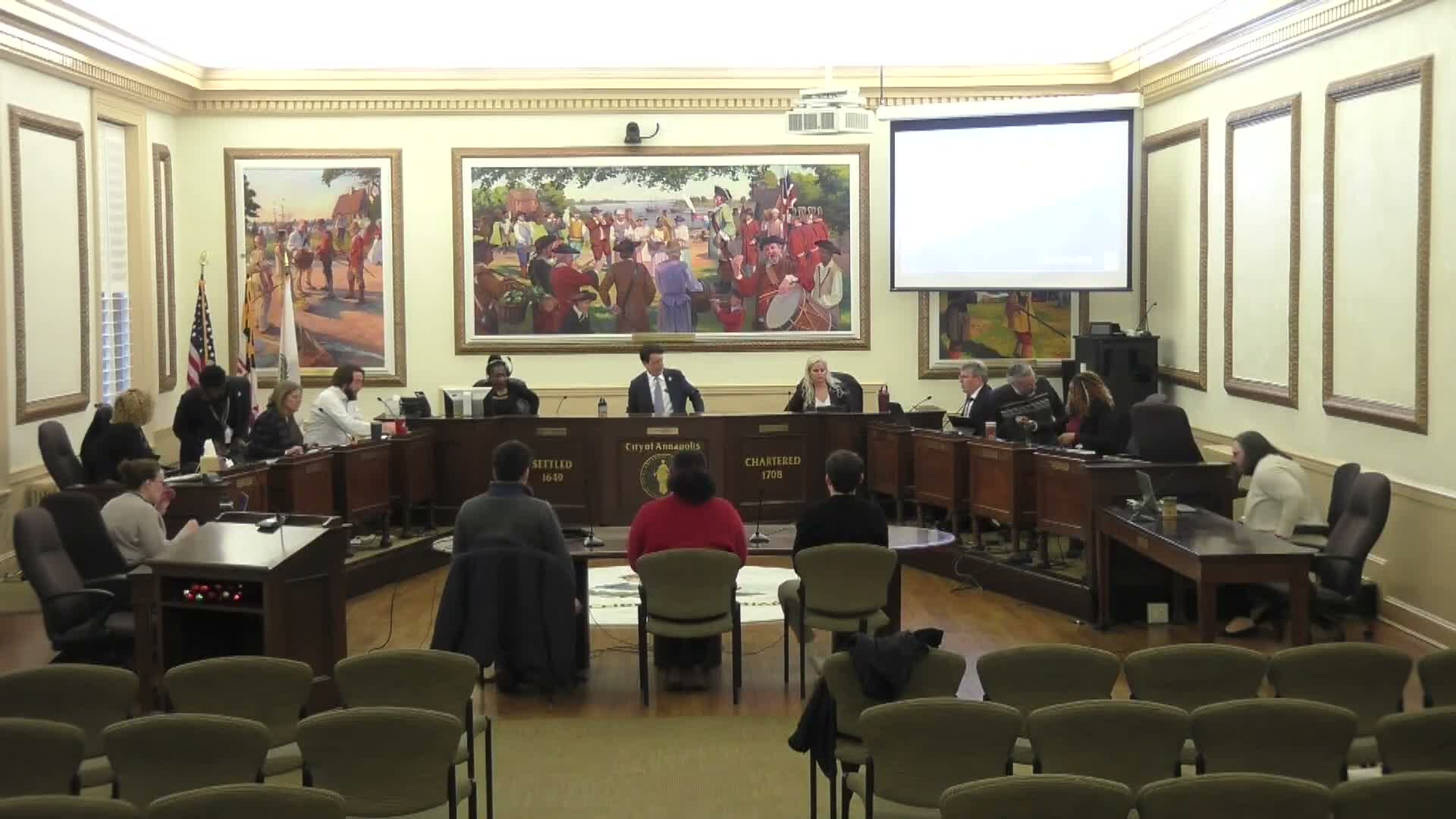
Annapolis planning staff on Feb. 19 presented 'Zoning Unlocked,' a multi‑year program to overhaul the city’s zoning map, reduce complexity and bring zoning into closer alignment with the city’s July 2024 comprehensive plan.
"We have 32 [zoning districts]," said Eric Leshinski, chief of comprehensive planning, describing the current map for an eight‑square‑mile city and arguing the number of districts makes the code confusing for residents and business owners. Staff said the immediate changes focus on consolidating a set of zoning districts and preparing form‑based standards for later phases.
The proposal would formally activate an open‑space zoning district created in 2005 that staff say was never used, mapping city parkland, conservation easements and certain public‑school parcels into that zone to make protections clearer. "The idea of Truxton Park being zoned for residential, I don't think anybody wants to see that turn into a residential development," Alexis Robinson, senior comprehensive planner, told the council, noting the change will require coordination with Anne Arundel County Public Schools for properties the county owns.
Staff walked aldermen through examples of proposed consolidations: some R1A and R1B parcels would be simplified into R1, R2 or R3 depending on existing lot patterns; several commercial and business districts (including parts of B3CD and BR) are proposed to be consolidated into a mixed‑use (MX) district to allow more residential uses above nonresidential uses; and many C1A parcels downtown are proposed to be rezoned C1 so multifamily and duplex housing could be allowed while remaining subject to the historic‑district overlay.
Casey Ortiz, a comprehensive planner, stressed the work is phased: immediate recommendations focus on about eight district types while later phases (including consultant work) will produce form‑based standards and detailed text amendments. Staff estimated the multi‑phase process will run through late spring or early summer of the year and said additional outreach and workshops will follow.
The presentation also flagged a specific downtown barrier: the current C1A district contains a bulk standard that requires units to be at least 1,800 square feet, a size staff said is incompatible with many existing, smaller units and with the comp plan’s goals for more diverse housing. "We don't know what that lower unit size should be, but we're looking at what's there today," Leshinski said, urging that a text amendment be considered to allow smaller units.
Aldermen pressed staff on private‑property impacts and outreach. Alderman Carmela O'Neil asked why parcels identified for "environmental enhancement" in the comp plan still appear after public concern; staff replied the future‑land‑use guidance in the comp plan is nonbinding, that the open‑space zoning change only targets parcels over two acres that are already city parkland or in conservation easement, and that HOA deed restrictions and existing ownership are not being overridden. Alderman Savage characterized cemeteries as "a huge waste of space" from a planning perspective and asked whether some cemetery land could support stormwater or passive‑use improvements; staff responded they intend the open‑space zone to "lock in" cemeteries' primary burial use while permitting compatible passive activities in appropriate cases.
Staff said public engagement will include an online parcel‑level map viewer and a community survey to be available during outreach, and staff listed upcoming public meetings (including a March 30 session at Bush Library). They said a final report and recommendations will be posted on the project website after outreach and commission reviews.
The council did not take legislative action at the session; staff requested guidance and indicated text amendments and legislation would be prepared for the council’s consideration if members wished to advance them.
The Planning & Zoning team asked the council to publicize outreach dates and to coordinate with the city's PIO; staff said they will distribute the updated presentation and dates to the council and post materials on the project site.
"We have 32 [zoning districts]," said Eric Leshinski, chief of comprehensive planning, describing the current map for an eight‑square‑mile city and arguing the number of districts makes the code confusing for residents and business owners. Staff said the immediate changes focus on consolidating a set of zoning districts and preparing form‑based standards for later phases.
The proposal would formally activate an open‑space zoning district created in 2005 that staff say was never used, mapping city parkland, conservation easements and certain public‑school parcels into that zone to make protections clearer. "The idea of Truxton Park being zoned for residential, I don't think anybody wants to see that turn into a residential development," Alexis Robinson, senior comprehensive planner, told the council, noting the change will require coordination with Anne Arundel County Public Schools for properties the county owns.
Staff walked aldermen through examples of proposed consolidations: some R1A and R1B parcels would be simplified into R1, R2 or R3 depending on existing lot patterns; several commercial and business districts (including parts of B3CD and BR) are proposed to be consolidated into a mixed‑use (MX) district to allow more residential uses above nonresidential uses; and many C1A parcels downtown are proposed to be rezoned C1 so multifamily and duplex housing could be allowed while remaining subject to the historic‑district overlay.
Casey Ortiz, a comprehensive planner, stressed the work is phased: immediate recommendations focus on about eight district types while later phases (including consultant work) will produce form‑based standards and detailed text amendments. Staff estimated the multi‑phase process will run through late spring or early summer of the year and said additional outreach and workshops will follow.
The presentation also flagged a specific downtown barrier: the current C1A district contains a bulk standard that requires units to be at least 1,800 square feet, a size staff said is incompatible with many existing, smaller units and with the comp plan’s goals for more diverse housing. "We don't know what that lower unit size should be, but we're looking at what's there today," Leshinski said, urging that a text amendment be considered to allow smaller units.
Aldermen pressed staff on private‑property impacts and outreach. Alderman Carmela O'Neil asked why parcels identified for "environmental enhancement" in the comp plan still appear after public concern; staff replied the future‑land‑use guidance in the comp plan is nonbinding, that the open‑space zoning change only targets parcels over two acres that are already city parkland or in conservation easement, and that HOA deed restrictions and existing ownership are not being overridden. Alderman Savage characterized cemeteries as "a huge waste of space" from a planning perspective and asked whether some cemetery land could support stormwater or passive‑use improvements; staff responded they intend the open‑space zone to "lock in" cemeteries' primary burial use while permitting compatible passive activities in appropriate cases.
Staff said public engagement will include an online parcel‑level map viewer and a community survey to be available during outreach, and staff listed upcoming public meetings (including a March 30 session at Bush Library). They said a final report and recommendations will be posted on the project website after outreach and commission reviews.
The council did not take legislative action at the session; staff requested guidance and indicated text amendments and legislation would be prepared for the council’s consideration if members wished to advance them.
The Planning & Zoning team asked the council to publicize outreach dates and to coordinate with the city's PIO; staff said they will distribute the updated presentation and dates to the council and post materials on the project site.
Don't Miss a Word: See the Full Meeting!
Go beyond summaries. Unlock every video, transcript, and key insight with a Founder Membership.
✓
Get instant access to full meeting videos
✓
Search and clip any phrase from complete transcripts
✓
Receive AI-powered summaries & custom alerts
✓
Enjoy lifetime, unrestricted access to government data
30-day money-back guarantee
