DLS warns of foster-care shortfalls; DHS details reforms and asks for time on some data requests
February 20, 2026 | Education, Business and Administration Subcommittee, Budget and Taxation Committee, SENATE, SENATE, Committees, Legislative, Maryland
This article was created by AI summarizing key points discussed. AI makes mistakes, so for full details and context, please refer to the video of the full meeting. Please report any errors so we can fix them. Report an error »
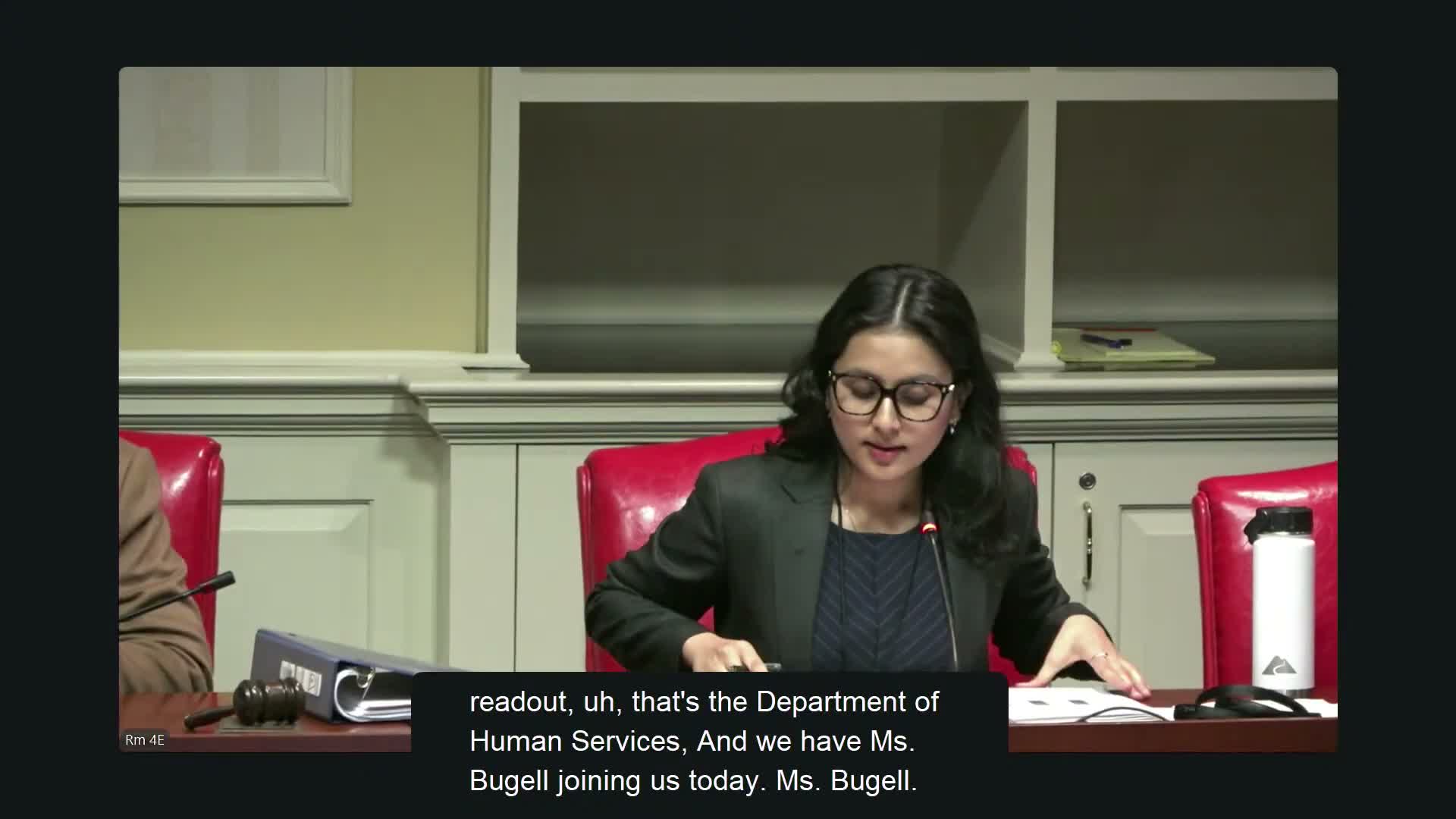
DLS officials told the Senate Health and Human Services subcommittee on Feb. 18 that the Social Services Administration(SSA) faces persistent foster-care budget pressure and multiple compliance concerns, and recommended a series of committee narratives and temporary fund restrictions to prompt more complete data and corrective action.
"The budget for social services administration increases by 25,400,000 or 3.1% to a total of 841,800,000 in fiscal 27," the DLS presenter said, then walked legislators through exhibits showing performance measures, caseload growth and cost drivers. DLS flagged a proposed deficiency of $30.2 million, most of it tied to foster-care shortfalls, and forecasted a shortfall of $18.6 million in fiscal 26 and roughly $17.4 million in fiscal 27 for foster care maintenance payments.
DLS also noted changes tied to the first phase of rate reform and said federal Medicaid reimbursement hinges on a yet-to-be-submitted state plan amendment (SPA). The analysis recommended withholding or restricting certain general funds pending submission of the SPA and supplemental reports — including hotel- and hospital-stay cost data, monthly child-welfare postings, and the status of corrective actions identified in the Office of Legislative Audits (OLA) report.
Deputy Secretary Gloria Brown Burnett and SSA leadership told the panel they have implemented a range of reforms aimed at stabilizing placements and strengthening oversight. "We are determined to ensure that all placement decisions align with permanency planning principles," Brown Burnett said, and she reported that DHS had reduced vacancy rates for child-welfare positions from over 17% in November 2022 to just over 6% in February 2026.
SSA executive leadership described several operational changes: instituting 100% background checks for care providers flagged by auditors, fiscal controls to prevent overpayments, a statewide rate structure for residential providers, and expanded child-placement agency (CPA) beds. The administration also said it has relaunched public data dashboards and is building a CJAMS-CRISP medical-data exchange and an "electronic health passport" to improve medical tracking for youth in care.
On several data points DLS requested, DHS said FY25 documentation is incomplete or nonstandardized and asked to provide more complete data for FY26 and subsequent years. Roman Napoli, DHS chief financial officer, said the department concurs with releasing $100,000 in withheld general funds (a DLS recommendation) and that corrections were made to previously submitted closeout numbers. DHS asked the committee not to impose some fund-restriction language tied to fiscal mechanics it said could prevent reinvestment of recouped funds after maximizing federal match.
Committee members pressed DHS about a discrepancy in counts of youth experiencing hospital overstays: hospitals and partners cited roughly 33 youth statewide while DHS reported 6 in custody. DHS said the difference stems in part from hospitals including youth not in DHS custody and those in voluntary placement processes; agency staff said they meet weekly with state partners and will work on improving interagency tracking.
DLS urged additional reporting and proposed committee narratives intended to make case-level and cost data available to legislators before releasing certain funds. DHS agreed to provide more complete FY26 and forward-looking cost data for hotel stays and 1-on-1 services but declined to produce standardized FY25 cost figures that it said local departments did not collect in a uniform way.
The hearing concluded with an agreement to continue the discussion in follow-up meetings and to press on remedies to repeat OLA findings. The committee also heard public testimony calling for full funding of rate reform and additional capacity for high-need youth.
"The budget for social services administration increases by 25,400,000 or 3.1% to a total of 841,800,000 in fiscal 27," the DLS presenter said, then walked legislators through exhibits showing performance measures, caseload growth and cost drivers. DLS flagged a proposed deficiency of $30.2 million, most of it tied to foster-care shortfalls, and forecasted a shortfall of $18.6 million in fiscal 26 and roughly $17.4 million in fiscal 27 for foster care maintenance payments.
DLS also noted changes tied to the first phase of rate reform and said federal Medicaid reimbursement hinges on a yet-to-be-submitted state plan amendment (SPA). The analysis recommended withholding or restricting certain general funds pending submission of the SPA and supplemental reports — including hotel- and hospital-stay cost data, monthly child-welfare postings, and the status of corrective actions identified in the Office of Legislative Audits (OLA) report.
Deputy Secretary Gloria Brown Burnett and SSA leadership told the panel they have implemented a range of reforms aimed at stabilizing placements and strengthening oversight. "We are determined to ensure that all placement decisions align with permanency planning principles," Brown Burnett said, and she reported that DHS had reduced vacancy rates for child-welfare positions from over 17% in November 2022 to just over 6% in February 2026.
SSA executive leadership described several operational changes: instituting 100% background checks for care providers flagged by auditors, fiscal controls to prevent overpayments, a statewide rate structure for residential providers, and expanded child-placement agency (CPA) beds. The administration also said it has relaunched public data dashboards and is building a CJAMS-CRISP medical-data exchange and an "electronic health passport" to improve medical tracking for youth in care.
On several data points DLS requested, DHS said FY25 documentation is incomplete or nonstandardized and asked to provide more complete data for FY26 and subsequent years. Roman Napoli, DHS chief financial officer, said the department concurs with releasing $100,000 in withheld general funds (a DLS recommendation) and that corrections were made to previously submitted closeout numbers. DHS asked the committee not to impose some fund-restriction language tied to fiscal mechanics it said could prevent reinvestment of recouped funds after maximizing federal match.
Committee members pressed DHS about a discrepancy in counts of youth experiencing hospital overstays: hospitals and partners cited roughly 33 youth statewide while DHS reported 6 in custody. DHS said the difference stems in part from hospitals including youth not in DHS custody and those in voluntary placement processes; agency staff said they meet weekly with state partners and will work on improving interagency tracking.
DLS urged additional reporting and proposed committee narratives intended to make case-level and cost data available to legislators before releasing certain funds. DHS agreed to provide more complete FY26 and forward-looking cost data for hotel stays and 1-on-1 services but declined to produce standardized FY25 cost figures that it said local departments did not collect in a uniform way.
The hearing concluded with an agreement to continue the discussion in follow-up meetings and to press on remedies to repeat OLA findings. The committee also heard public testimony calling for full funding of rate reform and additional capacity for high-need youth.
Don't Miss a Word: See the Full Meeting!
Go beyond summaries. Unlock every video, transcript, and key insight with a Founder Membership.
✓
Get instant access to full meeting videos
✓
Search and clip any phrase from complete transcripts
✓
Receive AI-powered summaries & custom alerts
✓
Enjoy lifetime, unrestricted access to government data
30-day money-back guarantee
