Senate advances supplemental budget package, placing multiple House appropriations on calendar
February 20, 2026 | Senate, Committees, Legislative, Colorado
This article was created by AI summarizing key points discussed. AI makes mistakes, so for full details and context, please refer to the video of the full meeting. Please report any errors so we can fix them. Report an error »
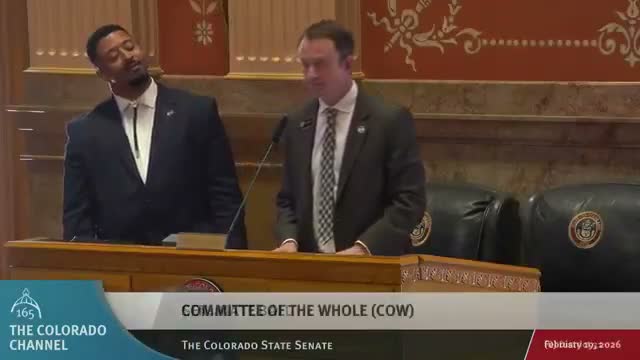
The Colorado Senate on Feb. 19 voted to advance a broad package of supplemental appropriations and placed the bills on the calendar for third reading, moving dozens of House measures that reallocate funding across state agencies.
The Committee of the Whole took up and recommended passage of a long list of House bills covering supplemental appropriations for departments that include Agriculture, Early Childhood, Education, Human Services, Health Care Policy and Financing, Judicial, Labor and Employment, Law, Local Affairs, Military and Veterans Affairs, Natural Resources, and capital construction. Committee vice-chair Senator Ball presented the committee report and the Senate adopted it, with the Committee of the Whole reporting a recorded committee vote in favor of the report.
Majority Leader Rodriguez moved the special-orders consent calendar to be called at specified hours and asked the Senate to take up sets of House bills on special orders. After brief consideration and the required two-thirds motions, the body resolved into the Committee of the Whole and the clerk read the titles of the bills on the second-reading consent calendar. Membership actions in committee recommended the bills be revised and placed for third reading and final passage.
Why it matters: the supplemental bills are part of the Legislature’s short-term fiscal adjustments as lawmakers confront projected revenue shortfalls and specific obligations that the departments say must be covered this fiscal year. Several measures were technical or time-sensitive and were moved together on a consent track to expedite consideration.
Votes at a glance: House bills 11-50 through 11-79 were reported by the Committee of the Whole and ordered to third reading and final passage; the committee report was adopted (committee tally reported during floor proceedings). On third reading later in the session, several bills on the consent calendar (for example, Senate bills 7 and 54 and House Bill 10-27) passed final passage by voice and recorded votes where noted.
What’s next: the bills placed on the calendar will return for third reading and final passage. Senators recorded individualized yes/no positions for several measures during final passage, and the calendar will show any further amendments or roll-call votes before enactment.
The Committee of the Whole took up and recommended passage of a long list of House bills covering supplemental appropriations for departments that include Agriculture, Early Childhood, Education, Human Services, Health Care Policy and Financing, Judicial, Labor and Employment, Law, Local Affairs, Military and Veterans Affairs, Natural Resources, and capital construction. Committee vice-chair Senator Ball presented the committee report and the Senate adopted it, with the Committee of the Whole reporting a recorded committee vote in favor of the report.
Majority Leader Rodriguez moved the special-orders consent calendar to be called at specified hours and asked the Senate to take up sets of House bills on special orders. After brief consideration and the required two-thirds motions, the body resolved into the Committee of the Whole and the clerk read the titles of the bills on the second-reading consent calendar. Membership actions in committee recommended the bills be revised and placed for third reading and final passage.
Why it matters: the supplemental bills are part of the Legislature’s short-term fiscal adjustments as lawmakers confront projected revenue shortfalls and specific obligations that the departments say must be covered this fiscal year. Several measures were technical or time-sensitive and were moved together on a consent track to expedite consideration.
Votes at a glance: House bills 11-50 through 11-79 were reported by the Committee of the Whole and ordered to third reading and final passage; the committee report was adopted (committee tally reported during floor proceedings). On third reading later in the session, several bills on the consent calendar (for example, Senate bills 7 and 54 and House Bill 10-27) passed final passage by voice and recorded votes where noted.
What’s next: the bills placed on the calendar will return for third reading and final passage. Senators recorded individualized yes/no positions for several measures during final passage, and the calendar will show any further amendments or roll-call votes before enactment.
View the Full Meeting & All Its Details
This article offers just a summary. Unlock complete video, transcripts, and insights as a Founder Member.
✓
Watch full, unedited meeting videos
✓
Search every word spoken in unlimited transcripts
✓
AI summaries & real-time alerts (all government levels)
✓
Permanent access to expanding government content
30-day money-back guarantee
