Senate debates Medicaid and "Cover All Coloradans" program; amendments fail and supplemental is adopted
February 20, 2026 | Senate, Committees, Legislative, Colorado
This article was created by AI summarizing key points discussed. AI makes mistakes, so for full details and context, please refer to the video of the full meeting. Please report any errors so we can fix them. Report an error »
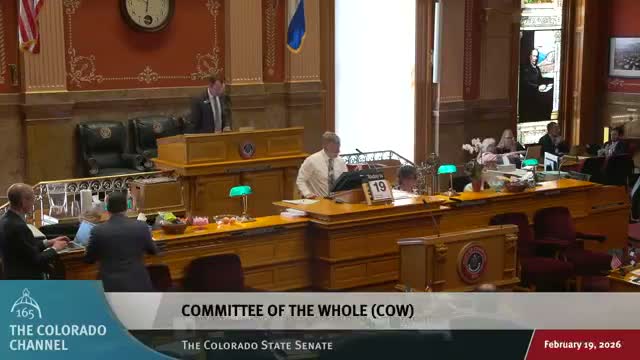
After the clerk read House Bill 11-55, a supplemental appropriation for the Department of Health Care Policy and Financing, the Senate spent the bulk of the morning and early afternoon in a sustained and detailed debate over the package’s fiscal priorities.
At issue were two linked topics: the Cover All Coloradans program (a state-funded entitlement extending coverage to some pregnant people and children regardless of immigration status) and proposed Medicaid provider-rate cuts. Senator Kirkmeyer warned that the Cover All Coloradans line item had grown far beyond early projections, saying in floor remarks that current fiscal-year estimates had "balloon[ed] to $80,000,000" and arguing that the program does not pull down a federal match in the way some other Medicaid programs do. She urged restraint and proposed an amendment to cap or reduce the line to earlier projections.
Opponents of the amendment said it would not functionally reduce entitlement spending because the program is an entitlement and thus would still be paid when services are rendered; Senator Bridges repeatedly emphasized that pregnant people in the program receive a federal match and that changing budget-language entries would not stop payment obligations. Bridges said the amendment would nevertheless increase general-fund commitments elsewhere. Multiple senators expressed concern that cutting provider rates would push hospitals and clinics — especially in rural areas — to reduce services or exit Medicaid, worsening existing maternal-health deserts.
Two prominent amendments to the supplemental were debated and put to recorded/voice votes. Amendment J009 (which would have restored provider increases by reallocating funds away from the Cover All Coloradans expansion) failed after floor discussion and a voice/record vote. A subsequent amendment, J010, which was similar in design and sought to make provider-rate increases whole while reallocating excess to higher education, also failed. Floor votes on the amendments were recorded as "noes have it" or "nos have it," and senators on both sides used the debates to press for follow-up policy work on provider rates, federal drawdowns and the structure of state entitlements.
After amendments were defeated, the Senate voted to adopt House Bill 11-55 as presented. Supporters framed the supplemental as a painful but necessary set of adjustments given TABOR-related constraints and a structural shortfall; opponents warned of long-term consequences for provider access and urged future audits and caps on rapidly growing state entitlements.
What the Senate heard in debate: members cited detailed fiscal-note figures (floor speakers referenced line items such as $53,360,259 in general-fund costs listed in supplemental materials, various estimates of federal match, and a claimed $103,000,000 impact tied to provider-rate changes). Several senators urged audits and higher transparency from departments that administer entitlements and Medicaid finances.
Next steps: HB11-55 was adopted on the floor and placed for final passage; several members signaled intent to pursue additional statutory bills, audits, and oversight to resolve the long-term structural issues identified in debate.
At issue were two linked topics: the Cover All Coloradans program (a state-funded entitlement extending coverage to some pregnant people and children regardless of immigration status) and proposed Medicaid provider-rate cuts. Senator Kirkmeyer warned that the Cover All Coloradans line item had grown far beyond early projections, saying in floor remarks that current fiscal-year estimates had "balloon[ed] to $80,000,000" and arguing that the program does not pull down a federal match in the way some other Medicaid programs do. She urged restraint and proposed an amendment to cap or reduce the line to earlier projections.
Opponents of the amendment said it would not functionally reduce entitlement spending because the program is an entitlement and thus would still be paid when services are rendered; Senator Bridges repeatedly emphasized that pregnant people in the program receive a federal match and that changing budget-language entries would not stop payment obligations. Bridges said the amendment would nevertheless increase general-fund commitments elsewhere. Multiple senators expressed concern that cutting provider rates would push hospitals and clinics — especially in rural areas — to reduce services or exit Medicaid, worsening existing maternal-health deserts.
Two prominent amendments to the supplemental were debated and put to recorded/voice votes. Amendment J009 (which would have restored provider increases by reallocating funds away from the Cover All Coloradans expansion) failed after floor discussion and a voice/record vote. A subsequent amendment, J010, which was similar in design and sought to make provider-rate increases whole while reallocating excess to higher education, also failed. Floor votes on the amendments were recorded as "noes have it" or "nos have it," and senators on both sides used the debates to press for follow-up policy work on provider rates, federal drawdowns and the structure of state entitlements.
After amendments were defeated, the Senate voted to adopt House Bill 11-55 as presented. Supporters framed the supplemental as a painful but necessary set of adjustments given TABOR-related constraints and a structural shortfall; opponents warned of long-term consequences for provider access and urged future audits and caps on rapidly growing state entitlements.
What the Senate heard in debate: members cited detailed fiscal-note figures (floor speakers referenced line items such as $53,360,259 in general-fund costs listed in supplemental materials, various estimates of federal match, and a claimed $103,000,000 impact tied to provider-rate changes). Several senators urged audits and higher transparency from departments that administer entitlements and Medicaid finances.
Next steps: HB11-55 was adopted on the floor and placed for final passage; several members signaled intent to pursue additional statutory bills, audits, and oversight to resolve the long-term structural issues identified in debate.
View the Full Meeting & All Its Details
This article offers just a summary. Unlock complete video, transcripts, and insights as a Founder Member.
✓
Watch full, unedited meeting videos
✓
Search every word spoken in unlimited transcripts
✓
AI summaries & real-time alerts (all government levels)
✓
Permanent access to expanding government content
30-day money-back guarantee
