Registrar briefs board on operations, staffing and pending legislation that could affect election processing
February 20, 2026 | Fairfax County, Virginia
This article was created by AI summarizing key points discussed. AI makes mistakes, so for full details and context, please refer to the video of the full meeting. Please report any errors so we can fix them. Report an error »
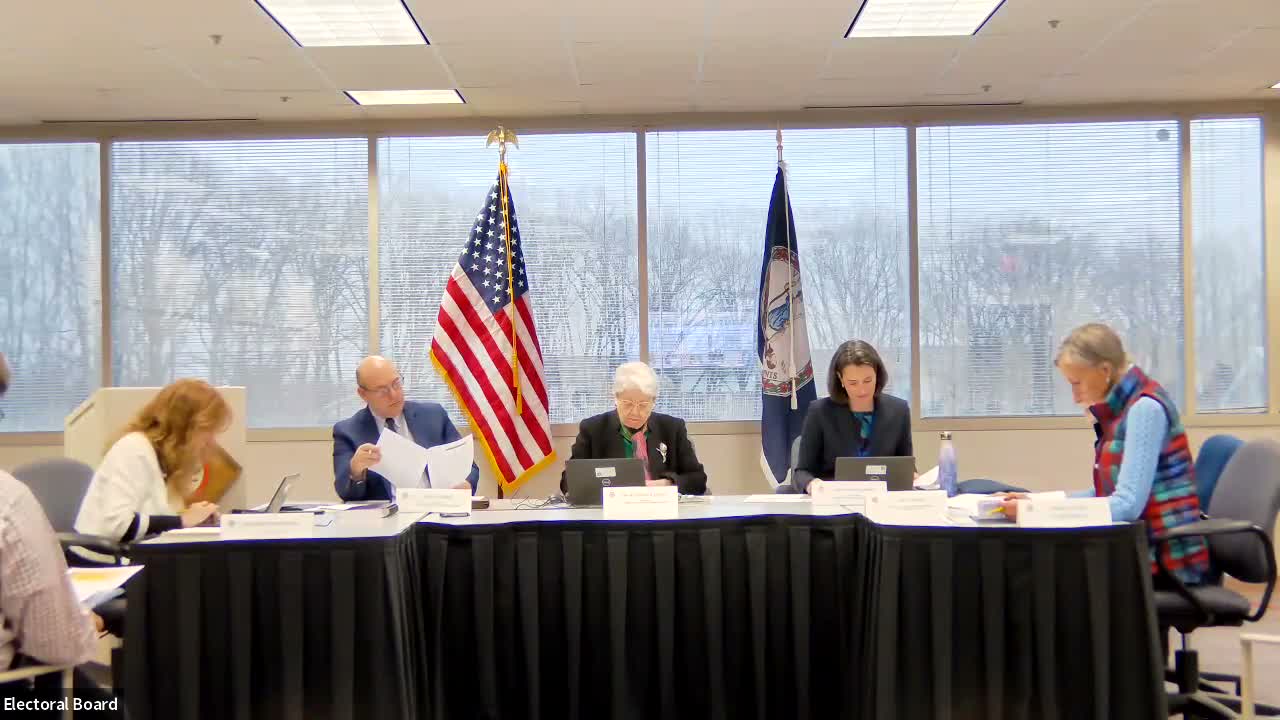
General Registrar Eric Spicer delivered an operational report Feb. 19 covering mailings, ballot orders, staffing and legislative proposals that might affect election-day processing. He said a Feb. 2 confirmation mailing reached 17,577 Fairfax County voters and described the purpose of confirmation mailings to update status and remove inactive registrants after nonresponse.
Spicer briefed the board on preparations for multiple special elections and explained the office's ballot-ordering approach (ordering a minimum of roughly 50% of typical ballots per precinct, with higher allocations for busier precincts). He said the office planned about 2,230 election officers for the upcoming cycle (roughly eight per precinct) and that staff would closely monitor early voting and order additional ballots if needed.
Staff clarified a table showing low turnout percentages for Precinct 134 (a university precinct) by explaining that provisional ballots — historically high at university precincts and sometimes exceeding 400 in prior elections — are not included in the percentage column used in their tabulation display; provisional ballots are counted separately from the stock ballots sent to precincts.
Spicer announced personnel changes: a longtime clerk successfully qualified as clerk to the electoral court and Sean Rogers will assume the role of election manager as of the coming Saturday. He also reported the office had received seven FOIA requests and two NVRA requests so far this year.
On legislation, staff described General Assembly activity: proposals that would limit when machines can be opened on election day (a bill discussed would limit opening to 05:00), proposals to require additional Sunday early-voting days, and suggested changes to absentee receipt and curing deadlines. Spicer warned that limiting when machines can be opened can materially delay tabulation because processing machine tapes for many precincts and write-in images can take hours; staff cited a 2023 example in which a government-center machine took about four hours to run tapes and additional time to assemble write-in images for the tape.
Spicer also reported procurement results, saying negotiations on a voting equipment project saved the county about $1,500,000. The office said it will continue to refine procedures and circulate implementation details for policy or operational changes.
Spicer briefed the board on preparations for multiple special elections and explained the office's ballot-ordering approach (ordering a minimum of roughly 50% of typical ballots per precinct, with higher allocations for busier precincts). He said the office planned about 2,230 election officers for the upcoming cycle (roughly eight per precinct) and that staff would closely monitor early voting and order additional ballots if needed.
Staff clarified a table showing low turnout percentages for Precinct 134 (a university precinct) by explaining that provisional ballots — historically high at university precincts and sometimes exceeding 400 in prior elections — are not included in the percentage column used in their tabulation display; provisional ballots are counted separately from the stock ballots sent to precincts.
Spicer announced personnel changes: a longtime clerk successfully qualified as clerk to the electoral court and Sean Rogers will assume the role of election manager as of the coming Saturday. He also reported the office had received seven FOIA requests and two NVRA requests so far this year.
On legislation, staff described General Assembly activity: proposals that would limit when machines can be opened on election day (a bill discussed would limit opening to 05:00), proposals to require additional Sunday early-voting days, and suggested changes to absentee receipt and curing deadlines. Spicer warned that limiting when machines can be opened can materially delay tabulation because processing machine tapes for many precincts and write-in images can take hours; staff cited a 2023 example in which a government-center machine took about four hours to run tapes and additional time to assemble write-in images for the tape.
Spicer also reported procurement results, saying negotiations on a voting equipment project saved the county about $1,500,000. The office said it will continue to refine procedures and circulate implementation details for policy or operational changes.
Don't Miss a Word: See the Full Meeting!
Go beyond summaries. Unlock every video, transcript, and key insight with a Founder Membership.
✓
Get instant access to full meeting videos
✓
Search and clip any phrase from complete transcripts
✓
Receive AI-powered summaries & custom alerts
✓
Enjoy lifetime, unrestricted access to government data
30-day money-back guarantee
