County report flags code ‘barriers to housing’ and outlines March open house
February 20, 2026 | Washington County, Oregon
This article was created by AI summarizing key points discussed. AI makes mistakes, so for full details and context, please refer to the video of the full meeting. Please report any errors so we can fix them. Report an error »
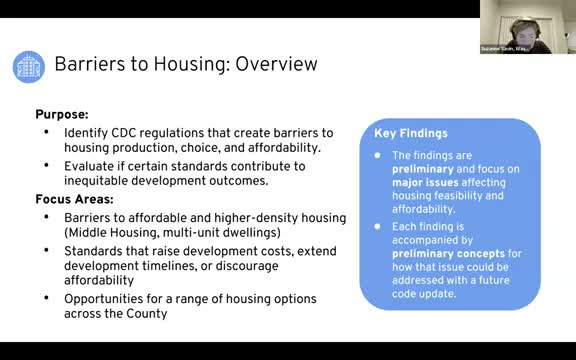
Senior planner Suzanne Savin briefed the Planning Commission on Feb. 18 that consultants have drafted a substantially complete Community Development Code (CDC) assessment summary report, including a new section on "barriers to housing production." Savin said consultants identified that middle housing types required by state law are treated differently from visually similar legacy housing types in the county code, producing inconsistencies that can raise costs and timelines for some development.
Savin described several code issues: few districts permit high-density multiunit housing; thresholds (for example, rules that activate at more than 24 units per acre) and cumulative standards (setbacks that double above specific story heights, lot coverage caps triggered at high densities) can make higher-density projects financially infeasible. "One of the issues... is that the inconsistencies between the requirements that apply to middle housing and the requirements that apply to the visually comparable legacy housing types create barriers for housing development," Savin said.
On incentives, staff noted current CDC incentives for regulated affordable housing require all units in a project to be income‑restricted at 80% of area median income, which "limits the production of mixed income housing," and suggested examining partial affordability or higher income thresholds to attract both nonprofit and for‑profit developers.
Neighborhood meetings were also flagged as a possible procedural barrier: the CDC currently requires neighborhood meetings before most Type 2 applications (staff‑level decisions), and the project team proposed using clear thresholds — number of units, floor‑area ratio, or project type — to determine when they are required.
Engagement and next steps: Savin said staff will host an in‑person and virtual open house on March 17 and will circulate email notifications; a CDC priorities report is expected in May and further public briefings and technical advisory meetings will follow. The report and a detailed findings table have been provided to commissioners for review.
Why it matters: the assessment is the first phase of a multiyear program to update the CDC to comply with state law and remove unnecessary barriers to housing production; potential amendments could alter allowable densities, design standards and developer incentives across the county.
Savin described several code issues: few districts permit high-density multiunit housing; thresholds (for example, rules that activate at more than 24 units per acre) and cumulative standards (setbacks that double above specific story heights, lot coverage caps triggered at high densities) can make higher-density projects financially infeasible. "One of the issues... is that the inconsistencies between the requirements that apply to middle housing and the requirements that apply to the visually comparable legacy housing types create barriers for housing development," Savin said.
On incentives, staff noted current CDC incentives for regulated affordable housing require all units in a project to be income‑restricted at 80% of area median income, which "limits the production of mixed income housing," and suggested examining partial affordability or higher income thresholds to attract both nonprofit and for‑profit developers.
Neighborhood meetings were also flagged as a possible procedural barrier: the CDC currently requires neighborhood meetings before most Type 2 applications (staff‑level decisions), and the project team proposed using clear thresholds — number of units, floor‑area ratio, or project type — to determine when they are required.
Engagement and next steps: Savin said staff will host an in‑person and virtual open house on March 17 and will circulate email notifications; a CDC priorities report is expected in May and further public briefings and technical advisory meetings will follow. The report and a detailed findings table have been provided to commissioners for review.
Why it matters: the assessment is the first phase of a multiyear program to update the CDC to comply with state law and remove unnecessary barriers to housing production; potential amendments could alter allowable densities, design standards and developer incentives across the county.
View the Full Meeting & All Its Details
This article offers just a summary. Unlock complete video, transcripts, and insights as a Founder Member.
✓
Watch full, unedited meeting videos
✓
Search every word spoken in unlimited transcripts
✓
AI summaries & real-time alerts (all government levels)
✓
Permanent access to expanding government content
30-day money-back guarantee
