County planners preview multiyear Transportation System Plan update, say VMT metrics will shape choices
February 20, 2026 | Washington County, Oregon
This article was created by AI summarizing key points discussed. AI makes mistakes, so for full details and context, please refer to the video of the full meeting. Please report any errors so we can fix them. Report an error »
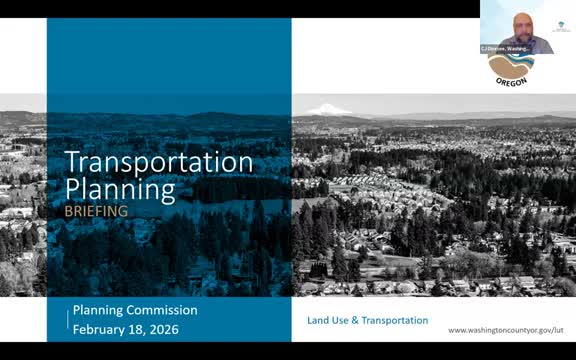
CJ Dotsey, senior transportation planner, gave the Planning Commission an overview of the Transportation System Plan (TSP) update on Feb. 18, emphasizing new state and regional requirements and the implications for local planning. Dotsey said the Transportation Planning Rule changes and the Climate Friendly and Equitable Communities rule mean the county will need to demonstrate reductions in vehicle miles traveled (VMT) and incorporate stronger multimodal performance standards.
"Future transportation plans, we're gonna need to demonstrate reductions in vehicle miles traveled and a greater integration between transportation and land use," Dotsey said, describing a shift from traditional congestion metrics toward system‑performance outcomes and multimodal access.
Staff outlined the TSP's core modal components (roadway, freight, pedestrian, bicycle, transit) and noted that certain capacity projects (those planning more than three lanes or similar expansions) will be subject to an enhanced O8‑30 review and an alternatives analysis before they can be authorized in the updated plan. Dotsey said Metro will perform much of the regional modeling and that the county will coordinate with TriMet and other partners on transit assumptions.
Funding constraints and process: transportation staff summarized the county's "three‑legged" funding strategy (major street program/MSTIP, maintenance funded by fuel taxes and user fees, and growth funding via development charges or tax increment tools) and cautioned that inclusion in the TSP does not guarantee project funding or near‑term construction.
Timeline and engagement: staff said the TSP update will likely be phased across two to three years and will include a statistically valid community survey, virtual and in‑person open houses, and both technical and community advisory committees to broaden engagement. Commissioners asked how VMT‑focused metrics will affect quality of life and congestion; staff said modeling and regional metrics are still being developed but the aim is to provide alternatives so people do not need to drive as far.
"Future transportation plans, we're gonna need to demonstrate reductions in vehicle miles traveled and a greater integration between transportation and land use," Dotsey said, describing a shift from traditional congestion metrics toward system‑performance outcomes and multimodal access.
Staff outlined the TSP's core modal components (roadway, freight, pedestrian, bicycle, transit) and noted that certain capacity projects (those planning more than three lanes or similar expansions) will be subject to an enhanced O8‑30 review and an alternatives analysis before they can be authorized in the updated plan. Dotsey said Metro will perform much of the regional modeling and that the county will coordinate with TriMet and other partners on transit assumptions.
Funding constraints and process: transportation staff summarized the county's "three‑legged" funding strategy (major street program/MSTIP, maintenance funded by fuel taxes and user fees, and growth funding via development charges or tax increment tools) and cautioned that inclusion in the TSP does not guarantee project funding or near‑term construction.
Timeline and engagement: staff said the TSP update will likely be phased across two to three years and will include a statistically valid community survey, virtual and in‑person open houses, and both technical and community advisory committees to broaden engagement. Commissioners asked how VMT‑focused metrics will affect quality of life and congestion; staff said modeling and regional metrics are still being developed but the aim is to provide alternatives so people do not need to drive as far.
View the Full Meeting & All Its Details
This article offers just a summary. Unlock complete video, transcripts, and insights as a Founder Member.
✓
Watch full, unedited meeting videos
✓
Search every word spoken in unlimited transcripts
✓
AI summaries & real-time alerts (all government levels)
✓
Permanent access to expanding government content
30-day money-back guarantee
